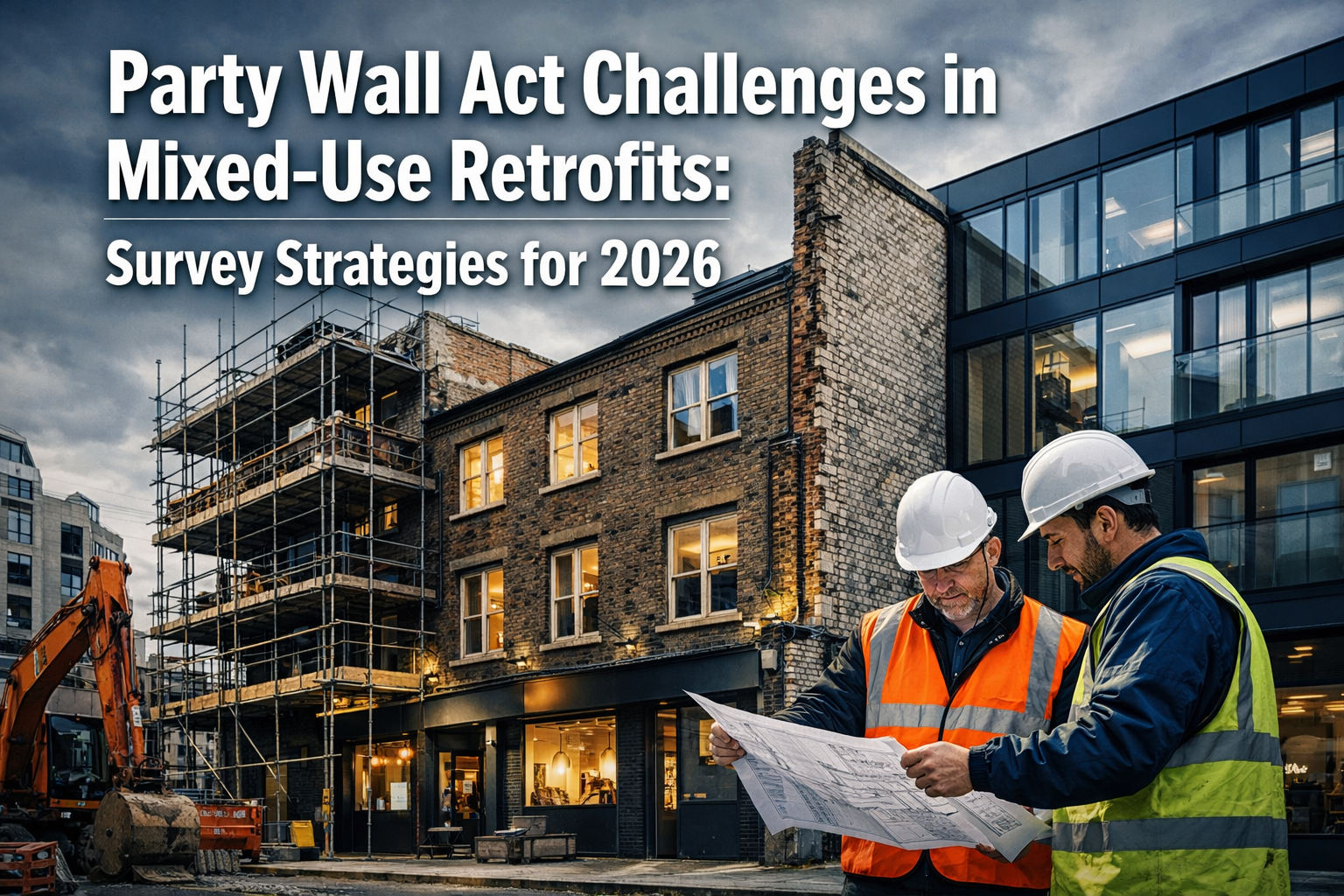
The urban landscape is transforming at an unprecedented pace in 2026. Following the Quality Summit initiatives and new legislative frameworks, cities across the UK are witnessing a retrofit boom that's reshaping how we approach building regeneration. This surge in mixed-use development—where commercial spaces coexist with residential units in the same structure—has created a complex web of Party Wall Act challenges that surveyors, developers, and property owners must navigate carefully.
Understanding Party Wall Act Challenges in Mixed-Use Retrofits: Survey Strategies for 2026 Urban Renewal Projects has become essential for anyone involved in urban renewal. The intersection of heritage preservation, modern building standards, and the legal requirements surrounding shared walls demands a sophisticated approach that balances multiple stakeholder interests while ensuring regulatory compliance.
Key Takeaways
- 🏗️ Mixed-use retrofits present unique party wall complications due to different usage patterns, structural requirements, and stakeholder interests between commercial and residential spaces
- 📋 Proper survey documentation and early notification procedures can prevent 80% of party wall disputes in retrofit projects
- ⚖️ New 2026 regulations including the Building Safety Act and fire safety amendments significantly impact party wall survey strategies and compliance requirements
- 🤝 Proactive dispute prevention through comprehensive schedules of condition, clear communication protocols, and professional party wall awards saves time and money
- 📊 Digital survey tools and standardized templates streamline the party wall process while ensuring legal compliance across complex multi-occupancy developments
Understanding the Party Wall Act Framework in Urban Renewal Contexts
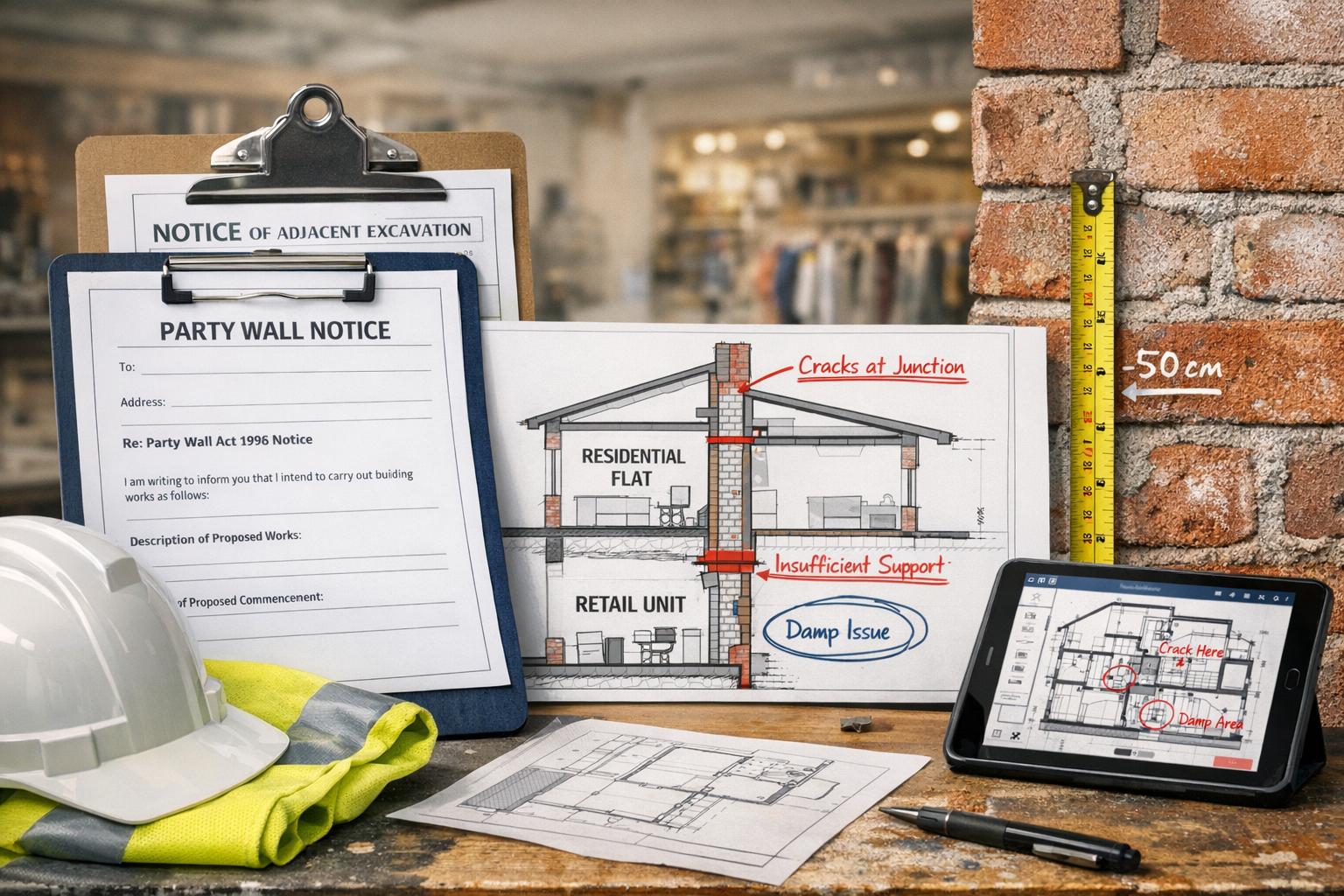
The Party Wall Act 1996 provides the legal foundation for managing construction work affecting shared walls, boundaries, and excavations near neighboring properties. However, when applied to mixed-use retrofit projects, the Act's provisions become significantly more complex.
What Makes Mixed-Use Retrofits Different?
Mixed-use developments combine commercial and residential spaces within the same building structure. This creates several unique challenges:
Multiple Stakeholder Categories
- Ground-floor retail or office tenants
- Residential leaseholders on upper floors
- Commercial freeholders
- Residential freeholders
- Property management companies
- Local authority interests
Varied Usage Requirements
- Different structural loading needs (heavy commercial equipment vs. residential use)
- Distinct acoustic insulation standards
- Separate fire safety regulations
- Divergent access and egress requirements
Complex Ownership Structures
- Split freehold arrangements
- Long leasehold interests
- Commercial lease obligations
- Service charge responsibilities
These factors mean that a single retrofit project might require multiple party wall notices, different survey approaches for various sections of the building, and coordination among numerous parties with competing interests.
Legislative Changes Impacting 2026 Projects
The regulatory landscape governing retrofits has evolved substantially. The Building Safety Act introduces staged application processes for complex multi-block developments, requiring enhanced coordination between party wall procedures and building control submissions[2].
Fire safety amendments to Approved Document B now mandate that blocks of flats 18 meters or higher must have multiple common staircases, effective September 30, 2026[2]. This requirement often necessitates structural modifications that directly impact party walls, particularly in historic buildings being converted to residential use.
Additionally, the Remediation Acceleration Plan targets completion of unsafe cladding remediation by 2029, with new landlord enforcement powers[2]. These remediation works frequently trigger party wall procedures when shared structural elements require modification.
Common Party Wall Act Challenges in Mixed-Use Retrofits: Survey Strategies for 2026 Urban Renewal Projects
Identifying potential complications early allows surveyors to develop proactive mitigation strategies. Here are the most prevalent challenges encountered in 2026 urban renewal projects:
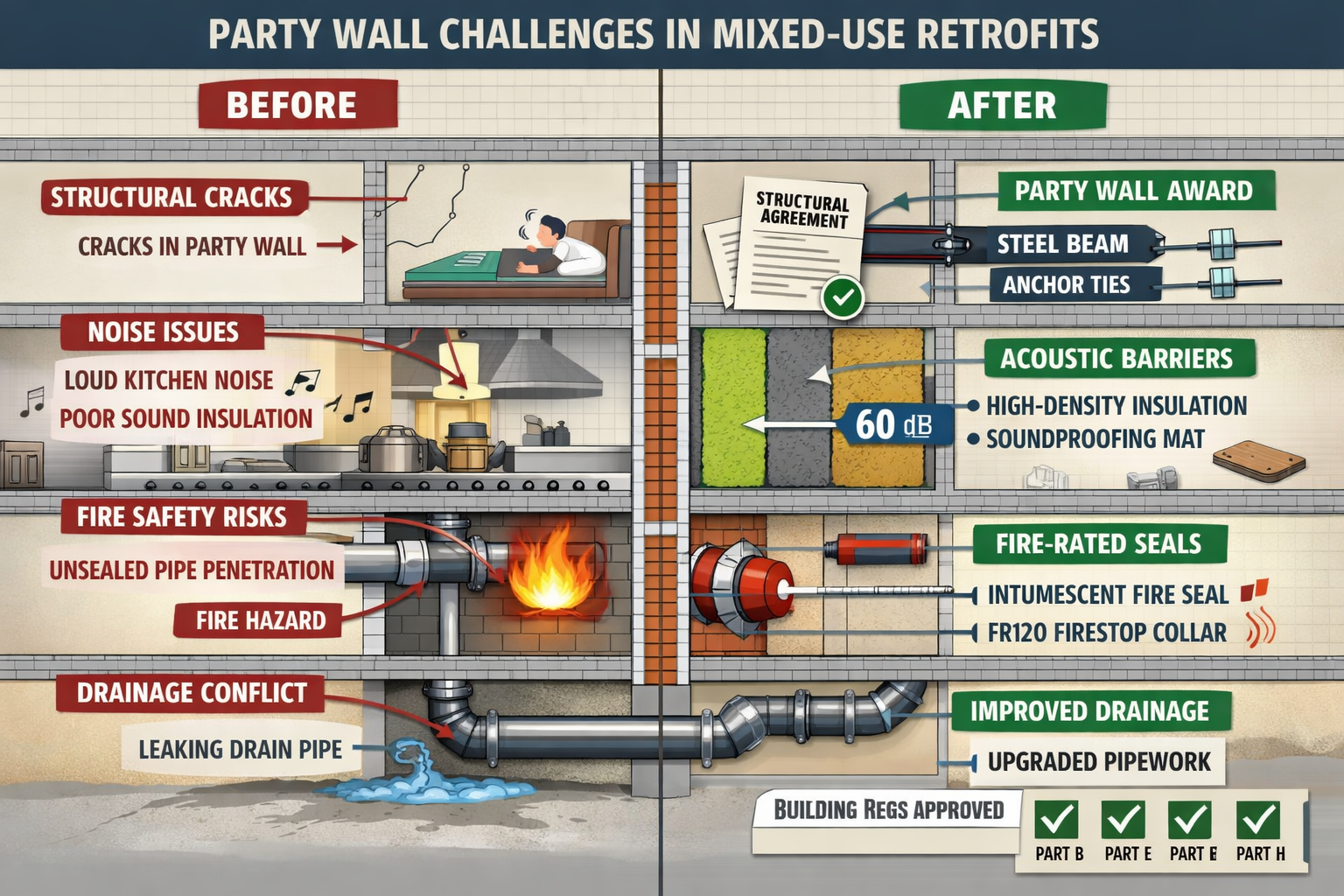
🔧 Structural Modification Conflicts
When retrofitting existing buildings for mixed-use, structural alterations often affect party walls in ways that create disputes:
Load Transfer Issues
- Adding residential floors above commercial spaces increases loading on party walls
- Installing heavy commercial equipment (HVAC systems, commercial kitchens) creates vibration concerns
- Removing internal walls to create open-plan commercial spaces may compromise party wall stability
Foundation and Excavation Concerns
- Creating basement commercial spaces beneath existing residential units
- Underpinning works affecting neighboring properties
- New service runs requiring excavation near party wall foundations
🔊 Acoustic and Vibration Challenges
The different noise profiles of commercial and residential use create significant party wall complications:
| Commercial Activity | Residential Impact | Survey Consideration |
|---|---|---|
| Restaurant/bar operations | Late-night noise transmission | Enhanced acoustic insulation requirements |
| Retail deliveries | Early morning disturbance | Loading bay positioning and wall treatment |
| Gym/fitness facilities | Vibration and impact noise | Structural isolation measures |
| Office HVAC systems | Continuous low-frequency noise | Plant room positioning and acoustic barriers |
Surveyors must assess existing party wall construction and specify appropriate upgrades to meet current acoustic standards while documenting pre-work conditions thoroughly.
🔥 Fire Safety and Compartmentation
The 2026 fire safety regulations create particular challenges for party walls in mixed-use retrofits:
Compartmentation Requirements
- Maintaining fire resistance ratings during retrofit work
- Ensuring proper fire stopping at party wall penetrations
- Managing different fire safety standards for commercial vs. residential spaces
Means of Escape Modifications
- Creating new stairwells that may penetrate party walls
- Installing fire doors and lobbies affecting shared structures
- Balancing heritage preservation with modern fire safety requirements
The Building Safety Act's emphasis on accountability and documentation means party wall surveyors must now coordinate closely with fire safety engineers and building control officers[2].
💰 Cost Allocation Disputes
Determining who pays for party wall works becomes exponentially more complex in mixed-use settings:
Benefit Assessment Challenges
- Apportioning costs when work benefits both commercial and residential portions
- Managing service charge implications for leaseholders
- Resolving disputes when freeholders and leaseholders have different interests
Betterment Considerations
- Distinguishing between necessary repairs and improvements
- Calculating appropriate contributions when works exceed minimum requirements
- Documenting pre-existing conditions to establish liability
Professional party wall agreement surveyors play a crucial role in navigating these financial complexities and ensuring equitable cost distribution.
⏰ Access and Timing Coordination
Mixed-use retrofits require careful scheduling to minimize disruption:
Commercial vs. Residential Timing
- Retail tenants may require work outside trading hours
- Residential occupants prefer daytime work to avoid sleep disruption
- Coordinating access through occupied commercial premises
Phasing Complications
- Sequencing work to maintain building occupancy
- Managing temporary supports and propping across party walls
- Coordinating multiple contractors working on different aspects
Effective Survey Strategies for Party Wall Act Challenges in Mixed-Use Retrofits: Survey Strategies for 2026 Urban Renewal Projects
Implementing systematic survey approaches dramatically reduces disputes and ensures compliance with both party wall legislation and modern building regulations.
Pre-Notice Assessment and Planning
Before serving any party wall notices, comprehensive preliminary work establishes the foundation for smooth project delivery:
Stakeholder Mapping
- Identify all parties with interests in affected party walls
- Determine ownership structures and decision-making authority
- Establish communication protocols for each stakeholder group
- Document existing relationships and potential conflict areas
Building Analysis
- Conduct detailed structural surveys of existing party walls
- Review historical building records and previous party wall awards
- Assess current condition using photographic and written schedules
- Identify heritage designations and conservation area restrictions
Regulatory Compliance Review
- Determine applicable building regulations for each portion of the development
- Identify fire safety upgrade requirements affecting party walls
- Review planning conditions that may impact party wall procedures
- Assess Building Safety Act applicability for higher-risk buildings[2]
Comprehensive Schedule of Condition Documentation
The schedule of condition represents the most critical dispute prevention tool available to party wall surveyors:
Essential Documentation Elements
✅ Photographic Evidence
- High-resolution images of all party wall surfaces (both sides)
- Close-up photos of existing cracks, defects, and finishes
- Wide-angle shots establishing spatial context
- Time-stamped and geo-tagged digital files
✅ Written Descriptions
- Room-by-room condition narratives
- Measurements of existing cracks and defects
- Material identification and construction details
- Existing services and penetrations through party walls
✅ Technical Measurements
- Laser scanning for complex geometries
- Vibration monitoring baseline readings
- Acoustic performance testing where relevant
- Structural movement monitoring points
This documentation protects all parties by establishing objective baseline conditions against which post-work assessments can be compared.
Party Wall Notice Templates and Procedures
Proper notice procedures prevent procedural challenges that can delay projects. For 2026 urban renewal projects, surveyors should utilize standardized templates that address mixed-use complexities:
Line of Junction Notice (Section 1)
Used when building a new party wall or rebuilding an existing one:
PARTY WALL ETC. ACT 1996
NOTICE OF INTENTION TO BUILD ON LINE OF JUNCTION

To: [Adjoining Owner Name and Address]
From: [Building Owner Name and Address]

NOTICE is hereby given that [Building Owner] intends to carry out work to which
Section 1 of the Party Wall etc. Act 1996 applies at [Property Address].

Nature of Proposed Work:
[Detailed description including mixed-use elements]

Commencement Date: [Date - minimum 1 month from notice]

This notice relates to [specify which party wall/boundary]

Plans and sections showing the proposed work are attached.

You have 14 days from receipt to consent or dissent. If you dissent or do not
respond, a party wall surveyor must be appointed...
Party Structure Notice (Section 2)
For work directly affecting existing party walls:
Key elements for mixed-use retrofits include:
- Specific identification of commercial vs. residential affected areas
- Clear description of structural modifications
- Loading calculations for new uses
- Acoustic and fire safety upgrade specifications
- Phasing proposals to minimize disruption
Adjacent Excavation Notice (Section 6)
Critical when creating basement commercial spaces or underpinning:
- Precise excavation depths and proximity to party walls
- Temporary support proposals
- Monitoring protocols during excavation
- Remediation procedures if damage occurs
Understanding party wall notice requirements helps ensure compliance from the outset.
Appointing Appropriate Party Wall Surveyors
The surveyor appointment process significantly impacts project outcomes:
Single Agreed Surveyor vs. Two Surveyors
For mixed-use retrofits, the agreed surveyor approach often works best when:
- All parties have cooperative relationships
- The project scope is well-defined and straightforward
- Cost efficiency is a priority
- Timeline is tight
The two surveyor approach (one for building owner, one for adjoining owner) provides better protection when:
- Complex technical issues require specialized expertise
- Significant financial interests are at stake
- Parties have previous dispute history
- Multiple adjoining owners have conflicting interests
Third Surveyor Selection
Appointing a third surveyor at the outset prevents delays if disputes arise. This surveyor should have:
- Experience with mixed-use developments
- Understanding of current building regulations
- Dispute resolution expertise
- No conflicts of interest with either party
The cost of party wall surveyors varies based on project complexity, but represents essential investment in dispute prevention.
Creating Comprehensive Party Wall Awards
The party wall award represents the legally binding agreement governing the work. For mixed-use retrofits in 2026, awards must address:
Technical Specifications
- Detailed work descriptions for each party wall element
- Performance standards for acoustic and fire safety upgrades
- Structural calculations and engineering specifications
- Materials specifications and construction methods
Access Arrangements
- Specific access routes through commercial and residential areas
- Working hours differentiated by area type
- Security protocols for occupied buildings
- Temporary facility provisions
Protection Measures
- Temporary supports and propping specifications
- Dust and noise control measures
- Vibration limits and monitoring protocols
- Protection of existing finishes and services
Financial Provisions
- Cost allocation methodology
- Payment schedules and security requirements
- Dispute resolution procedures
- Insurance and indemnity requirements
Monitoring and Compliance
- Inspection schedules and reporting requirements
- Condition monitoring protocols
- Variation procedures for unforeseen circumstances
- Completion certification process
Digital Tools and Technology Integration
Modern survey practice leverages digital technologies to enhance accuracy and efficiency:
Building Information Modeling (BIM)
- 3D visualization of party wall relationships
- Clash detection between proposed work and existing structures
- Coordination between multiple design disciplines
- Digital record keeping and version control
Drone and Laser Scanning
- Accurate measurement of tall buildings and difficult-to-access areas
- Point cloud data for existing condition documentation
- Integration with BIM models
- Reduced need for disruptive access
Digital Documentation Platforms
- Cloud-based storage for schedules of condition
- Automated notice generation and tracking
- Stakeholder communication portals
- Mobile inspection apps for site documentation
Monitoring Technology
- Automated vibration and movement monitoring
- Real-time alerts for threshold exceedances
- Historical data analysis and trending
- Evidence collection for potential disputes
These tools enhance the traditional building survey process while providing superior documentation.
Dispute Prevention and Resolution Strategies
Despite best efforts, party wall disputes sometimes arise. Proactive strategies minimize their frequency and severity:
Early Engagement and Communication
The foundation of dispute prevention lies in transparent, early communication:
Pre-Notice Consultation
- Informal discussions before serving formal notices
- Explanation of proposed work and its benefits
- Addressing concerns before positions harden
- Building cooperative relationships
Regular Updates
- Progress reports to all affected parties
- Advance warning of particularly disruptive phases
- Transparent handling of variations and changes
- Accessible project contacts for questions
Stakeholder Meetings
- Periodic briefings for commercial and residential occupants
- Separate sessions for different stakeholder groups when needed
- Visual presentations of work scope and timeline
- Opportunity for questions and feedback
Common Dispute Triggers and Solutions
Understanding typical conflict sources allows preventive intervention:
| Dispute Trigger | Prevention Strategy | Resolution Approach |
|---|---|---|
| Noise and vibration exceeding expectations | Set realistic expectations; provide detailed work schedules | Enhanced monitoring; adjusted working methods |
| Damage to finishes or structures | Comprehensive pre-work condition surveys | Reference to schedule of condition; fair compensation |
| Access disputes | Clear access provisions in award; advance coordination | Mediation; revised access arrangements |
| Cost disagreements | Transparent cost breakdowns; clear allocation methodology | Independent cost assessment; third surveyor determination |
| Timeline delays | Realistic scheduling; contingency planning | Revised program; mitigation measures |
Third Surveyor Determination Process
When building owner and adjoining owner surveyors cannot agree, the third surveyor makes binding determinations:
Referral Procedures
- Either appointed surveyor may refer disputed matters
- Third surveyor reviews submissions from both parties
- Site inspections and technical assessments conducted
- Written determination issued with reasoning
- Determination becomes part of the party wall award
Appealable Matters
- Awards may be appealed to county court within 14 days
- Appeals typically limited to points of law or procedure
- Technical determinations rarely overturned
- Legal costs can be substantial
Professional surveyors familiar with adjoining properties issues help avoid the need for third surveyor intervention through skillful negotiation.
Case Study: Mixed-Use Retrofit in Central London
A 2026 urban renewal project in a London conservation area illustrates effective party wall management:
Project Overview
Building Description:
- Victorian commercial building (1880s construction)
- Ground floor: Retained retail use
- Floors 1-4: Conversion to 12 residential flats
- Shared party walls with occupied buildings on both sides
Scope of Work:
- Structural modifications to create residential layouts
- Installation of new stairwell penetrating party walls
- Acoustic and fire safety upgrades to party wall construction
- Roof extension adding fifth floor (triggering 18m+ fire safety requirements)
Party Wall Challenges Encountered
Multiple Stakeholder Complexity:
- 8 residential leaseholders in adjoining building (east)
- Commercial office tenant in adjoining building (west)
- Freeholders for both adjoining properties
- Local authority conservation officer oversight
- Building Safety Regulator involvement due to height
Technical Complications:
- Existing party walls in poor condition requiring remediation
- Acoustic performance upgrade needed between new residential and existing commercial
- Fire compartmentation requiring party wall penetration sealing
- Underpinning required for foundation strengthening
Survey Strategy Implemented
Phase 1: Comprehensive Assessment (3 months pre-construction)
- Detailed structural survey of all party walls
- Photographic schedule of condition (over 500 images)
- Laser scanning of complex junctions and existing defects
- Stakeholder mapping and communication plan development
Phase 2: Notice and Appointment (2 months pre-construction)
- Tailored party wall notices for each affected party
- Agreed surveyor appointed for residential leaseholders (east)
- Separate surveyor appointed for commercial freeholder (west)
- Third surveyor appointed by agreement at outset
Phase 3: Award Development (1 month pre-construction)
- Detailed technical specifications for all party wall work
- Phased access arrangements minimizing commercial disruption
- Acoustic performance standards exceeding Building Regulations
- Vibration monitoring protocol with defined action thresholds
Phase 4: Construction Monitoring (12 months)
- Weekly inspection visits by party wall surveyors
- Automated vibration monitoring with real-time alerts
- Monthly stakeholder update meetings
- Responsive handling of minor variations
Outcomes and Lessons Learned
Successful Results:
✅ Zero formal disputes requiring third surveyor determination
✅ Project completed on schedule without party wall delays
✅ Post-construction survey confirmed minimal impact on adjoining properties
✅ Positive relationships maintained with all stakeholders
Key Success Factors:
- Early investment in comprehensive condition documentation
- Proactive communication preventing misunderstandings
- Realistic expectations set through detailed pre-work briefings
- Professional surveyor expertise in mixed-use complexities
- Technology utilization for monitoring and documentation
Lessons for Future Projects:
- Budget adequate time for party wall procedures (minimum 3 months)
- Engage specialist surveyors with mixed-use retrofit experience
- Invest in monitoring technology for objective evidence
- Maintain separate communication strategies for different stakeholder groups
- Document everything meticulously from the earliest stages
Regulatory Compliance in 2026: Building Safety Act Implications
The Building Safety Act fundamentally changes how party wall surveyors approach higher-risk buildings:
Gateway Process Integration
For buildings over 18 meters, the three-gateway approval process intersects with party wall procedures[2]:
Gateway 1 (Planning Stage):
- Party wall implications should be identified in planning submissions
- Fire safety strategy must address party wall compartmentation
- Stakeholder consultation includes party wall considerations
Gateway 2 (Pre-Construction):
- Building control approval required before party wall work commences
- Party wall awards must align with approved construction details
- Fire safety information submitted includes party wall specifications
Gateway 3 (Completion):
- Party wall work completion must be certified
- As-built documentation includes party wall modifications
- Building Safety Case incorporates party wall fire protection measures
Accountability and Record-Keeping
The Act's emphasis on accountability requires enhanced party wall documentation:
Golden Thread of Information
- Digital records of all party wall notices, awards, and variations
- Photographic and technical documentation accessible throughout building lifecycle
- Integration with building information management systems
- Handover to building owners and residents for ongoing management
Competence Requirements
- Party wall surveyors should demonstrate relevant qualifications
- Understanding of fire safety and structural engineering principles
- Familiarity with Building Safety Act requirements
- Continuing professional development in regulatory changes
Working with RICS surveyors ensures appropriate professional standards and competence.
Cost Management and Financial Planning
Understanding party wall costs helps developers budget accurately for mixed-use retrofits:
Typical Cost Components
Professional Fees:
- Party wall surveyor appointments: £2,000-£8,000 per surveyor depending on complexity
- Schedule of condition preparation: £1,500-£5,000
- Award preparation and negotiation: £3,000-£10,000
- Monitoring and inspection during construction: £500-£2,000 per visit
Construction Costs:
- Acoustic upgrades to party walls: £150-£400 per square meter
- Fire protection enhancements: £100-£300 per square meter
- Structural repairs/strengthening: £500-£2,000 per square meter
- Temporary works and protection: £5,000-£25,000
Contingency Allowances:
- Unforeseen party wall condition issues: 10-15% of party wall budget
- Dispute resolution costs: £5,000-£20,000 if third surveyor determination needed
- Enhanced monitoring if issues arise: £2,000-£10,000
Detailed information about party wall agreement costs helps with financial planning.
Cost Allocation Principles
Benefit-Based Apportionment:
- Work solely benefiting building owner: 100% building owner cost
- Work benefiting both parties: Proportional allocation based on benefit
- Work required due to building owner's actions but benefiting adjoining owner: Negotiated split
Service Charge Implications:
- Residential leaseholders may challenge costs through service charge mechanisms
- Clear lease provisions regarding structural works essential
- Transparent cost documentation prevents disputes
- Professional quantity surveyor input valuable for complex allocations
Future Trends and Emerging Considerations
The retrofit landscape continues evolving, with several trends shaping party wall practice:
Sustainability and Energy Efficiency Retrofits
Net Zero Targets drive building envelope improvements affecting party walls:
- External wall insulation systems requiring party wall agreements
- Heat pump installations creating new vibration and noise considerations
- Solar panel arrays and green roofs increasing roof loading
- Ventilation system upgrades penetrating party wall structures
Party wall surveyors must now consider environmental performance alongside traditional structural and legal factors.
Adaptive Reuse Acceleration
Legislative changes facilitate commercial-to-residential conversions:
California's AB 507 (effective July 1, 2026) expands streamlining for adaptive reuse projects, including ministerial and CEQA-exempt processing for retrofitting existing buildings into residential units[1]. While UK-specific, similar policy directions in British jurisdictions encourage rapid retrofit delivery.
This acceleration increases the importance of efficient party wall processes that don't become project bottlenecks.
Technology and Automation
Digital transformation continues reshaping survey practice:
- AI-assisted condition assessment and defect detection
- Automated notice generation and tracking systems
- Blockchain-based award recording for immutable records
- Virtual reality stakeholder consultations and visualizations
These technologies enhance traditional surveying expertise rather than replacing professional judgment.
Climate Resilience Considerations
Extreme weather events and climate adaptation create new party wall challenges:
- Flood resilience measures affecting below-ground party wall structures
- Overheating mitigation requiring party wall modifications
- Drainage system upgrades impacting shared infrastructure
- Structural strengthening for increased wind loading
Surveyors must consider long-term resilience when assessing party wall work proposals.
Practical Templates and Resources
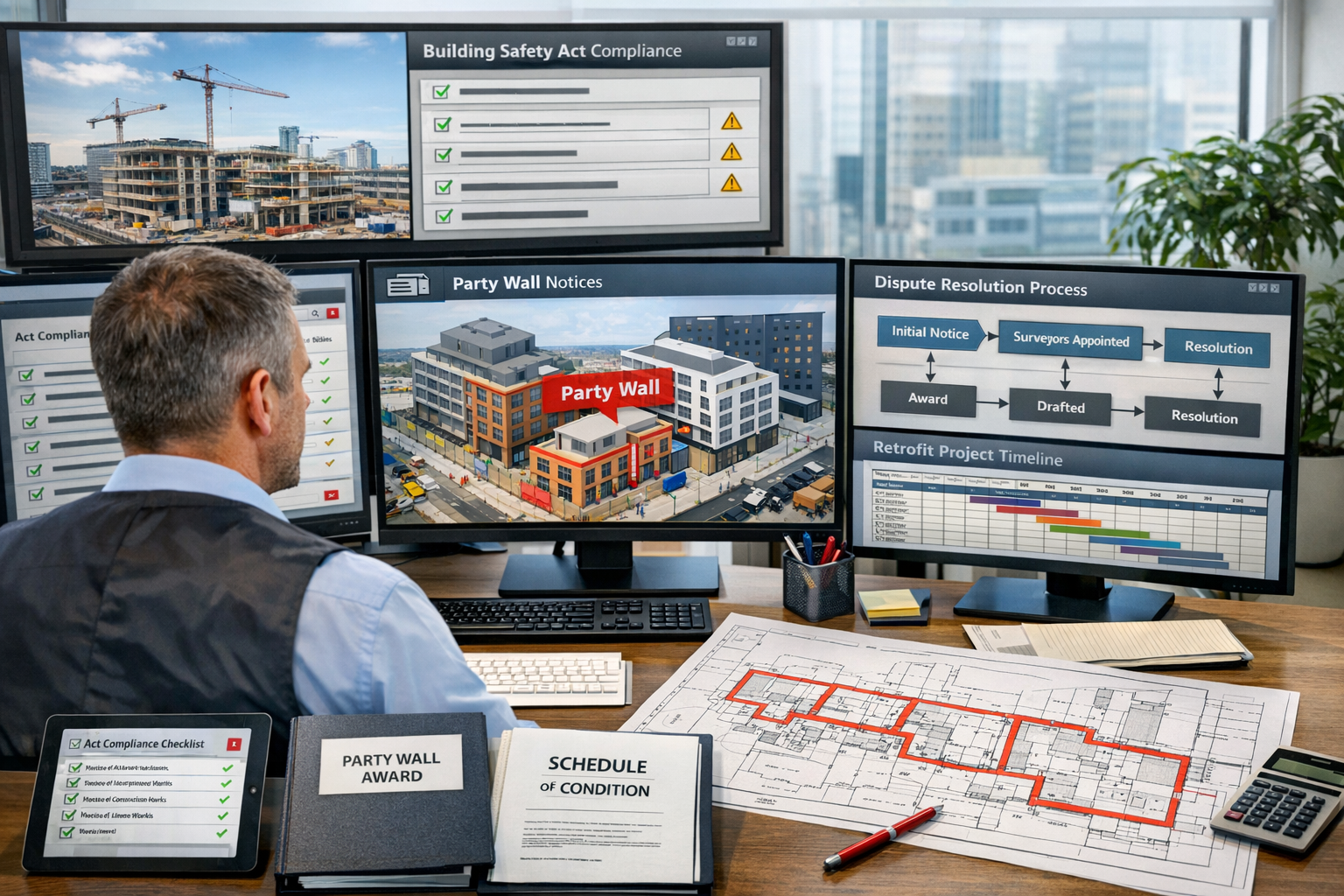
To assist practitioners managing Party Wall Act Challenges in Mixed-Use Retrofits: Survey Strategies for 2026 Urban Renewal Projects, the following template framework proves valuable:
Essential Document Templates
1. Stakeholder Register Template
| Stakeholder Name | Property Interest | Contact Details | Communication Preference | Special Considerations |
|---|---|---|---|---|
| [Name] | [Freeholder/Leaseholder/Tenant] | [Email/Phone] | [Email/Post/Meeting] | [Access issues/Vulnerable person/Language needs] |
2. Pre-Work Condition Survey Checklist
✅ External party wall inspection (both sides)
✅ Internal room-by-room condition assessment
✅ Photographic documentation (minimum 20 images per party wall)
✅ Existing crack mapping with measurements
✅ Structural movement monitoring baseline
✅ Acoustic performance testing (if relevant)
✅ Services and penetrations documentation
✅ Historical records review
✅ Adjoining owner walkthrough and sign-off
3. Notice Tracking Matrix
| Notice Type | Service Date | Recipient | Response Deadline | Response Received | Surveyor Appointed | Award Date |
|---|---|---|---|---|---|---|
| Section 1 | [Date] | [Name] | [Date+14 days] | [Yes/No/Date] | [Name/Date] | [Date] |
4. Risk Assessment Framework
For each party wall element, assess:
- Structural risk: Low/Medium/High
- Acoustic risk: Low/Medium/High
- Fire safety risk: Low/Medium/High
- Access complexity: Low/Medium/High
- Stakeholder sensitivity: Low/Medium/High
This assessment guides resource allocation and monitoring intensity.
Professional Development Resources
Surveyors managing complex mixed-use retrofits benefit from:
- RICS Party Wall Guidance Notes (updated regularly)
- Pyramus & Thisbe Club technical publications and training
- Building Safety Regulator guidance on higher-risk buildings
- Local authority conservation officer consultation for heritage buildings
- Fire safety engineering continuing professional development
Staying current with legal requirements ensures compliant practice.
Regional Considerations Across London and the UK
Party wall practice varies by location based on building stock characteristics and local development pressures:
Central London Challenges
Areas like Clerkenwell, Islington, and Hackney face:
- Dense Victorian and Georgian terraces with continuous party walls
- Conservation area restrictions limiting construction methods
- High property values increasing dispute stakes
- Sophisticated stakeholders with legal representation
Outer London Dynamics
Boroughs such as Bromley, Barnet, and Bexley present:
- More varied building types and construction periods
- Greater spacing between buildings reducing party wall frequency
- Mixed urban-suburban character affecting retrofit economics
- Different stakeholder expectations and communication needs
South London Specifics
Areas including Lewisham, Wandsworth, and Merton experience:
- Significant regeneration and retrofit activity
- Diverse ownership patterns requiring careful stakeholder management
- Heritage assets alongside modern development
- Active local authority engagement in urban renewal
East London Growth Areas
Locations such as Ilford, Romford, and East Ham feature:
- Rapid commercial-to-residential conversion activity
- Multicultural communities requiring diverse communication approaches
- Significant transport infrastructure investment driving development
- Emerging retrofit markets with evolving practice standards
Understanding local context enhances survey effectiveness and stakeholder engagement.
Conclusion: Navigating Party Wall Act Challenges in Mixed-Use Retrofits Successfully
The retrofit boom transforming UK cities in 2026 presents unprecedented opportunities for urban renewal, sustainable development, and community enhancement. However, realizing these benefits requires sophisticated management of Party Wall Act Challenges in Mixed-Use Retrofits: Survey Strategies for 2026 Urban Renewal Projects.
Success depends on several critical factors:
🎯 Early Planning and Assessment
Beginning party wall considerations at the earliest project stages prevents delays and reduces dispute risk. Comprehensive condition documentation, stakeholder mapping, and regulatory compliance review establish solid foundations.
📋 Professional Expertise
Engaging experienced party wall agreement surveyors with mixed-use retrofit knowledge ensures appropriate technical specifications, fair cost allocation, and effective dispute prevention.
🤝 Proactive Communication
Transparent, regular stakeholder engagement builds trust and manages expectations. Different communication strategies for commercial and residential parties acknowledge their distinct interests and concerns.
⚖️ Regulatory Compliance
Understanding the intersection between party wall legislation, Building Safety Act requirements, and fire safety regulations ensures compliant, future-proof solutions.
💻 Technology Utilization
Digital tools enhance documentation quality, monitoring effectiveness, and stakeholder communication while creating robust records for building lifecycle management.
Actionable Next Steps
For developers, property owners, and construction professionals embarking on mixed-use retrofit projects:
- Conduct preliminary party wall assessment at feasibility stage—identify all affected parties and potential complications
- Budget appropriately for professional surveyor fees, monitoring, and potential remediation—typically 2-5% of construction costs
- Engage specialist surveyors early—preferably during design development rather than immediately before construction
- Invest in comprehensive condition documentation—this single investment prevents the majority of disputes
- Develop stakeholder communication plan—tailor approaches to different party categories and maintain regular updates
- Integrate party wall procedures with Building Safety Act compliance—ensure coordinated approach for higher-risk buildings
- Plan realistic timelines—allow minimum 3-4 months for party wall procedures before construction commencement
The Path Forward
As urban renewal accelerates through 2026 and beyond, party wall practice will continue evolving. Surveyors who combine traditional expertise with modern technology, regulatory knowledge, and stakeholder engagement skills will deliver the best outcomes for all parties.
The complexity of mixed-use retrofits demands nothing less than excellence in party wall management. By implementing the survey strategies outlined in this guide, projects can proceed smoothly, relationships remain positive, and the built environment transforms sustainably for future generations.
Whether you're planning a small-scale conversion or a major urban renewal project, understanding and properly managing party wall challenges represents not just legal compliance, but professional best practice that protects all stakeholders' interests while enabling transformative development.
References
[1] Californias 2026 Housing Laws What You Need To Know – https://www.hklaw.com/en/insights/publications/2025/12/californias-2026-housing-laws-what-you-need-to-know
[2] Building Safety Act 2026 Key Developments And What To Expect – https://www.rwkgoodman.com/info-hub/building-safety-act-2026-key-developments-and-what-to-expect/
[3] Party Wall Surveys Amid 2026 Construction Boom Handling Disputes In High Demand Uk Housing Markets – https://nottinghillsurveyors.com/blog/party-wall-surveys-amid-2026-construction-boom-handling-disputes-in-high-demand-uk-housing-markets