


The UK property market is experiencing a dramatic shift that's reshaping the investment landscape across the nation. Latest RICS data reveals a widening north-south divide with Scotland and Northern Ireland seeing sustained price growth while London and the South East lag behind. For property valuers, investors, and homebuyers, understanding these Regional Property Valuation Trends 2026: Why Scotland, Northern Ireland, and the North Are Outperforming the South is essential for making informed decisions in today's evolving market.
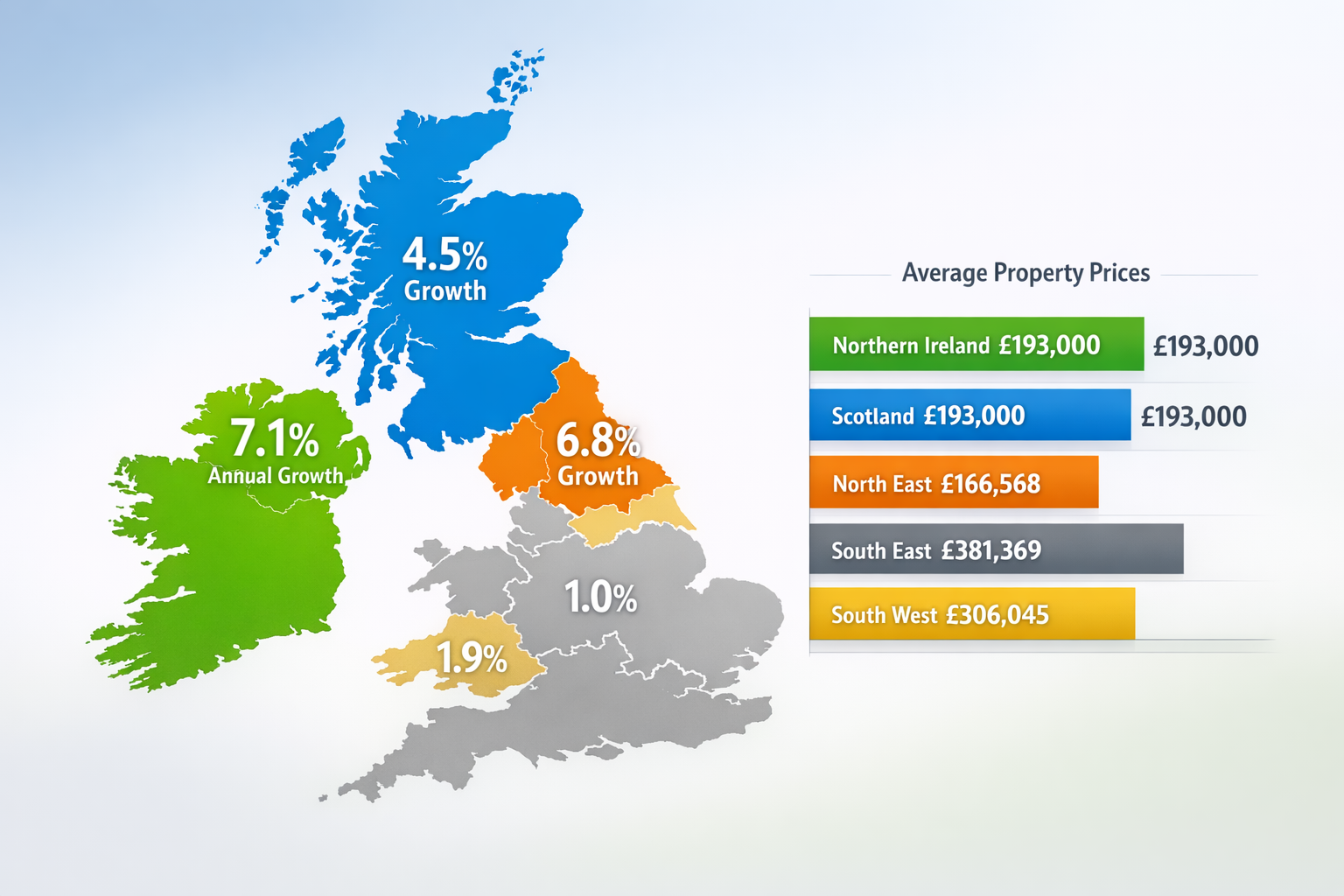
Northern Ireland leads the charge with an impressive 7.1% annual growth rate, while Scotland follows closely with 4.5% annual increases.[2][3] Meanwhile, the traditionally dominant South East manages only 1.0% growth, and the South West achieves just 1.9%—a stark contrast that signals a fundamental rebalancing of the UK property market.[5]
This geographical shift isn't a temporary blip. It represents a sustained trend driven by affordability constraints, changing work patterns, and economic rebalancing that's creating unprecedented opportunities in regions previously overlooked by investors.
Key Takeaways
✅ Northern Ireland dominates with 7.1% annual property price growth, achieving the strongest performance across all UK regions with average house prices of £193,000.[2][4]
✅ Scotland and northern England regions consistently outperform southern counterparts, with Scotland achieving 4.5% growth and the North East reaching 6.8% annually.[2][5]
✅ Southern regions face significant affordability challenges, with the South East averaging only 1.0% annual growth despite property values of £381,369.[5]
✅ The north-south divide is expected to persist through 2026 and beyond, driven by better affordability, wage growth, and easing mortgage rates in northern markets.[5]
✅ Professional property valuations are increasingly critical for capitalizing on regional variations and understanding true market value across different UK regions.
Understanding the Regional Property Valuation Trends 2026: Why Scotland, Northern Ireland, and the North Are Outperforming the South
The current property market landscape represents one of the most significant regional divergences in recent UK history. To fully grasp why northern regions are outperforming their southern counterparts, it's essential to examine the specific data points and underlying market dynamics.
Northern Ireland: The UK's Strongest Property Market 🏆
Northern Ireland has emerged as the undisputed leader in UK property price growth. According to the latest ONS data, the region achieved 7.1% annual growth in Q3 2025, with this momentum continuing into early 2026.[2] The average house price in Northern Ireland stands at £193,000—significantly more affordable than southern equivalents while delivering superior returns.[2]
PropertyPal's Q4 2025 data reveals even more impressive figures, with average property valuations reaching £235,000, reflecting a 6.4% annual increase.[1] New homes in the region command an average of £267,000, up 5.2% year-on-year.[1]
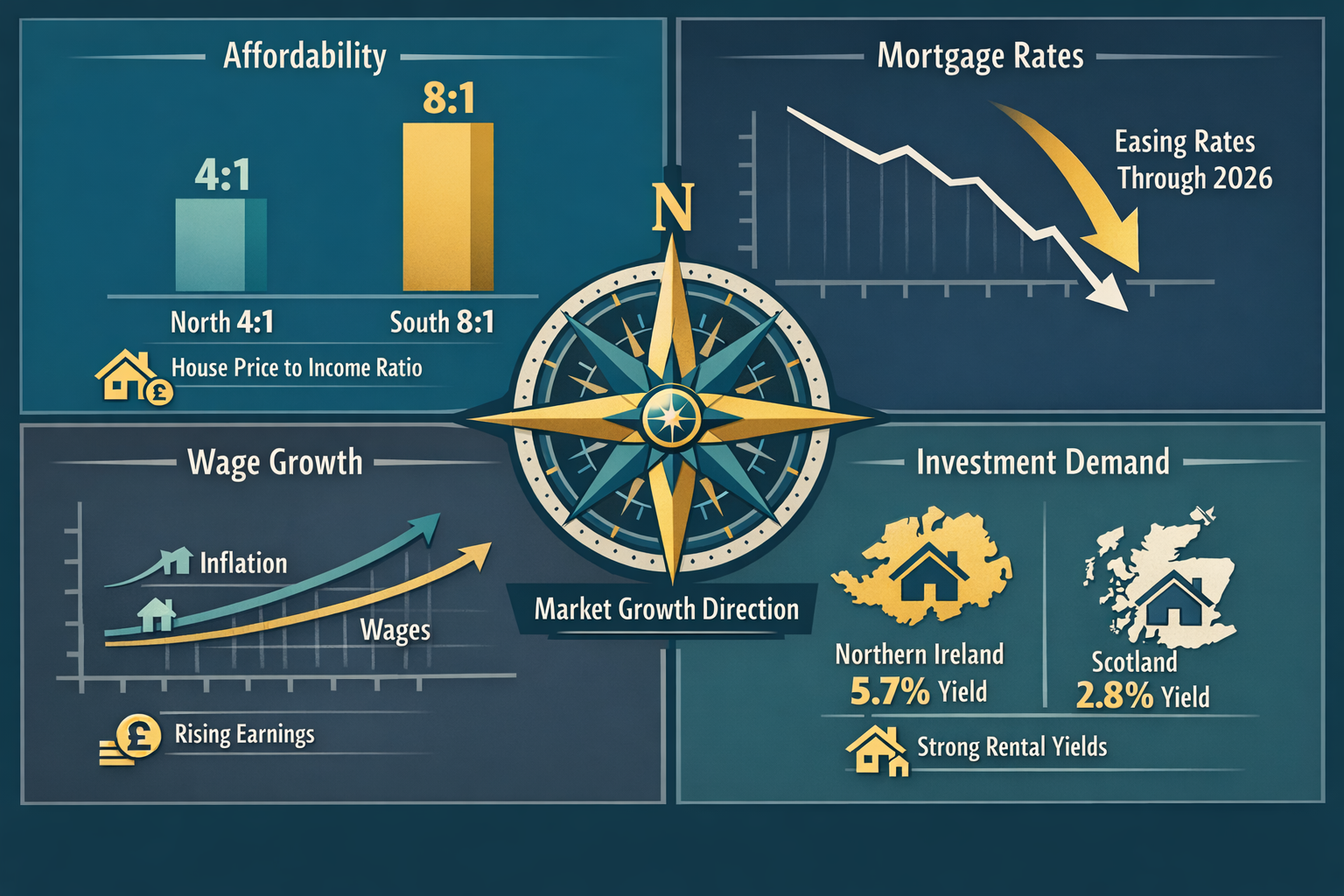
The strength of Northern Ireland's market isn't limited to price appreciation. The region's rental market demonstrates robust demand with average rents of £873 per month (October 2025), showing 5.7% annual growth—outpacing Scotland's rental growth of 2.8%.[2]
Key Northern Ireland market indicators:
| Metric | Value | Annual Change |
|---|---|---|
| Average House Price | £193,000 – £235,000 | +6.4% to +7.1% |
| New Home Average | £267,000 | +5.2% |
| Average Monthly Rent | £873 | +5.7% |
| Q4 2025 Sales Agreed | 5,512 properties | -3% vs Q4 2024 |
The transactional activity remains strong, with 5,512 properties reaching sale-agreed status in Q4 2025—only 3% lower than the same period in 2024, demonstrating sustained buyer confidence despite broader economic headwinds.[1]
Demand remains particularly concentrated in Belfast, Bangor, Lisburn, and Newtownards, where employment opportunities, infrastructure improvements, and quality of life factors continue to attract buyers.[1]
Scotland's Sustained Growth Trajectory 🏴
Scotland positions itself as the second-strongest performer in the UK property market, achieving 4.5% annual growth with average prices reaching £193,000 as of November 2025.[2][3] This performance places Scotland neck-and-neck with Northern Ireland in terms of average pricing while maintaining consistent upward momentum.
The RICS January 2026 report confirms Scotland as one of the regions with the strongest price growth expectations, with surveyors reporting continued upward trends throughout the region.[3] This professional sentiment from chartered surveyors provides valuable insight for those seeking expert property valuation services.
Scotland's rental market, while experiencing more modest growth than Northern Ireland, still demonstrates healthy demand. Average rents stand at £1,018 per month, with 2.8% annual growth.[2] The higher absolute rental values compared to Northern Ireland reflect Scotland's more developed urban centers, particularly Edinburgh and Glasgow, where professional employment opportunities drive sustained housing demand.
Factors driving Scottish property market strength:
- Affordability advantage compared to southern England
- Strong employment markets in Edinburgh, Glasgow, and Aberdeen
- Quality of life factors attracting remote workers
- Infrastructure investment improving connectivity
- Educational institutions creating stable rental demand
For property investors and homebuyers, understanding these regional nuances through comprehensive property inspection and valuation is crucial for making informed decisions.
Northern England: The Rising Star Regions
Northern England's property markets are experiencing remarkable growth that challenges decades of southern dominance. The North East leads with 6.8% annual price growth, despite maintaining the most affordable average property values at £166,568.[5] This combination of strong growth and low entry prices creates exceptional opportunities for first-time buyers and investors alike.
The North West achieves 4.1% annual growth with average prices at £216,741, demonstrating that affordability and growth aren't mutually exclusive.[5] Cities like Manchester, Liverpool, and Leeds are experiencing renaissance periods driven by:
- Major infrastructure projects including HS2 and Northern Powerhouse Rail
- Technology sector growth attracting high-skilled workers
- Cultural and lifestyle improvements enhancing urban appeal
- University presence creating stable rental markets
- Commercial property development supporting employment growth
"We expect higher growth in the north of England than in the south as easing mortgage rates and steady wage growth slowly improve affordability." — Paula Higgins, CEO, HomeOwners Alliance[5]
This professional forecast aligns with data from multiple sources, suggesting the northern advantage will persist throughout 2026 and potentially beyond.
Southern Regions: Affordability Constraints Limit Growth
The stark contrast between northern and southern performance becomes most apparent when examining the South East and South West regions. The South East manages only 1.0% annual growth despite average property values of £381,369—more than double the prices in Northern Ireland and Scotland.[5]
The South West achieves 1.9% growth with average prices at £306,045, still significantly outpacing northern affordability.[5] These minimal growth rates reflect fundamental affordability constraints that are pricing increasing numbers of buyers out of southern markets.
Southern market challenges:
- House-price-to-income ratios reaching unsustainable levels
- Limited first-time buyer activity due to deposit requirements
- Mortgage affordability stress at elevated price points
- Competition from cash buyers distorting local markets
- Limited wage growth relative to property price inflation
London, traditionally the UK's property market bellwether, continues to underperform according to the RICS January 2026 report, with surveyors reporting weak price growth expectations alongside the South East, South West, and East Anglia.[3]
For those considering southern property purchases, obtaining detailed residential property advice and professional valuations becomes even more critical given the elevated prices and limited growth prospects.
Key Drivers Behind Regional Property Valuation Trends 2026: Why Scotland, Northern Ireland, and the North Are Outperforming the South
Understanding the underlying factors driving these regional variations is essential for property professionals, investors, and buyers seeking to capitalize on market opportunities. The outperformance of northern regions isn't coincidental—it's the result of multiple converging economic and social factors.
Affordability: The Primary Growth Driver 💰
Affordability represents the single most important factor explaining why Scotland, Northern Ireland, and northern England are outperforming southern regions. When average property prices in the South East reach £381,369 compared to £193,000 in Northern Ireland, the mathematics of homeownership become dramatically different.[2][5]
Consider the deposit requirements alone:
| Region | Average Price | 10% Deposit | 15% Deposit |
|---|---|---|---|
| Northern Ireland | £193,000 | £19,300 | £28,950 |
| Scotland | £193,000 | £19,300 | £28,950 |
| North East | £166,568 | £16,657 | £24,985 |
| South East | £381,369 | £38,137 | £57,205 |
| South West | £306,045 | £30,605 | £45,907 |
The deposit gap between northern and southern regions creates a fundamental barrier to entry that's pricing entire demographic cohorts out of southern markets. First-time buyers, young families, and those without substantial family wealth find northern markets far more accessible.
House-price-to-income ratios further illustrate this divide. While northern regions typically maintain ratios between 4:1 and 6:1, southern regions frequently exceed 8:1 or even 10:1 in prime locations. This disparity means that even with identical incomes, buyers in northern regions can afford substantially better properties.
The affordability advantage extends beyond purchase prices to ongoing costs:
- Lower mortgage payments reducing monthly financial stress
- Reduced stamp duty liability on lower-value properties
- Lower property maintenance costs in less inflated markets
- More affordable property insurance premiums
- Better value renovation investments with lower baseline costs
Mortgage Rate Trends and Financial Accessibility
The mortgage market plays a crucial role in regional property performance. As the Bank of England implements anticipated interest rate cuts through 2026, the impact varies significantly across regions based on average loan sizes.[6]
Consider a typical mortgage scenario:
Northern Ireland buyer:
- Property price: £193,000
- 10% deposit: £19,300
- Mortgage required: £173,700
- Monthly payment (4.5% rate, 25 years): £967
South East buyer:
- Property price: £381,369
- 10% deposit: £38,137
- Mortgage required: £343,232
- Monthly payment (4.5% rate, 25 years): £1,910
Even with identical interest rates, the southern buyer pays nearly double the monthly mortgage cost. When rates decrease by even 0.5%, the absolute savings are larger for southern buyers, but the proportional impact on affordability is greater in northern markets where more buyers sit on the borderline of mortgage approval.
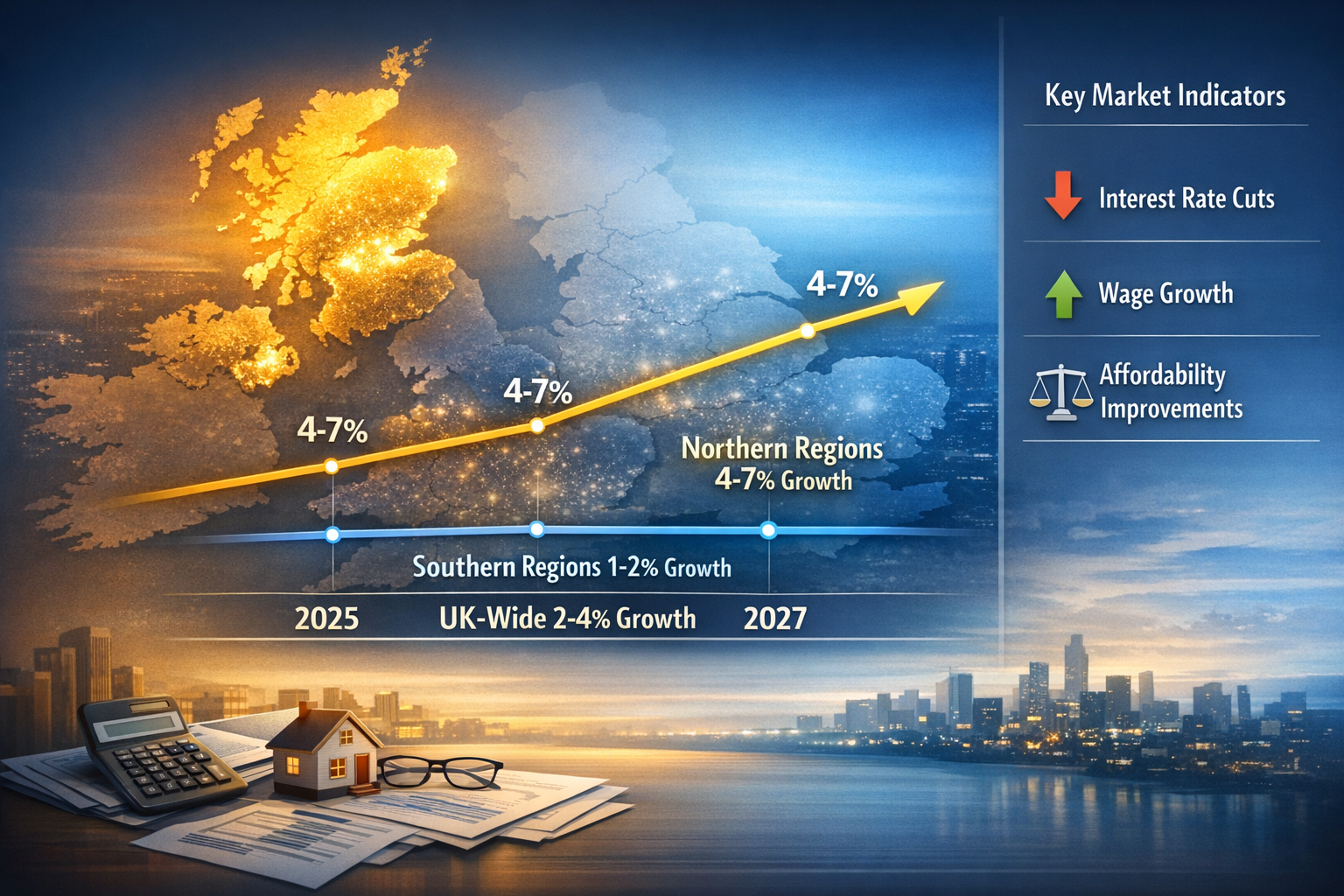
Nationwide forecasts UK-wide house price growth of 2-4% for 2026, driven by anticipated interest rate cuts and wage growth outpacing property price increases.[6] However, this growth won't be evenly distributed—northern regions are positioned to capture the majority of this growth due to superior affordability dynamics.
Employment, Wages, and Economic Rebalancing
The UK economy is experiencing a gradual rebalancing that favors northern regions. While London and the South East maintain advantages in certain sectors (finance, professional services, media), northern regions are capturing growth in:
- Technology and digital sectors with major hubs in Manchester, Edinburgh, and Belfast
- Advanced manufacturing benefiting from lower operating costs
- Life sciences and biotechnology clusters
- Creative industries attracted by affordable workspace
- Green energy and sustainability sectors
Wage growth in northern regions, while starting from a lower base, is increasingly competitive with southern counterparts in many sectors. Combined with significantly lower housing costs, the real disposable income advantage for northern residents is substantial.
This economic shift is reinforced by:
- Government levelling-up initiatives directing investment northward
- Major infrastructure projects improving connectivity
- University research partnerships driving innovation
- International investment attracted by lower costs and skilled workforces
Remote Work and Lifestyle Migration
The sustained shift toward remote and hybrid working arrangements continues to reshape property demand patterns. Workers no longer tethered to London and southern offices are increasingly choosing northern locations offering:
- Superior property value for equivalent budgets
- Higher quality of life with reduced commuting stress
- Access to natural amenities including coastlines, countryside, and national parks
- Strong community connections in smaller cities and towns
- Better work-life balance enabled by lower cost of living
This migration pattern creates a virtuous cycle in northern property markets: incoming professionals increase local demand, support service sector growth, enhance cultural amenities, and attract further migration—all while maintaining affordability advantages over southern alternatives.
Investment Demand and Rental Yields
Property investors are increasingly recognizing the superior returns available in northern markets. The combination of lower entry costs, strong rental demand, and capital appreciation creates compelling investment cases.
Rental yield comparison:
| Region | Avg. Property Price | Avg. Monthly Rent | Annual Rent | Gross Yield |
|---|---|---|---|---|
| Northern Ireland | £193,000 | £873 | £10,476 | 5.4% |
| Scotland | £193,000 | £1,018 | £12,216 | 6.3% |
| South East | £381,369 | £1,400* | £16,800 | 4.4% |
*Estimated based on market data
Scottish properties deliver gross yields approaching 6.3%—substantially higher than the 4.4% typical in the South East. When combined with stronger capital appreciation (4.5% vs 1.0%), the total return differential becomes dramatic.
Northern Ireland's rental market growth of 5.7% annually demonstrates sustained demand that supports both yield and capital growth.[2] This dual-return profile attracts professional investors and portfolio builders seeking optimal risk-adjusted returns.
For investors considering regional opportunities, obtaining professional property valuation services ensures accurate assessment of both current value and income potential.
Market Outlook and Future Predictions for Regional Property Valuation Trends 2026
Understanding where the market is heading is as important as understanding where it stands today. Multiple authoritative forecasts provide insight into how Regional Property Valuation Trends 2026: Why Scotland, Northern Ireland, and the North Are Outperforming the South will evolve through the remainder of 2026 and beyond.
Short-Term Forecasts (2026)
The consensus among major forecasters points to continued northern outperformance throughout 2026, though with some moderation from peak growth rates:
Nationwide's 2026 forecast:
- UK-wide growth: 2-4%
- Driven by Bank of England interest rate cuts
- Wage growth outpacing property price increases
- Gradual improvement in affordability metrics[6]
Hamptons' more conservative projection:
- UK-wide growth: 2.5% by Q4 2026
- Cautious outlook reflecting economic uncertainties
- Regional variations expected to persist[4]
RICS surveyor sentiment (January 2026):
- Strongest growth expectations: Scotland and Northern Ireland
- Positive trends: North West and North of England
- Continued weakness: London, South East, South West, East Anglia[3]
The HomeOwners Alliance CEO Paula Higgins explicitly predicts "higher growth in the north of England than in the south" as the defining characteristic of 2026's property market, driven by easing mortgage rates and steady wage growth improving affordability in northern regions.[5]
Medium-Term Outlook (2027-2028)
Looking beyond 2026, several structural factors suggest the north-south divide will persist rather than reverse:
Demographic trends:
- Aging southern populations with lower mobility
- Younger northern demographics driving household formation
- Migration patterns favoring northern cities
- International immigration increasingly distributed beyond London
Economic factors:
- Infrastructure investment continuing to favor northern regions
- Technology sector growth dispersing beyond southern hubs
- Cost of living advantages attracting businesses northward
- Commercial property development supporting employment growth
Housing supply dynamics:
- Planning constraints limiting southern development
- Land availability supporting northern construction
- Affordability-driven development focusing on accessible markets
- Build-to-rent sector expanding in northern cities
Potential Risks and Countervailing Factors ⚠️
While the northern outperformance trend appears robust, several factors could moderate or temporarily reverse regional patterns:
Economic recession: A significant economic downturn could disproportionately impact northern regions with less diversified economies, though affordability advantages would likely limit downside relative to southern markets.
Interest rate volatility: Unexpected increases in Bank of England base rates would impact all regions but could particularly affect recent northern buyers with high loan-to-value mortgages.
Government policy changes: Alterations to stamp duty, capital gains tax, or landlord taxation could shift investment patterns and regional demand.
Southern market correction: A significant price correction in southern markets could temporarily improve affordability and reignite demand, though this would require substantial price decreases (20%+) to meaningfully close the affordability gap.
Strategic Implications for Property Professionals
For surveyors, valuers, and property professionals, these regional trends create both opportunities and obligations:
Valuation methodology adjustments:
- Regional market knowledge becomes increasingly critical
- Comparable selection must account for localized trends
- Growth assumptions require region-specific calibration
- Risk assessments should incorporate regional economic factors
Professional valuers should ensure their methodologies account for the diverging regional trajectories rather than applying UK-wide assumptions. Those seeking to understand what a surveyor does in this context will find that regional expertise has become a core competency.
Client advisory services:
- Investment guidance highlighting northern opportunities
- Portfolio diversification across regions
- Timing strategies for regional market entry/exit
- Risk mitigation through geographic spread
Professional development priorities:
- Regional market expertise in high-growth areas
- Data analytics capabilities for trend identification
- Economic forecasting skills for client advisory
- Comparative regional analysis methodologies
Practical Implications for Buyers, Sellers, and Investors
Understanding Regional Property Valuation Trends 2026: Why Scotland, Northern Ireland, and the North Are Outperforming the South translates into actionable strategies for different market participants.
For First-Time Buyers 🏠
The regional divide creates dramatically different pathways to homeownership:
Northern market advantages:
- Lower deposit requirements making homeownership achievable sooner
- Stronger capital appreciation building equity faster
- Better property for budget improving quality of life
- Lower ongoing costs reducing financial stress
Strategic recommendations:
- Prioritize northern regions if employment permits
- Consider remote work opportunities enabling geographic flexibility
- Research emerging areas in northern cities before gentrification
- Obtain professional surveys to ensure property quality matches value
- Factor in total cost of living beyond just property prices
First-time buyers should consider comprehensive home surveys to ensure their investment is sound, particularly when purchasing in unfamiliar northern markets.
For Property Investors 📈
The investment case for northern regions has rarely been stronger:
Investment strategy considerations:
Buy-to-let investors:
- Target northern cities with strong rental demand (Edinburgh, Manchester, Belfast, Leeds, Newcastle)
- Focus on areas near universities for stable student rental markets
- Consider new-build developments in regeneration zones
- Calculate yields carefully accounting for void periods and management costs
Capital growth investors:
- Identify emerging neighborhoods in established northern cities
- Monitor infrastructure projects creating future value
- Diversify across multiple northern regions to spread risk
- Hold medium-term (5-10 years) to capture appreciation cycles
Portfolio investors:
- Rebalance toward northern exposure from overweight southern positions
- Maintain some southern holdings for diversification and stability
- Consider build-to-rent opportunities in northern cities
- Engage professional valuers for accurate portfolio assessment
Investors should ensure they obtain detailed property valuations before purchase and regularly thereafter to track performance accurately.
For Existing Homeowners Considering Relocation
The regional price differential creates unique opportunities for equity release through strategic relocation:
Example scenario:
- Sell: 2-bedroom flat in South East for £380,000
- Buy: 4-bedroom house in Northern Ireland for £235,000
- Equity release: £145,000 (before costs)
This released equity can fund:
- Mortgage-free living with surplus cash
- Investment portfolio generating income
- Business ventures or career changes
- Enhanced lifestyle with lower ongoing costs
Relocation considerations:
- Employment opportunities in target region
- Family and social connections impact on quality of life
- Education options for children
- Healthcare access particularly for older relocators
- Cultural and lifestyle fit with new location
For Property Sellers in Different Regions
Selling strategies should account for regional market dynamics:
Northern sellers:
- Market timing is favorable with strong demand
- Price competitively to capitalize on buyer enthusiasm
- Highlight investment potential to investor buyers
- Professional presentation maximizes value in competitive markets
- Consider sale-agreed timelines which remain robust[1]
Southern sellers:
- Be realistic about pricing in slower growth markets
- Emphasize unique property features to stand out
- Target specific buyer demographics (downsizers, international buyers)
- Consider timing around seasonal demand patterns
- Professional staging becomes more important in competitive markets
Regardless of region, obtaining an accurate property inspection before listing helps identify and address issues that could derail sales.
For Commercial Property Stakeholders
The residential trends mirror and influence commercial property dynamics:
Commercial investment opportunities:
- Retail and hospitality in growing northern cities
- Office space for expanding technology companies
- Industrial and logistics benefiting from infrastructure improvements
- Student accommodation near northern universities
- Co-working spaces supporting remote work transitions
Risk considerations:
- Economic concentration in certain northern cities
- Retail sector challenges affecting high streets
- Office demand uncertainty with remote work trends
- Planning and development risks in regeneration areas
Those involved in commercial property inspections should develop expertise in northern markets where growth opportunities are concentrated.
Regional Deep Dive: Specific Market Characteristics
While broad regional trends are clear, understanding specific characteristics of high-performing areas provides actionable insight.
Northern Ireland: Market-Specific Factors
Belfast and Greater Belfast:
- Strong professional employment in technology, financial services, and professional services
- Cultural renaissance enhancing city appeal
- Titanic Quarter development creating premium residential zones
- Transport connectivity to Dublin and beyond
- Average prices: £235,000 (Q4 2025)[1]
Bangor and coastal towns:
- Commuter appeal to Belfast professionals
- Coastal lifestyle at affordable prices
- Retirement destination attracting downsizers
- Tourism sector supporting local economy
Lisburn and Newtownards:
- Family-friendly with good schools
- Balanced urban-rural character
- Strong local employment reducing commute dependence
- Consistent demand across property types[1]
Scotland: Regional Variations
Edinburgh:
- Capital city premium with cultural attractions
- Strong professional employment particularly finance and government
- University presence creating rental demand
- Tourism sector supporting economy
- Higher price point within Scottish market
Glasgow:
- More affordable than Edinburgh
- Cultural and artistic hub
- Regeneration projects creating value opportunities
- Strong rental yields for investors
Aberdeen:
- Energy sector dominance
- Volatility linked to oil prices
- Potential value in current market conditions
- Long-term prospects tied to energy transition
Smaller cities and towns:
- Lifestyle appeal for remote workers
- Affordability advantage over major cities
- Community character attractive to families
- Variable employment requiring research
Northern England: City-by-City Analysis
Manchester:
- Technology and media sector growth
- Major infrastructure investment including HS2
- Cultural renaissance with arts and music scenes
- Strong university presence (University of Manchester, Manchester Metropolitan)
- Rental demand from young professionals and students
Liverpool:
- Waterfront regeneration creating premium zones
- Cultural heritage as UNESCO City of Music
- Affordability relative to Manchester
- Growing professional sector diversifying economy
Leeds:
- Financial and professional services hub
- Strong retail sector serving Yorkshire
- Major development projects in city center
- Good transport links to London and northern cities
Newcastle:
- Lifestyle appeal with vibrant culture
- Affordable entry point for northern markets
- University presence (Newcastle University, Northumbria University)
- Regeneration potential in certain neighborhoods
Sheffield:
- Green city with parks and countryside access
- Two universities creating rental demand
- Advanced manufacturing sector
- Excellent value for money in property market
Professional Valuation Considerations in Regional Markets
For chartered surveyors and valuation professionals, the regional divergence creates both challenges and opportunities requiring methodological rigor.
Valuation Methodology Adjustments
Comparable selection:
- Geographic specificity is increasingly critical
- Time-sensitive comparables given rapid regional changes
- Adjustment factors for regional trends
- Cross-regional comparables require careful calibration
Growth assumptions:
- Region-specific forecasts rather than UK-wide
- Local economic factors incorporated into projections
- Infrastructure impact on future values
- Demographic trends affecting long-term demand
Risk assessment:
- Regional economic concentration risks
- Market liquidity variations across regions
- Regulatory and planning differences
- Environmental and climate considerations
Client Advisory Services
Professional surveyors can add value through:
Investment guidance:
- Regional opportunity identification based on data analysis
- Portfolio optimization across geographic markets
- Risk-adjusted return comparisons
- Timing recommendations for market entry
Due diligence services:
- Comprehensive property surveys in unfamiliar markets
- Local market intelligence for out-of-region buyers
- Regulatory compliance verification
- Environmental risk assessment
Those seeking chartered surveyors should prioritize firms with demonstrated regional expertise and data-driven methodologies.
Technology and Data Analytics
Modern valuation increasingly relies on:
- Automated valuation models (AVMs) with regional calibration
- Big data analytics identifying micro-market trends
- Predictive modeling for growth forecasting
- Geographic information systems (GIS) for spatial analysis
- Market sentiment indicators from multiple data sources
Professional surveyors who invest in these capabilities can provide superior service and insights to clients navigating regional market variations.
Conclusion: Navigating the New Regional Reality
The evidence is unequivocal: Regional Property Valuation Trends 2026: Why Scotland, Northern Ireland, and the North Are Outperforming the South represents a fundamental rebalancing of the UK property market. Northern Ireland's 7.1% annual growth, Scotland's 4.5% appreciation, and northern England's strong performance (6.8% in the North East, 4.1% in the North West) stand in stark contrast to the South East's 1.0% and South West's 1.9% growth.[2][5]
This isn't a temporary aberration—it's a structural shift driven by affordability constraints, economic rebalancing, changing work patterns, and demographic trends that will persist through 2026 and likely beyond. The north-south divide that has characterized UK property markets for decades is reversing, creating unprecedented opportunities for those positioned to capitalize on the transition.
Key Strategic Imperatives
For buyers: Northern regions offer superior value, stronger growth prospects, and better quality of life for equivalent budgets. First-time buyers in particular should seriously consider northern markets where homeownership remains achievable.
For investors: The combination of strong capital appreciation (4-7% annually), superior rental yields (5-6%+), and lower entry costs creates compelling investment cases in Scotland, Northern Ireland, and northern England. Portfolio rebalancing toward northern exposure is strategically sound.
For sellers: Northern sellers should capitalize on strong demand and favorable market conditions. Southern sellers must be realistic about pricing in slower-growth markets while emphasizing unique property characteristics.
For property professionals: Regional expertise, data-driven valuation methodologies, and comprehensive client advisory services become critical differentiators. Surveyors and valuers who develop deep knowledge of northern markets will be best positioned to serve clients effectively.
Actionable Next Steps
-
Conduct thorough research on specific northern markets aligned with your goals (employment, lifestyle, investment returns)
-
Obtain professional valuations and surveys before making purchase decisions—regional variations make professional assessment even more critical
-
Consider geographic diversification if building an investment portfolio across multiple northern regions
-
Monitor infrastructure developments that will drive future value (transport links, regeneration projects, employment hubs)
-
Engage local expertise through professional surveyor services with demonstrated regional knowledge
-
Calculate total cost of ownership including mortgage costs, maintenance, insurance, and lifestyle expenses across regions
-
Plan for medium-term holding periods (5-10 years) to capture full appreciation cycles in northern markets
-
Stay informed on regional trends through authoritative sources including RICS reports, ONS data, and professional market analysis
The UK property market of 2026 looks fundamentally different from previous decades. The traditional southern dominance has given way to a more balanced, regionally diverse landscape where Scotland, Northern Ireland, and northern England offer superior opportunities for growth, value, and returns. Those who recognize and act on this shift will be best positioned to achieve their property goals in the years ahead.
Whether you're a first-time buyer seeking affordable homeownership, an investor pursuing optimal returns, or a property professional serving clients across regions, understanding and leveraging these Regional Property Valuation Trends 2026 is essential for success in today's evolving market.
References
[1] Northern Ireland Property Market In 2026 Why Now Is A Good Time To Sell – https://www.reedsrains.co.uk/blog/northern-ireland-property-market-in-2026-why-now-is-a-good-time-to-sell
[2] January2026 – https://www.ons.gov.uk/economy/inflationandpriceindices/bulletins/privaterentandhousepricesuk/january2026
[3] Uk Resi Survey Jan 2026 Report Shows Early Signs Market Recovery Despite Caution – https://www.rics.org/news-insights/uk-resi-survey-jan-2026-report-shows-early-signs-market-recovery-despite-caution
[4] House Prices – https://moneyweek.com/investments/house-prices/house-prices
[5] House Price Forecast – https://hoa.org.uk/advice/guides-for-homeowners/i-am-buying/house-price-forecast/
[6] Hpi Review Outlook 2026 – https://www.nationwide-intermediary.co.uk/news/hpi-review-outlook-2026