
The commercial real estate market in 2026 stands at a critical crossroads. With $1.26 trillion in commercial real estate loans maturing in 2027[3], elevated interest rates hovering around 4%[2], and economic forecasts predicting GDP growth to slow to 2.0%[2], investors face unprecedented uncertainty. Yet amid this fog of market volatility, a surprising statistic emerges: 74% of commercial real estate investors plan to increase purchases in 2026[1]. This paradox—heightened uncertainty coupled with aggressive investment intentions—creates both risk and opportunity. The question becomes: how can property investors make confident decisions when the path forward remains unclear?
This is precisely where surveying the capital markets uncertainty: how property surveyors can help clients navigate 2026's 'fog' becomes not just relevant, but essential. Professional property surveyors serve as the critical link between market ambiguity and informed decision-making, providing the data-driven insights that transform risky ventures into calculated investments.
Key Takeaways
✅ Commercial real estate investment volume is projected to increase by 16% in 2026 to approximately $562 billion, creating significant opportunities despite market uncertainty[1][2]
✅ Property surveyors provide essential risk mitigation through comprehensive assessments that reveal hidden defects, structural issues, and accurate valuations in volatile markets
✅ 97% of investors are maintaining or increasing real estate allocations, making professional survey data more critical than ever for competitive advantage[1]
✅ Refinancing challenges loom large with interest rate differentials between old loans (near 4%) and new financing (6.5%), requiring precise property valuations[3]
✅ Strategic survey deployment across different property types helps investors capitalize on cap rate compression opportunities of 5-15 basis points[2]
Understanding the 2026 Capital Markets Landscape

The Current State of Commercial Real Estate Uncertainty
The commercial real estate sector in 2026 operates within what industry experts describe as a "fog"—a period of reduced visibility where traditional market indicators send mixed signals. According to CBRE's comprehensive research, commercial real estate investment volume is expected to increase by 16% in 2026 to approximately $562 billion, nearly matching pre-pandemic annual averages from 2015-2019[1][2]. This represents a significant recovery trajectory, yet the path remains fraught with challenges.
Uncertain economic outlook and weakening labor market conditions rank as the biggest challenges cited by both U.S. and Canadian investors[1]. The GDP growth forecast shows a slowdown to 2.0% in 2026, with softening labor market conditions and inflation averaging 2.5%[2]. These macroeconomic headwinds create a complex environment where property values, rental income projections, and exit strategies all carry higher degrees of uncertainty.
Interest Rate Dynamics and Financing Challenges
Perhaps no factor contributes more to the current market fog than elevated long-term interest rates, which remain the second-biggest concern for U.S. investors[1]. The 10-year Treasury yield is expected to remain around 4%[2], creating a persistent cost-of-capital challenge that affects property valuations and investment returns.
The refinancing landscape presents particular concern. With $1.26 trillion in commercial real estate loans made in 2015 maturing in 2027 at rates near 4%, compared to 6.5% for loans made today[3], property owners face a significant interest rate differential that could impact cash flows and force distressed sales. This refinancing wave creates both risks for overleveraged properties and opportunities for well-capitalized buyers—but only if they can accurately assess property values and condition.
Investor Sentiment vs. Market Reality
Despite these challenges, investor confidence shows remarkable resilience. 97% of investors are maintaining or increasing their real estate allocations, with a slight majority citing stabilizing interest rates or potential debt cost decreases as rationale[1]. Furthermore, just under 50% of investors plan to sell more assets[1], creating competitive dynamics where increased buying intentions will likely firm pricing despite elevated interest rates.
This disconnect between caution and action creates the "fog" metaphor: investors recognize risks but remain committed to the asset class. The NCREIF ODCE Index turned positive in Q3 2024 and posted five consecutive quarters of gains, with year-to-date returns of 2.82% as of Q3 2025[3], reflecting income-driven returns and modest valuation recovery that supports continued investment.
Surveying the Capital Markets Uncertainty: The Critical Role of Property Surveyors
Why Professional Surveys Matter More in Uncertain Markets
When market conditions are stable and predictable, property surveys serve as important due diligence tools. When markets enter periods of uncertainty like 2026, professional surveys transform into essential risk mitigation instruments that can mean the difference between profitable investment and costly mistakes.
Property surveyors provide the objective, data-driven clarity that cuts through market fog. While economic forecasts and market trends offer macro-level guidance, comprehensive property assessments deliver the micro-level intelligence that determines actual property value, condition, and investment viability.
Consider the refinancing challenge facing the market: a property purchased in 2015 with a loan maturing in 2027 faces a potential interest rate increase from 4% to 6.5%. Whether that property can sustain higher debt service depends entirely on its current condition, required capital expenditures, and realistic rental income potential—all factors that professional surveys reveal with precision.
Key Survey Types for Capital Markets Navigation
Different market conditions and property types require different survey approaches. Understanding which survey type provides the most value becomes crucial for surveying the capital markets uncertainty: how property surveyors can help clients navigate 2026's 'fog'.
Stock Condition Surveys for Portfolio Assessment
For investors managing multiple properties or considering portfolio acquisitions, stock condition surveys provide comprehensive assessments across entire property portfolios. These surveys:
- 📊 Identify immediate repair requirements and deferred maintenance
- 💰 Project capital expenditure needs over 5-10 year horizons
- 🔍 Reveal hidden defects that could impact refinancing or sale prospects
- 📈 Support accurate budgeting for property improvements
In 2026's uncertain market, understanding the true condition of portfolio assets helps investors make informed hold-versus-sell decisions and negotiate from positions of knowledge rather than assumption.
Building Surveys for Major Acquisitions
For significant property acquisitions, particularly in the commercial sector where cap rates are expected to compress by 5-15 basis points for most property types[2], comprehensive building surveys provide the detailed analysis necessary to justify premium pricing or negotiate discounts based on discovered defects.
Choosing between survey levels depends on property age, complexity, and transaction size, but in uncertain markets, the most thorough assessment typically provides the best risk mitigation.
Specific Defect Surveys for Targeted Investigation
When preliminary assessments or visual inspections raise concerns about particular building elements, specific defect surveys allow investors to investigate potential problems without commissioning full building surveys. These targeted investigations prove particularly valuable when:
- 🏗️ Evaluating distressed properties with known issues
- 🔧 Assessing repair cost implications before making offers
- ⚠️ Investigating structural concerns that could affect financing
- 📋 Validating seller disclosures about property condition
The Data Advantage: Surveys as Investment Intelligence
Professional property surveys generate data that extends far beyond simple pass/fail assessments. Modern survey reports provide:
Quantified Risk Profiles: Rather than subjective opinions, professional surveys assign condition ratings, estimate repair costs, and project maintenance timelines that support financial modeling and investment analysis.
Comparable Market Intelligence: Experienced surveyors understand local market conditions and can contextualize property condition within competitive sets, helping investors understand relative value positioning.
Negotiation Leverage: Documented defects and required repairs provide objective justification for price negotiations, often recovering survey costs many times over through reduced purchase prices or seller concessions.
Financing Confidence: Lenders in 2026's higher-rate environment scrutinize property condition more carefully. Professional survey reports that demonstrate sound property condition facilitate financing approvals and potentially secure better terms.
How Property Surveyors Can Help Clients Navigate 2026's 'Fog'
Strategic Survey Deployment Across Property Types
The commercial real estate market in 2026 shows significant variation across property types, with commercial real estate leasing activity expected to continue recovery in 2026, surpassing 2019 levels as large users return to the market[2]. This recovery creates opportunities, but different property sectors require different survey strategies.
Office Properties: Assessing Adaptation Potential
Office properties face unique challenges in 2026, with hybrid work models permanently altering demand patterns. Surveyors help clients evaluate:
- 🏢 Building systems capacity for modern HVAC and air quality requirements
- 💡 Electrical infrastructure adequacy for increased technology demands
- 🚪 Spatial configuration flexibility for conversion to alternative uses
- ♿ Accessibility compliance and modernization requirements
Professional surveys reveal whether office properties can adapt to evolving tenant requirements or face obsolescence risks that market pricing may not yet reflect.
Industrial and Logistics: Capitalizing on E-Commerce Demand
Industrial properties continue showing strength, but not all facilities meet modern logistics requirements. Surveys assess:
- 📦 Clear height adequacy for automated storage systems
- 🚛 Loading dock configuration and capacity
- ⚡ Power supply sufficiency for warehouse automation
- 🏗️ Structural capacity for mezzanine additions or equipment loads
These technical assessments determine whether properties can command premium rents or require significant capital investment to remain competitive.
Retail Properties: Evaluating Repositioning Viability
Retail real estate continues evolving, with successful properties often requiring repositioning. Property evaluation helps determine:
- 🔄 Structural feasibility of layout modifications
- 🅿️ Site capacity for experiential retail additions
- 🛠️ Building systems age and replacement timelines
- 📱 Infrastructure readiness for omnichannel retail integration
Timing Survey Deployment for Maximum Value
In volatile markets, when surveys occur can be as important as the surveys themselves. Strategic timing considerations include:
Pre-Acquisition Due Diligence: Standard practice, but in 2026's competitive market where 74% of investors plan to increase purchases[1], early survey deployment—even before formal offers—can provide competitive advantage by enabling faster, more confident decision-making.
Portfolio Review Cycles: Annual or biannual portfolio surveys help investors identify properties approaching critical repair thresholds, optimizing capital expenditure timing and potentially identifying disposition candidates before market conditions deteriorate.
Pre-Refinancing Assessment: With the massive refinancing wave approaching in 2027, conducting surveys 12-18 months before loan maturity allows time to address defects that could impair refinancing terms or require lender reserves.
Pre-Listing Preparation: For the nearly 50% of investors planning to sell more assets[1], pre-listing surveys identify issues that could derail transactions, allowing sellers to address problems proactively or price properties appropriately with full disclosure.
Integrating Survey Data with Market Analysis
Professional surveyors provide maximum value when their technical assessments integrate with broader market analysis. This integration creates surveying the capital markets uncertainty: how property surveyors can help clients navigate 2026's 'fog' in its most powerful form.
Valuation Context: Survey findings should inform valuation models by:
- Adjusting comparable sales for condition differences
- Quantifying deferred maintenance as value reductions
- Projecting capital expenditure impacts on cash flows
- Identifying value-add opportunities through remediation
Risk-Adjusted Returns: Survey data enables more accurate risk-adjusted return calculations by:
- Quantifying downside scenarios based on discovered defects
- Estimating probability-weighted repair cost outcomes
- Identifying binary risks (structural issues) versus manageable concerns
- Supporting sensitivity analysis for investment committee presentations
Hold-Period Planning: Survey findings influence optimal hold-period strategies by:
- Identifying near-term capital requirements that affect cash flow projections
- Revealing long-term structural issues that may limit exit options
- Highlighting opportunities for value creation through targeted improvements
- Supporting build-versus-buy decisions for portfolio expansion
Leveraging Technology-Enhanced Survey Capabilities
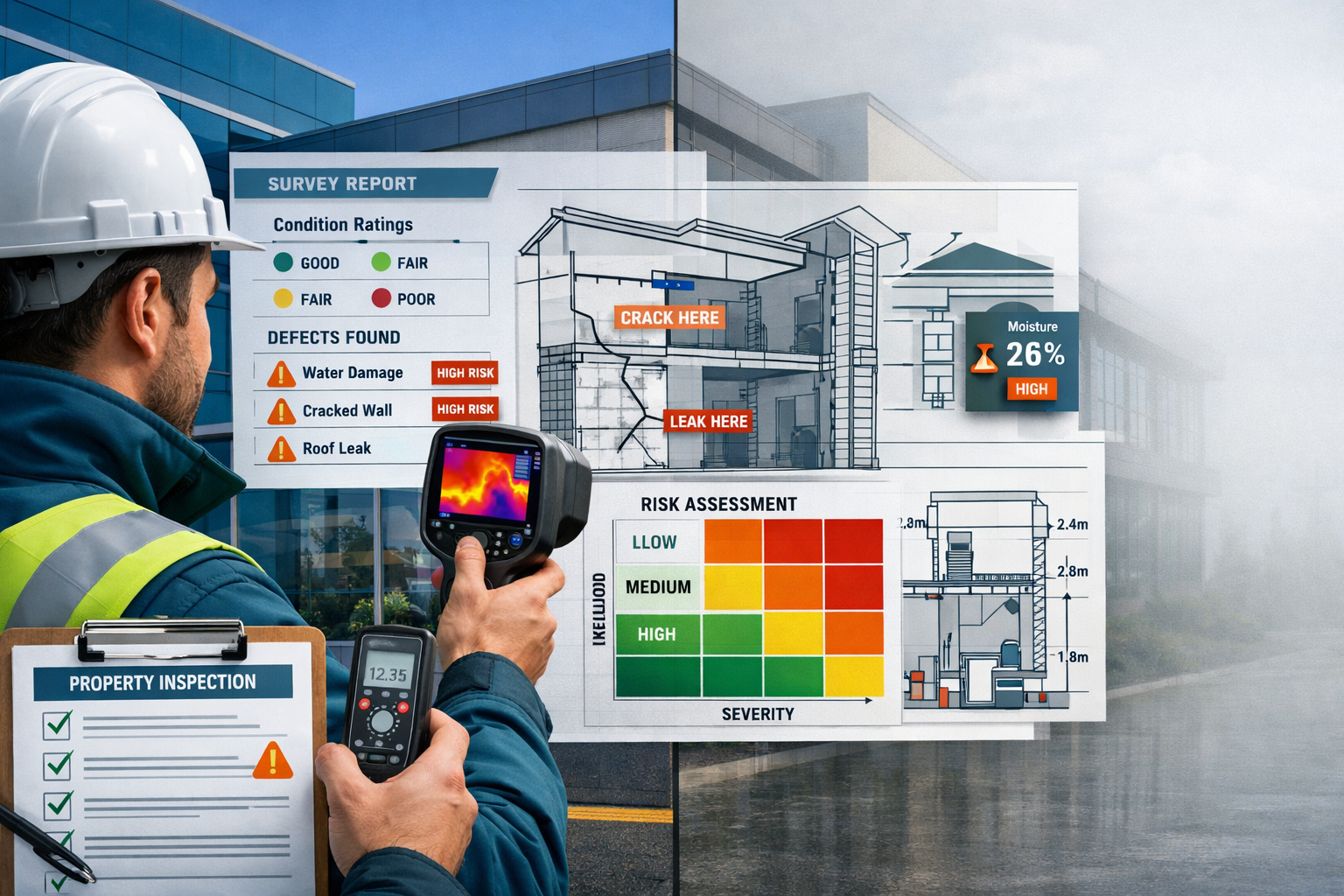
Modern property surveying extends far beyond clipboard inspections. Technology enhancements in 2026 provide capabilities that previous generations of investors couldn't access:
Thermal Imaging: Reveals hidden moisture intrusion, insulation deficiencies, and HVAC distribution problems that visual inspections miss, preventing costly surprises post-acquisition.
Drone Surveys: Enable comprehensive roof and facade inspections without expensive scaffolding or access equipment, particularly valuable for large commercial properties or portfolio assessments.
3D Laser Scanning: Creates precise building measurements and spatial documentation, supporting renovation planning, tenant improvement design, and as-built verification.
Moisture Detection Technology: Identifies water infiltration and damp conditions that could indicate serious structural problems or create health hazards, as detailed in damp survey services.
Digital Reporting Platforms: Modern survey reports include interactive elements, photographic documentation, and prioritized repair schedules that facilitate decision-making and stakeholder communication.
Practical Applications: Survey Strategies for Different Investor Types
Institutional Investors and Portfolio Managers
Institutional investors managing large commercial portfolios face unique challenges in 2026's uncertain market. With 97% of investors maintaining or increasing real estate allocations[1], competition for quality assets intensifies, making superior due diligence a competitive differentiator.
Portfolio-Wide Condition Assessments: Annual or biannual stock condition surveys across entire portfolios provide:
- 📊 Standardized condition metrics enabling cross-property comparisons
- 💰 Multi-year capital expenditure forecasting for budgeting accuracy
- 🎯 Data-driven asset disposition recommendations
- 📈 Performance benchmarking against industry standards
Acquisition Due Diligence Protocols: Standardized survey requirements for all acquisitions ensure consistent risk assessment and facilitate investment committee decision-making. Protocols should specify:
- Minimum survey scope based on property type and transaction size
- Required turnaround times that align with offer deadlines
- Standardized reporting formats for easy comparison
- Clear escalation procedures when significant defects emerge
ESG and Sustainability Assessments: Environmental, social, and governance considerations increasingly influence institutional investment decisions. Surveys that evaluate energy efficiency, environmental compliance, and accessibility support ESG reporting requirements while identifying value-creation opportunities through sustainability improvements.
Private Equity and Opportunity Funds
Private equity firms and opportunity funds typically pursue value-add or distressed property strategies that require particularly sophisticated survey deployment. In 2026's market, where pricing remains firm despite elevated interest rates[1], accurate assessment of improvement costs determines deal viability.
Value-Add Feasibility Analysis: Before acquiring properties requiring significant improvements, surveys should assess:
- 🔧 Structural capacity for planned modifications
- 💡 Building systems upgrade requirements and costs
- 🏗️ Code compliance gaps requiring remediation
- ⏱️ Construction timeline implications from discovered conditions
Distressed Asset Evaluation: When pursuing properties facing refinancing challenges or deferred maintenance, specific defect surveys help quantify:
- Minimum required repairs for stabilization
- Full renovation costs for repositioning
- Hidden structural issues affecting feasibility
- Environmental remediation requirements
Exit Strategy Validation: Survey data should validate exit assumptions by confirming that planned improvements will deliver anticipated value creation and that no undiscovered issues could impair eventual disposition.
Individual and Family Office Investors
Individual investors and family offices often operate with longer time horizons and different risk tolerances than institutional investors, but professional surveys remain equally critical for surveying the capital markets uncertainty: how property surveyors can help clients navigate 2026's 'fog'.
Acquisition Confidence: For investors making significant capital commitments, comprehensive surveys provide peace of mind and objective validation of investment decisions. Choosing the right property assessment ensures appropriate depth of investigation.
Intergenerational Planning: Family offices planning to hold properties across generations benefit from detailed condition documentation that supports long-term capital planning and eventual estate transitions.
Hands-On Management Support: Individual investors often take active management roles. Survey reports that include prioritized repair schedules, maintenance recommendations, and vendor selection guidance support effective property stewardship.
Real Estate Developers and Conversion Projects
Developers pursuing ground-up construction or adaptive reuse projects require specialized survey approaches that assess development potential rather than simply current condition.
Site Assessment and Feasibility: Pre-acquisition surveys for development sites should evaluate:
- 🏗️ Soil conditions and foundation requirements
- 🌳 Environmental constraints and remediation needs
- 🚧 Existing structure demolition versus incorporation decisions
- 🔌 Utility availability and capacity
Adaptive Reuse Evaluation: Converting office buildings to residential, retail to mixed-use, or other repositioning strategies requires surveys assessing:
- Structural modifications feasibility
- Building systems replacement requirements
- Historic preservation compliance (if applicable)
- Code upgrade triggers and costs
Construction Monitoring: Monitoring surveys during construction or renovation projects document progress, verify quality, and identify issues before they become costly problems.
Overcoming Common Survey Objections and Misconceptions
"Surveys Are Too Expensive in This Market"
One of the most persistent common myths about property surveys centers on cost. In 2026's competitive market, some investors view surveys as discretionary expenses that can be minimized or eliminated to improve returns.
This perspective fundamentally misunderstands survey economics. Consider:
Cost vs. Risk: A comprehensive building survey might cost £3,000-£10,000 depending on property size and complexity. Discovering a £100,000 structural issue, £50,000 in deferred maintenance, or £75,000 in required environmental remediation provides immediate return on investment through:
- Price negotiations that recover survey costs many times over
- Deal termination before significant additional due diligence expenses
- Accurate budgeting that prevents post-acquisition cash flow surprises
Financing Implications: In 2026's higher interest rate environment, lenders scrutinize property condition more carefully. A professional survey report that satisfies lender requirements can facilitate financing approval and potentially secure better terms, offsetting survey costs through improved loan pricing.
Opportunity Cost: Failed acquisitions due to undiscovered defects waste significant time and resources. Survey investments that identify problems early allow investors to redirect efforts toward viable opportunities, improving overall portfolio productivity.
For detailed information on property survey expenses, investors can access resources that demonstrate typical cost ranges and value propositions.
"Visual Inspections Are Sufficient"
Some investors believe that personal property tours or broker-provided information adequately substitute for professional surveys. This misconception proves particularly dangerous in 2026's uncertain market.
Professional Training and Experience: Chartered surveyors undergo extensive training and maintain continuing education requirements that enable them to:
- Recognize subtle indicators of serious problems
- Understand building systems interactions and failure modes
- Identify code compliance issues that affect use and value
- Apply industry standards and best practices to assessments
Liability and Insurance: Professional surveyors carry errors and omissions insurance that protects clients if significant defects are missed. Visual inspections by unqualified parties provide no such protection.
Technology and Tools: Professional surveys employ specialized equipment—thermal imaging, moisture meters, structural analysis tools—that reveal conditions invisible to casual observation.
Objective Documentation: Professional survey reports provide third-party documentation that supports negotiations, financing applications, and potential legal proceedings in ways that personal observations cannot.
"Surveys Slow Down Transactions"
In competitive markets where 74% of investors plan to increase purchases[1], speed matters. Some investors worry that survey requirements will cause them to lose deals to faster-moving competitors.
Reality Check: Professional surveyors understand transaction timelines and can typically complete surveys within 5-10 business days, often faster for rush requests. This timeline rarely represents the critical path in transaction closings.
Strategic Pre-Positioning: Sophisticated investors conduct preliminary surveys before making formal offers, enabling faster due diligence periods and stronger competitive positioning.
Contingency Structuring: Well-structured purchase agreements include reasonable inspection periods that protect buyers without creating excessive delays. Sellers in 2026's market understand that serious buyers conduct proper due diligence.
Deal Certainty: Surveys that identify problems early prevent last-minute renegotiations or deal failures that create far more significant delays than the survey process itself.
Case Studies: Surveys Preventing Costly Mistakes in Uncertain Markets
Case Study 1: Office Building Refinancing Crisis Averted
Situation: A family office owned a 50,000 square foot office building purchased in 2015 with a loan maturing in early 2027. With interest rates rising from their original 4% to current market rates around 6.5%[3], they faced significantly higher debt service.
Survey Deployment: Eighteen months before loan maturity, they commissioned a comprehensive building survey to assess condition and identify any issues that could impair refinancing.
Key Findings: The survey revealed:
- HVAC system approaching end of useful life (estimated replacement: £180,000)
- Roof membrane showing early deterioration (estimated replacement: £95,000)
- Parking lot requiring resurfacing (estimated cost: £45,000)
- Minor façade repairs needed (estimated cost: £25,000)
Outcome: Armed with survey data, the family office:
- Completed critical HVAC replacement before refinancing, demonstrating property stewardship to lenders
- Negotiated lender reserves for remaining items rather than immediate completion
- Secured refinancing terms 0.25% better than initially quoted due to demonstrated property condition
- Avoided potential refinancing denial or severely restricted terms
Value Created: The £8,500 survey investment enabled strategic capital deployment that saved approximately £35,000 annually in interest costs over the loan term, while preventing a potential refinancing crisis.
Case Study 2: Portfolio Acquisition Due Diligence
Situation: A private equity fund evaluated a 12-property retail portfolio acquisition totaling £45 million. The seller provided property condition reports from two years prior showing generally good condition.
Survey Deployment: The fund commissioned fresh stock condition surveys across the entire portfolio rather than relying on outdated seller reports.
Key Findings: Updated surveys revealed:
- Three properties with significant deferred maintenance not reflected in seller reports
- One property with structural issues requiring immediate attention (estimated cost: £275,000)
- Two properties with environmental compliance gaps (estimated remediation: £125,000 combined)
- Portfolio-wide capital expenditure requirements of £1.8 million over five years versus £850,000 projected by seller
Outcome: The fund:
- Renegotiated purchase price down by £1.2 million based on survey findings
- Restructured deal to exclude the property with structural issues
- Adjusted underwriting models to reflect accurate capital expenditure requirements
- Proceeded with acquisition on terms that maintained target returns
Value Created: The £67,000 survey investment generated £1.2 million in immediate value through price reduction, while preventing acquisition of a problem property and enabling accurate financial modeling.
Case Study 3: Value-Add Opportunity Validation
Situation: An opportunity fund identified an older industrial building for potential conversion to creative office space, targeting the growing demand for unique workspace. The property appeared structurally sound during initial tours.
Survey Deployment: Before making a formal offer, the fund commissioned a comprehensive building survey with specific focus on conversion feasibility.
Key Findings: The survey revealed:
- Structural capacity adequate for planned mezzanine additions
- Electrical service requiring complete upgrade (estimated cost: £320,000)
- Asbestos-containing materials requiring abatement (estimated cost: £185,000)
- Foundation issues in one section requiring remediation (estimated cost: £95,000)
Outcome: Survey findings enabled the fund to:
- Accurately budget conversion costs, including previously unknown requirements
- Adjust acquisition price to maintain target returns given higher improvement costs
- Develop phased construction approach that addressed foundation issues first
- Proceed with confidence that no additional major surprises would emerge
Value Created: The £12,000 survey investment prevented a potentially failed development by revealing hidden costs totaling £600,000 that would have eliminated project returns if discovered post-acquisition.
Building Long-Term Relationships with Survey Professionals

Selecting the Right Survey Partner
Not all property surveyors offer equivalent expertise, particularly for commercial properties in uncertain markets. Surveying the capital markets uncertainty: how property surveyors can help clients navigate 2026's 'fog' requires selecting professionals with specific qualifications:
Professional Credentials: Look for chartered surveyors with RICS (Royal Institution of Chartered Surveyors) or equivalent professional designations, ensuring adherence to professional standards and continuing education requirements.
Commercial Property Experience: Residential surveyors may lack the specialized knowledge required for commercial properties. Seek professionals with demonstrated expertise in your target property types.
Market Knowledge: Surveyors familiar with local market conditions provide context that enhances technical findings, helping clients understand how discovered issues compare to market norms.
Technology Capabilities: Modern survey practices incorporate advanced diagnostic tools. Ensure prospective survey partners utilize current technology and methodologies.
Communication Skills: Technical expertise means little if surveyors cannot clearly communicate findings to non-technical stakeholders. Evaluate sample reports and references for communication quality.
For investors seeking qualified professionals, resources on finding a surveyor provide guidance on selection criteria and evaluation approaches.
Establishing Ongoing Relationships
Rather than treating surveys as one-off transactions, sophisticated investors develop ongoing relationships with survey professionals that provide multiple benefits:
Portfolio Familiarity: Surveyors who regularly assess portfolio properties develop institutional knowledge that enhances subsequent surveys and enables trend identification across properties.
Responsive Service: Established relationships typically generate priority scheduling and faster turnaround times when urgent survey needs arise.
Strategic Consultation: Beyond formal survey engagements, trusted survey partners can provide informal guidance on property issues, market conditions, and industry trends.
Negotiated Pricing: Volume relationships often enable preferential pricing structures that reduce per-survey costs while maintaining quality.
Coordinated Scheduling: For portfolio owners, established relationships facilitate coordinated survey scheduling that optimizes surveyor travel time and minimizes disruption to property operations.
Maximizing Survey Value Through Collaboration
Property surveys generate maximum value when clients and surveyors collaborate effectively:
Clear Scope Definition: Articulate specific concerns, intended property uses, and decision criteria to ensure surveys address relevant questions.
Access Facilitation: Ensure surveyors can access all property areas, including roofs, mechanical rooms, and tenant spaces, enabling comprehensive assessment.
Background Information: Provide available property documentation—previous surveys, maintenance records, tenant complaints—that helps surveyors focus attention on known or suspected issues.
Follow-Up Questions: Engage surveyors in dialogue about findings, asking clarifying questions that ensure full understanding of implications and recommendations.
Implementation Support: Utilize surveyors' expertise when implementing recommended repairs, potentially engaging them to review contractor proposals or monitor remediation work.
Future-Proofing Investment Decisions Through Survey Intelligence
Anticipating Market Shifts
The commercial real estate market in 2026 represents a transitional period, with capital markets recovery underway as volumes climb and participation broadens after 2025 demonstrated resilience[5]. Professional surveys help investors position for emerging trends:
Sustainability and Energy Efficiency: As ESG considerations increasingly influence property values, surveys that assess energy performance, carbon footprint, and sustainability improvement opportunities help investors identify properties aligned with future market preferences.
Technology Infrastructure: Modern tenants demand robust technology infrastructure. Surveys evaluating electrical capacity, telecommunications infrastructure, and smart building system compatibility help identify properties positioned for future tenant requirements versus those facing obsolescence.
Flexibility and Adaptability: Post-pandemic market dynamics favor properties that can adapt to changing uses. Surveys assessing structural flexibility, building systems modularity, and space reconfiguration potential identify assets with future-proof characteristics.
Resilience and Climate Risk: Increasing awareness of climate risks makes property resilience increasingly important. Surveys evaluating flood risk, extreme weather vulnerability, and climate adaptation requirements help investors assess long-term viability.
Integrating Survey Data with Broader Investment Strategies
Professional surveys provide maximum value when integrated into comprehensive investment frameworks:
Acquisition Criteria: Survey findings should inform acquisition criteria development, helping investors articulate minimum condition standards and identify property characteristics that align with investment strategies.
Portfolio Optimization: Regular portfolio surveys support data-driven hold-versus-sell decisions by identifying properties requiring significant capital investment versus those positioned for value creation.
Capital Allocation: Survey-driven capital expenditure forecasting enables strategic capital allocation that maximizes returns by timing improvements to market conditions and property cash flows.
Risk Management: Survey data supports enterprise risk management by quantifying property-level risks, enabling portfolio-wide risk aggregation and mitigation strategy development.
Conclusion: Clearing the Fog with Professional Survey Intelligence
The commercial real estate market in 2026 presents a complex landscape of opportunity and risk. With investment volume expected to increase by 16% to approximately $562 billion[1][2], 74% of investors planning to increase purchases[1], and $1.26 trillion in loans maturing in 2027[3], the stakes have never been higher for making informed property decisions.
Surveying the capital markets uncertainty: how property surveyors can help clients navigate 2026's 'fog' is not merely a theoretical concept—it represents a practical, proven approach to risk mitigation and value creation in volatile markets. Professional property surveys transform uncertainty into clarity by providing:
✅ Objective, data-driven property assessments that cut through market noise and seller representations
✅ Quantified risk profiles that support accurate financial modeling and investment committee decision-making
✅ Negotiation leverage that recovers survey costs many times over through price adjustments and seller concessions
✅ Financing confidence that facilitates lender approvals and potentially secures better loan terms
✅ Strategic intelligence that informs hold-versus-sell decisions, capital allocation, and portfolio optimization
The investors who thrive in 2026's uncertain market will be those who recognize that professional surveys represent not costs to be minimized, but investments in intelligence that generate substantial returns through better decisions, avoided mistakes, and competitive advantages.
Actionable Next Steps
For investors seeking to navigate 2026's capital markets uncertainty effectively:
-
Audit Current Survey Practices: Review recent property acquisitions to assess whether survey scope and quality adequately supported investment decisions. Identify gaps or missed opportunities.
-
Establish Survey Protocols: Develop standardized survey requirements for different transaction types and property categories, ensuring consistent risk assessment across all investments.
-
Build Survey Relationships: Identify and establish relationships with qualified survey professionals who understand your investment strategy and target property types. For comprehensive property assessments, explore RICS surveys and other professional services.
-
Schedule Portfolio Reviews: Commission portfolio-wide condition assessments to identify properties requiring attention, approaching refinancing deadlines, or presenting disposition opportunities.
-
Integrate Survey Data: Ensure survey findings flow into financial models, investment committee presentations, and strategic planning processes rather than remaining isolated technical documents.
-
Educate Stakeholders: Share survey insights with investment committees, partners, and advisors to build organizational appreciation for survey value and support appropriate due diligence investments.
-
Monitor Market Evolution: Stay informed about market trends, regulatory changes, and emerging property technologies that may require adjusted survey approaches or additional assessment criteria.
The fog of market uncertainty will eventually clear, but waiting for perfect visibility means missing opportunities that bold, well-informed investors capture today. Professional property surveys provide the clarity needed to move forward with confidence, transforming uncertainty into competitive advantage.
For investors ready to enhance their property due diligence and navigate 2026's challenging market with professional survey support, get a quote to begin the conversation about your specific requirements and objectives.
The capital markets uncertainty of 2026 presents challenges, but also unprecedented opportunities for investors who combine market knowledge with rigorous property-level intelligence. Professional surveyors stand ready to help clear the fog and illuminate the path to successful real estate investment.
References
[1] 2026 North American Investor Intentions Survey – https://www.cbre.com/insights/reports/2026-north-american-investor-intentions-survey
[2] Us Real Estate Market Outlook 2026 – https://www.cbre.com/insights/books/us-real-estate-market-outlook-2026
[3] 2026 Capital Markets Forecast – http://syntrinsic.com/insights/2026-capital-markets-forecast
[4] Housing Market Forecast 2026 2029 – https://www.noradarealestate.com/blog/housing-market-forecast-2026-2029/
[5] Trends To Watch – https://www.cushmanwakefield.com/en/united-states/insights/trends-to-watch
[6] Property Type Outlook – https://www.pwc.com/us/en/industries/financial-services/asset-wealth-management/real-estate/emerging-trends-in-real-estate-pwc-uli/property-type-outlook.html
[7] Emerging Trends In Real Estate United States And Canada 2026 – https://knowledge.uli.org/en/reports/emerging-trends/2026/emerging-trends-in-real-estate-united-states-and-canada-2026
[8] 2026 Commercial Real Estate Outlook – https://investments.metlife.com/insights/real-estate/2026-commercial-real-estate-outlook/