

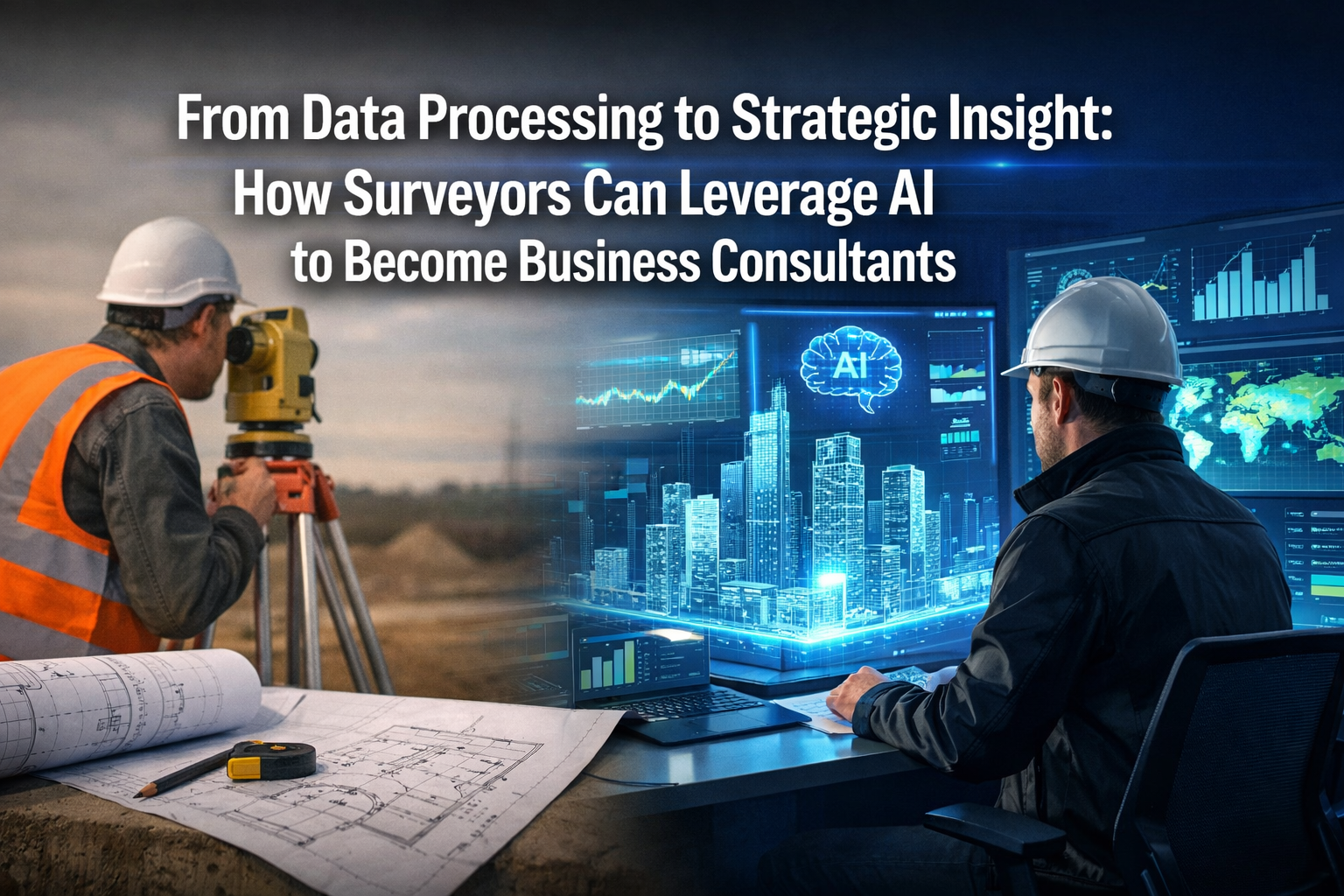
The surveying profession stands at a pivotal crossroads in 2026. As artificial intelligence rapidly automates routine data classification and anomaly detection tasks that once consumed hours of professional time, property surveyors face a critical choice: resist the technological tide or embrace it as a catalyst for professional evolution. The path forward is clear—from data processing to strategic insight: how surveyors can leverage AI to become business consultants represents not just an opportunity but a necessity for remaining relevant and valuable in an increasingly competitive marketplace.
Traditional surveying has long been characterized by meticulous data collection, detailed property inspections, and comprehensive report writing. While these technical skills remain foundational, they no longer differentiate exceptional surveyors from adequate ones. The real value proposition in 2026 lies in what surveyors do with the data after AI systems have processed it. By redirecting expertise from manual data entry toward interpreting what findings mean for clients' investment decisions, risk management strategies, and long-term property portfolios, surveyors can transform themselves from technical service providers into indispensable strategic advisors.
Key Takeaways
✅ AI automation frees surveyors from routine data processing tasks, creating capacity for high-value strategic consulting work that commands premium fees
✅ Strategic interpretation skills become the primary differentiator as AI handles technical analysis, allowing surveyors to focus on business implications and client advisory services
✅ Nearly 90% of executives recognize that agentic AI will fundamentally impact their organizations, creating unprecedented demand for professionals who can bridge technical data and business strategy[5]
✅ Successful transformation requires deliberate skill development in business acumen, client communication, financial analysis, and strategic thinking beyond traditional surveying competencies
✅ Top-down AI integration with focused investments in high-ROI workflows delivers better results than scattered technology adoption efforts[2]
Understanding the AI Revolution in Property Surveying

The Current State of AI in Surveying Practice
Artificial intelligence has moved from experimental technology to practical tool within the surveying profession. In 2026, AI-driven precision in property surveying is revolutionizing workflows across multiple dimensions[1]. Machine learning algorithms now automatically identify structural defects in photographs, classify damp patterns from thermal imaging, and flag potential subsidence indicators that might escape cursory human review.
Key AI applications currently transforming surveying include:
- 🤖 Automated defect detection from digital photographs and drone imagery
- 📊 Pattern recognition in historical property data to predict maintenance issues
- 🔍 Anomaly identification in moisture readings, thermal scans, and structural measurements
- 📝 Natural language processing for initial report drafting and standardized documentation
- 📈 Predictive analytics for property condition forecasting and lifecycle planning
The technology doesn't replace the surveyor's expertise—it amplifies it. Where a building surveyor might previously spend three hours manually cataloging defects from a condition survey report, AI systems now complete this classification in minutes, freeing the professional to focus on interpretation and strategic recommendations.
Why Automation Creates Consulting Opportunities
The counterintuitive reality is that automation doesn't diminish professional value—it elevates it. As AI handles increasingly sophisticated technical tasks, the human element becomes more critical, not less. Clients don't ultimately purchase survey reports; they purchase peace of mind, informed decision-making capability, and strategic guidance.
Consider the evolution of financial services. When automated trading systems emerged, many predicted the obsolescence of financial advisors. Instead, the profession evolved. The most successful advisors stopped focusing on stock picking (increasingly automated) and concentrated on holistic financial planning, behavioral coaching, and strategic wealth management. Surveyors face a parallel opportunity.
"Enterprise AI strategy success requires top-down, focused investments in high-ROI workflows rather than crowdsourced AI efforts. Organizations that strategically deploy AI agents to automate parts of complex, high-value workflows see transformational results."[2]
This principle applies directly to surveying practices. Rather than viewing AI as a threat to billable hours, forward-thinking surveyors recognize it as infrastructure that enables higher-value service delivery. The time previously allocated to data processing becomes available for client consultations, strategic property portfolio reviews, and advisory services that command significantly higher fees.
The Skills Gap Between Technical Surveying and Strategic Consulting
The transition from data processor to strategic consultant requires deliberate skill development. Traditional surveying education emphasizes technical competencies: understanding building pathology, mastering measurement techniques, interpreting regulatory requirements, and producing accurate documentation. These remain essential foundations.
However, strategic consulting demands additional capabilities:
| Traditional Surveying Skills | Strategic Consulting Skills |
|---|---|
| Defect identification | Business impact analysis |
| Technical measurement | Financial implication assessment |
| Regulatory compliance | Risk-adjusted decision frameworks |
| Report writing | Executive communication |
| Property inspection | Portfolio strategy development |
| Standard documentation | Customized advisory services |
The gap between these skill sets represents both the challenge and the opportunity. Surveyors who bridge this divide position themselves as irreplaceable advisors rather than interchangeable technicians. When conducting a damp survey, for example, the technical finding might be rising damp affecting 40% of ground floor walls. The strategic insight translates this into renovation cost implications, property value impact, rental income disruption timelines, and comparative investment analysis against alternative properties.
From Data Processing to Strategic Insight: Practical Applications for Surveyors
Transforming Survey Findings into Business Intelligence
The fundamental shift in professional identity begins with reframing how surveyors conceptualize their work output. The deliverable is no longer primarily a report document—it's actionable business intelligence that drives client decisions worth hundreds of thousands or millions of pounds.
Practical transformation strategies include:
1. Investment Decision Frameworks
When clients receive survey findings, their underlying question is rarely "What defects exist?" but rather "Should I proceed with this purchase, and under what terms?" Surveyors leveraging AI to handle technical cataloging can dedicate cognitive resources to developing comprehensive investment frameworks.
For a commercial property investor reviewing a stock condition survey, the strategic consultant-surveyor provides:
- Comparative analysis against similar properties in the portfolio
- Lifecycle cost modeling for identified maintenance requirements
- Risk-adjusted valuation incorporating remediation expenses
- Timeline optimization for repair sequencing to minimize operational disruption
- Financing strategy recommendations for capital expenditure planning
2. Risk Quantification and Mitigation Planning
AI excels at identifying potential issues; human expertise excels at contextualizing their significance and developing mitigation strategies. When monitoring surveys detect movement patterns, the strategic consultant doesn't simply report measurements—they develop risk scenarios.
This might include:
- Probability assessments for different progression scenarios
- Financial impact modeling for various intervention timelines
- Insurance implication analysis
- Regulatory compliance pathways
- Stakeholder communication strategies for property developers or landlords
3. Portfolio Optimization Consulting
For clients with multiple properties, individual survey reports provide limited value compared to strategic portfolio analysis. AI's capacity to process vast datasets enables surveyors to deliver insights previously impossible at practical cost points.
A surveyor working with a property management company across London property portfolios might leverage AI to:
- Identify systemic issues across multiple properties suggesting common root causes
- Prioritize capital expenditure across the portfolio for maximum ROI
- Benchmark property performance against market comparables
- Forecast maintenance requirements for budget planning
- Develop disposition strategies for underperforming assets
Developing Client Advisory Relationships
The consultant-surveyor relationship differs fundamentally from the transactional service provider model. It's characterized by ongoing engagement, proactive communication, and collaborative problem-solving rather than one-off report delivery.
Building advisory relationships requires:
Trust Through Transparency
Modern clients appreciate understanding the AI tools supporting their surveyor's analysis. Rather than concealing automation as potentially undermining professional value, leading practitioners embrace transparency about how technology enhances their capabilities. This positions the surveyor as an innovative partner leveraging cutting-edge tools for client benefit.
Proactive Communication
Traditional surveyors respond to client requests. Strategic consultants anticipate client needs. This might mean:
- Quarterly property health reviews for key clients
- Proactive alerts when market conditions affect property strategies
- Educational sessions on emerging building pathology trends
- Regular portfolio performance briefings
Customized Strategic Planning
Generic recommendations undermine consultant positioning. Each client engagement should reflect deep understanding of specific business objectives, risk tolerance, investment timelines, and operational constraints. When advising on party wall agreements, the strategic consultant considers not just regulatory compliance but also neighbor relationship management, project timeline implications, and cost-benefit analysis of different approach strategies.
Pricing Strategies for Strategic Consulting Services
The transition from data processing to strategic insight must be reflected in fee structures. Hourly rates and fixed-price survey reports commoditize professional services and cap earning potential. Strategic consulting enables value-based pricing aligned with client outcomes.
Alternative pricing models include:
💰 Retainer Arrangements – Monthly or annual fees for ongoing advisory access, portfolio monitoring, and strategic planning support
💰 Performance-Based Fees – Compensation tied to measurable outcomes like cost savings identified, successful negotiations enabled, or portfolio value enhancement
💰 Tiered Service Packages – Basic technical survey reports at standard rates, with premium tiers offering strategic analysis, investment recommendations, and ongoing consultation
💰 Project-Based Consulting – Comprehensive fees for defined strategic engagements like portfolio optimization, acquisition due diligence, or development feasibility analysis
The key principle is aligning fees with the value delivered rather than time expended. When AI reduces data processing time from eight hours to two hours, traditional billing models penalize efficiency. Value-based pricing rewards the strategic insight that helps clients avoid costly mistakes or identify lucrative opportunities.
Implementing AI Tools While Maintaining Professional Standards
Selecting Appropriate AI Technologies for Surveying Practice
The AI landscape in 2026 offers overwhelming options. Success requires strategic selection focused on genuine practice enhancement rather than technology for its own sake. Nearly 90% of business leaders recognize that agentic AI will fundamentally impact their organizations[5], but effective deployment requires careful planning.
Evaluation criteria for AI tools include:
1. Integration with Existing Workflows
Technology that requires complete process overhaul often fails to achieve adoption. The most successful AI implementations seamlessly enhance current practices rather than disrupting them. For surveyors conducting RICS surveys, ideal AI tools integrate with existing photography equipment, measurement devices, and report templates.
2. Accuracy and Reliability Validation
AI systems must demonstrate consistent accuracy across diverse property types and conditions. This requires:
- Testing against known defect scenarios
- Comparison with expert human identification
- Performance monitoring across property age ranges, construction types, and geographic locations
- Regular calibration and updating as building materials and construction techniques evolve
3. Transparency and Explainability
"Black box" AI systems that provide conclusions without reasoning undermine professional credibility. Surveyors must be able to explain and defend their findings. Optimal AI tools provide transparent logic chains showing how conclusions were reached, enabling professional validation and client explanation.
4. Data Security and Client Confidentiality
Property surveys contain sensitive information about structural vulnerabilities, valuation factors, and owner circumstances. AI systems must incorporate robust data protection, comply with relevant privacy regulations, and provide clear data handling policies. Cloud-based systems require particular scrutiny regarding data storage locations and access controls.
5. Scalability and Cost-Effectiveness
AI investments should scale with practice growth. Solutions with prohibitive per-use costs or rigid capacity limitations constrain practice development. The most effective tools offer flexible pricing aligned with practice size and usage patterns.
Governance Frameworks for AI-Assisted Surveying
As AI becomes integral to professional practice, formal governance frameworks ensure quality, consistency, and regulatory compliance. PwC notes that agentic AI deployment requires centralized governance frameworks to manage complex workflows effectively[2].
Essential governance elements include:
📋 Quality Assurance Protocols
- Human review requirements for AI-generated findings
- Validation procedures for anomaly detection
- Calibration schedules for predictive algorithms
- Documentation standards for AI-assisted analysis
📋 Professional Liability Considerations
- Clear delineation of AI tool capabilities and limitations
- Disclosure protocols for AI use in client reports
- Professional indemnity insurance coverage verification for AI-assisted work
- Liability allocation between surveyor judgment and AI recommendations
📋 Continuous Learning and Improvement
- Feedback loops capturing AI accuracy performance
- Regular training data updates reflecting emerging building issues
- Professional development ensuring surveyors understand AI tool capabilities and constraints
- Peer review processes for complex AI-assisted analyses
📋 Ethical Guidelines
- Transparency requirements for AI use disclosure to clients
- Bias detection and mitigation in AI training data
- Equitable service delivery across property types and values
- Professional judgment primacy over automated recommendations
Training and Professional Development for AI-Enhanced Practice
The surveyor-consultant transformation requires deliberate skill development beyond traditional technical training. This encompasses both AI technology competency and strategic business capabilities.
Recommended development pathways include:
Technical AI Literacy
Understanding AI fundamentals enables informed tool selection, effective deployment, and credible client communication. This doesn't require data science expertise but should include:
- Basic machine learning concepts and capabilities
- Understanding of training data requirements and limitations
- Recognition of AI strengths (pattern recognition, data processing) and weaknesses (contextual judgment, novel situations)
- Practical experience with AI tools relevant to surveying practice
Business Strategy and Financial Analysis
Strategic consulting requires fluency in business concepts often absent from traditional surveying education:
- Financial statement analysis and property investment evaluation
- Risk assessment frameworks and decision theory
- Portfolio management principles
- Market analysis and competitive positioning
- Strategic planning methodologies
Executive Communication Skills
Translating technical findings into strategic recommendations demands different communication approaches than traditional survey reports:
- Executive summary writing focused on decisions rather than details
- Presentation skills for boardroom and client meetings
- Visualization techniques for complex data
- Persuasive communication and recommendation framing
- Active listening and consultative questioning
Client Relationship Management
Building advisory relationships requires interpersonal skills and business development capabilities:
- Consultative selling approaches
- Long-term relationship nurturing
- Value demonstration and ROI communication
- Expectation management and service delivery excellence
- Professional networking and referral development
Many surveyors find value in formal business education—MBA programs, executive certificates, or specialized courses in real estate investment, financial analysis, or strategic consulting. Others pursue mentorship relationships with established consultants or participate in peer learning groups focused on practice transformation.
The Business Case: Why Strategic Consulting Delivers Superior Returns

Revenue Enhancement Through Value-Based Services
The financial advantages of transitioning from data processing to strategic consulting extend beyond hourly rate increases. The entire business model becomes more profitable, sustainable, and scalable.
Quantifiable benefits include:
Higher Average Transaction Values
Strategic consulting engagements typically command fees 3-5 times higher than equivalent technical survey reports. A standard homebuyers survey might generate £800-1,200. The same property evaluated within a comprehensive investment analysis framework, including comparable property assessment, renovation cost-benefit analysis, and portfolio fit evaluation, justifies £3,000-5,000 fees.
Recurring Revenue Streams
One-off survey commissions create revenue volatility and constant business development pressure. Advisory retainers with property investors, developers, or management companies provide predictable recurring revenue. A portfolio of 20 retainer clients at £500-2,000 monthly generates £120,000-480,000 annual baseline revenue before project work.
Reduced Price Sensitivity
Clients purchasing strategic advice demonstrate lower price sensitivity than those buying commoditized technical reports. When surveyors demonstrate clear ROI through cost savings identified, successful negotiations enabled, or investment risks avoided, fees become investments rather than expenses. This enables premium positioning resistant to price competition.
Improved Client Lifetime Value
Advisory relationships extend client engagement duration. Rather than single transaction interactions, consultant-surveyors maintain client relationships across multiple properties and years. A client who initially engages for a single property survey might become a long-term advisor relationship worth £50,000+ over five years through ongoing consultation, portfolio reviews, and repeat project work.
Competitive Differentiation in a Crowded Market
The surveying profession faces increasing commoditization pressure. Online platforms, automated valuation models, and price-competitive practices erode margins for undifferentiated technical services. Strategic consulting provides defensible competitive positioning.
Differentiation advantages include:
🎯 Unique Value Proposition
Most surveyors offer functionally identical services—property inspections and standardized reports. Strategic consultants offer customized business intelligence and decision support that can't be easily replicated or compared on price alone.
🎯 Reduced Competition
While thousands of surveyors compete for standard survey commissions, far fewer position themselves as strategic property advisors. This reduces competitive intensity and enables premium pricing.
🎯 Enhanced Referral Quality
Clients who receive strategic value become enthusiastic advocates, generating higher-quality referrals. Rather than price-shopping prospects, referred clients arrive predisposed to value and willing to pay appropriate fees for strategic guidance.
🎯 Barrier to Entry
Developing strategic consulting capabilities requires significant investment in skills, experience, and reputation that new entrants can't quickly replicate. This creates sustainable competitive advantages.
Scalability Through Leverage and Specialization
Traditional surveying faces scalability constraints—professional time limits revenue potential. Strategic consulting, enhanced by AI automation, enables greater leverage and scalability.
Scalability mechanisms include:
Technology Leverage
AI systems handling routine data processing enable each surveyor to serve more clients without proportional time increases. Where traditional practice might accommodate 8-10 comprehensive surveys monthly, AI-enhanced practice can deliver 15-20 while maintaining quality and adding strategic analysis.
Team Specialization
Strategic consulting practices can employ tiered team structures: junior staff handling AI-supervised data collection and processing, mid-level professionals conducting analysis and initial client consultation, senior consultants focusing exclusively on strategic advisory and key client relationships. This enables revenue growth without senior professional time constraints.
Productized Services
Standardized strategic consulting offerings—portfolio health assessments, acquisition due diligence packages, development feasibility studies—can be systematized and delivered efficiently while maintaining customization and value. This combines scalability benefits of standardization with premium pricing of customized services.
Geographic Expansion
AI-enabled remote analysis capabilities reduce geographic constraints. A surveyor-consultant in Richmond can serve clients in Bromley, Kingston, or Ealing without proportional travel time, expanding addressable markets and client bases.
Overcoming Barriers to Transformation
Addressing Professional Identity and Mindset Challenges
The transition from technical specialist to strategic consultant requires fundamental identity shifts that many surveyors find psychologically challenging. Professional identity often centers on technical mastery—the ability to identify obscure defects, interpret complex building pathology, and produce meticulous documentation.
Common mindset barriers include:
Imposter Syndrome
Many surveyors question their qualifications to provide business advice, feeling more comfortable with technical assessments than strategic recommendations. This often reflects educational backgrounds emphasizing technical competencies while neglecting business skills.
Overcoming this barrier requires: Recognizing that strategic property advice requires deep technical understanding—surveyors possess foundational expertise that pure business consultants lack. The combination of technical knowledge and developed business acumen creates unique value that neither pure technicians nor generic consultants can match.
Fear of Technology Displacement
Some surveyors view AI as threatening professional relevance rather than enabling professional evolution. This defensive posture leads to technology resistance that ultimately accelerates obsolescence.
Overcoming this barrier requires: Reframing AI as professional infrastructure rather than competition. Just as modern surveyors don't view digital cameras as threatening because they replaced film, AI tools are instruments that enhance rather than replace professional judgment.
Comfort Zone Attachment
Established practices and familiar work patterns provide psychological comfort. Strategic consulting requires uncomfortable learning curves, unfamiliar client interactions, and new service delivery models.
Overcoming this barrier requires: Incremental transformation rather than abrupt practice overhaul. Surveyors can introduce strategic elements gradually—adding investment analysis to standard reports, offering follow-up consultation calls, developing specialized advisory services for specific property types—building confidence and capabilities progressively.
Managing Client Expectations During Service Evolution
Existing clients accustomed to traditional survey services may initially resist expanded strategic offerings or higher fees. Managing this transition requires clear communication and demonstrated value.
Effective transition strategies include:
Educational Marketing
Help clients understand the limitations of pure technical reports and the value of strategic analysis. This might include:
- Case studies demonstrating how strategic insights prevented costly mistakes or identified lucrative opportunities
- Educational content explaining the difference between defect cataloging and investment analysis
- Transparent discussion of how AI enhances service quality and enables deeper strategic work
Grandfathering and Transition Pricing
Existing clients might receive transitional pricing or service packages that introduce strategic elements while maintaining some traditional service aspects. This enables gradual value demonstration without abrupt fee increases that trigger resistance.
Pilot Programs
Offering strategic consulting services to select clients on trial basis provides proof-of-concept and testimonials that facilitate broader rollout. Early adopters who experience tangible value become advocates for expanded services.
Clear Value Articulation
Every strategic recommendation should include explicit value quantification when possible. Rather than simply suggesting renovation sequencing, demonstrate how the recommended approach saves £15,000 in contractor costs or reduces rental income disruption by three months. Concrete ROI demonstration justifies premium fees and builds client appreciation for strategic value.
Regulatory and Professional Standards Considerations
Professional surveying operates within regulatory frameworks and industry standards that may not explicitly address AI use or strategic consulting services. Navigating this landscape requires careful attention to professional obligations.
Key considerations include:
Professional Indemnity Insurance
Standard professional indemnity policies cover technical surveying services but may not explicitly address strategic business consulting. Surveyors expanding into advisory services should:
- Review policy terms with insurers to confirm coverage
- Disclose service evolution and obtain explicit coverage confirmation
- Consider specialized business consulting insurance if necessary
- Maintain clear documentation distinguishing technical findings from strategic recommendations
RICS Standards and Guidance
The Royal Institution of Chartered Surveyors provides professional standards that govern member conduct. While these standards don't prohibit strategic consulting, they require:
- Competence in services offered
- Clear client communication about service scope
- Professional skepticism and independence
- Appropriate qualifications and experience for advice provided
Surveyors should ensure strategic consulting services align with professional standards and that they possess or develop requisite competencies.
Scope of Practice Clarity
Clear engagement letters and service agreements should explicitly define what services include—technical property assessment, strategic business advice, or both. This manages client expectations and provides liability protection by establishing agreed service boundaries.
Continuing Professional Development
Professional standards typically require ongoing education and skill development. Surveyors expanding into strategic consulting should document relevant training, education, and experience development to demonstrate competence in expanded service areas.
Future-Proofing Your Surveying Career in the AI Era
Emerging Trends Shaping the Profession
Understanding trajectory helps surveyors position themselves advantageously for long-term success. Several converging trends will define surveying's evolution through the remainder of the 2020s and beyond.
Key trends include:
Predictive and Prescriptive Analytics
Current AI applications largely focus on descriptive analytics—identifying what exists. Emerging capabilities enable predictive analytics (forecasting future conditions) and prescriptive analytics (recommending optimal actions). Surveyors who master these advanced applications will command premium positioning.
For example, rather than simply identifying early-stage subsidence, AI systems will predict progression likelihood under various scenarios and prescribe optimal intervention timing and methods based on cost-benefit optimization across thousands of similar cases.
Integration with Building Information Modeling (BIM)
As BIM adoption expands beyond new construction into existing building management, surveyors who can integrate survey findings with BIM systems provide enhanced value. This enables dynamic building performance tracking, maintenance optimization, and lifecycle cost management.
Climate Change and Sustainability Consulting
Property resilience to climate change impacts—flooding, extreme weather, temperature changes—becomes increasingly critical to investment decisions. Surveyors who develop expertise in climate risk assessment, adaptation strategies, and sustainability improvements position themselves as essential advisors for forward-thinking property investors.
Regulatory Complexity Navigation
Building regulations, energy efficiency requirements, and safety standards grow increasingly complex. Strategic consultant-surveyors who help clients navigate regulatory landscapes, ensure compliance, and optimize regulatory strategy provide valuable specialized expertise.
Building a Sustainable Competitive Advantage
Long-term success requires developing defensible competitive positioning that can't be easily replicated by competitors or automated by technology.
Sustainable advantage sources include:
Deep Specialization
Rather than generalist practice, developing deep expertise in specific property types (historic buildings, commercial developments, multi-family residential) or specific strategic domains (portfolio optimization, development feasibility, investment due diligence) creates specialized knowledge that commands premium fees and reduces competition.
Reputation and Thought Leadership
Establishing recognized expertise through content creation, speaking engagements, industry participation, and published insights builds reputation that attracts clients and referrals. Thought leaders can command premium positioning based on recognized authority.
Proprietary Methodologies
Developing unique analytical frameworks, assessment methodologies, or strategic planning processes creates intellectual property that differentiates services. While individual techniques may be replicable, comprehensive proprietary systems provide sustainable differentiation.
Strategic Relationships and Networks
Building deep relationships with property investors, developers, financial institutions, and other professional advisors creates referral networks and collaborative opportunities that sustain practice growth. These relationship networks represent competitive advantages that can't be quickly replicated.
Actionable Steps for Beginning the Transformation
The journey from data processor to strategic consultant begins with deliberate first steps. Rather than overwhelming practice overhaul, incremental progress builds momentum and capabilities.
Recommended implementation sequence:
Phase 1: Foundation Building (Months 1-3)
✓ Assess current AI tools and identify highest-impact automation opportunities
✓ Implement one AI system for routine data processing or defect identification
✓ Enroll in business strategy or financial analysis course
✓ Add strategic recommendations section to standard survey reports
✓ Schedule follow-up consultation calls with willing clients to discuss findings
Phase 2: Capability Development (Months 4-6)
✓ Expand AI tool usage to additional workflow components
✓ Develop standardized strategic analysis frameworks for common property types
✓ Create case studies documenting strategic value delivered to clients
✓ Launch specialized advisory service offering (e.g., portfolio reviews, investment analysis)
✓ Adjust pricing structure to reflect strategic value components
Phase 3: Market Positioning (Months 7-9)
✓ Update marketing materials emphasizing strategic consulting capabilities
✓ Develop thought leadership content (articles, presentations, webinars)
✓ Cultivate relationships with property investors and developers
✓ Introduce retainer-based advisory services for key clients
✓ Establish governance framework for AI-assisted work quality assurance
Phase 4: Practice Transformation (Months 10-12)
✓ Achieve 40%+ revenue from strategic consulting services
✓ Build team capabilities with specialized roles for data processing vs. strategic analysis
✓ Expand geographic reach leveraging AI-enabled remote capabilities
✓ Establish industry recognition through awards, certifications, or professional leadership
✓ Develop three-year strategic plan for continued practice evolution
Conclusion

The transformation from data processing to strategic insight represents the most significant opportunity facing surveyors in 2026 and beyond. As AI systems increasingly handle routine technical tasks—defect classification, anomaly detection, pattern recognition, and initial report drafting—the professional value proposition shifts decisively toward interpretation, strategic analysis, and business advisory services.
This evolution doesn't diminish the importance of technical expertise. Rather, it elevates technical knowledge from end product to essential foundation supporting higher-value strategic consulting. The surveyors who thrive in this new landscape will be those who embrace AI as professional infrastructure while developing the business acumen, communication skills, and strategic thinking capabilities that technology cannot replicate.
The business case for transformation is compelling: higher fees, recurring revenue streams, reduced price competition, improved client relationships, and enhanced professional satisfaction. The barriers—mindset challenges, skill gaps, client education requirements—are surmountable through deliberate action and incremental progress.
Nearly 90% of business leaders recognize that AI will fundamentally transform their organizations[5]. Property investors, developers, and managers increasingly demand advisors who can bridge technical property knowledge and strategic business insight. Surveyors uniquely positioned at this intersection can capture extraordinary value by evolving their professional identity and service delivery.
Next Steps: Your Action Plan
The journey begins today with commitment to professional evolution and concrete first steps:
-
Evaluate your current practice honestly—what percentage of time goes to data processing vs. strategic analysis? Where do AI tools offer immediate automation opportunities?
-
Invest in one AI technology that addresses your highest-volume routine task, freeing capacity for strategic work
-
Develop one new strategic capability—enroll in a business course, create an investment analysis framework, or design a portfolio review service
-
Have strategic conversations with three current clients, exploring their broader property objectives beyond immediate survey needs
-
Commit to continuous learning—schedule monthly professional development focused on business strategy, financial analysis, or executive communication
-
Join or create a peer learning group with other surveyors pursuing similar transformation, sharing experiences and supporting mutual growth
The surveying profession's future belongs to those who recognize that AI doesn't threaten professional relevance—it enables professional evolution toward higher-value, more impactful, and more rewarding strategic consulting roles. The technical foundation remains essential, but the value proposition increasingly centers on what surveyors do with data rather than how they collect it.
From data processing to strategic insight: how surveyors can leverage AI to become business consultants isn't merely a career option—it's the pathway to remaining indispensable in an AI-enhanced world. The question isn't whether to transform, but how quickly and effectively you'll embrace the opportunity.
For surveyors ready to begin this journey, whether you're practicing in Hammersmith, Lewisham, or anywhere across the property landscape, the time to act is now. The technology exists, the market demand is growing, and the competitive advantage awaits those bold enough to claim it.
References
[1] Ai Driven Precision In Property Surveying How Artificial Intelligence Is Revolutionizing Workflows In 2026 – https://nottinghillsurveyors.com/blog/ai-driven-precision-in-property-surveying-how-artificial-intelligence-is-revolutionizing-workflows-in-2026
[2] Ai Predictions – https://www.pwc.com/us/en/tech-effect/ai-analytics/ai-predictions.html
[3] Big Cities Plan Hiring Ai Expansion In 2026 Surveys Show – https://www.thestreet.com/economy/big-cities-plan-hiring-ai-expansion-in-2026-surveys-show
[4] Big Cities Plan Hiring Ai 212345463 – https://www.aol.com/finance/big-cities-plan-hiring-ai-212345463.html
[5] Hb How Executives Are Thinking About Ai Heading Into 2026 – https://hbr.org/2026/01/hb-how-executives-are-thinking-about-ai-heading-into-2026
[6] State Of Ai In The Enterprise – https://www.deloitte.com/us/en/what-we-do/capabilities/applied-artificial-intelligence/content/state-of-ai-in-the-enterprise.html