
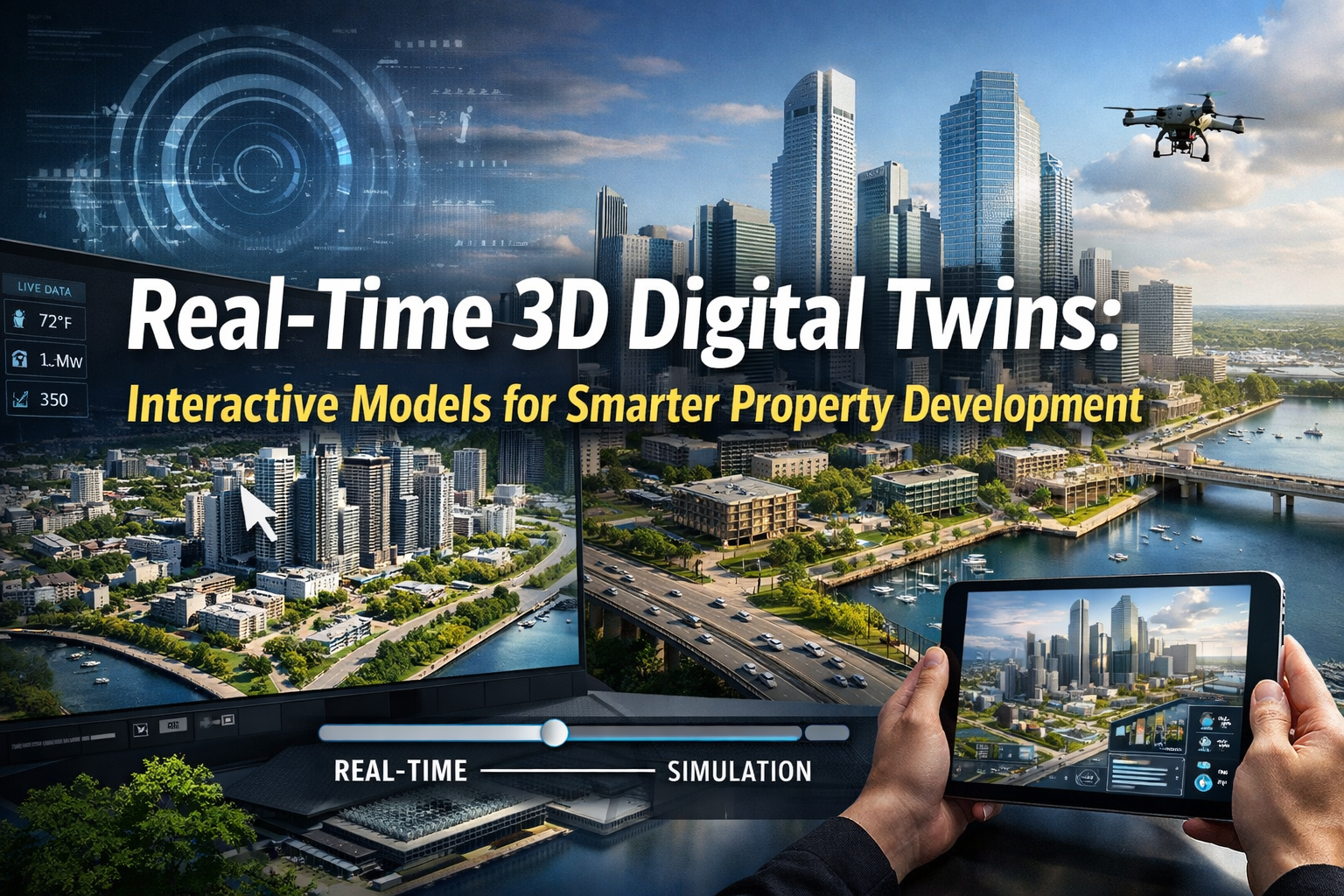
Imagine walking through a building that hasn't been constructed yet, adjusting the lighting in real-time, checking how the HVAC system responds to occupancy changes, and predicting maintenance issues years before they occur—all from your computer or mobile device. This isn't science fiction; it's the reality of Real-Time 3D Digital Twins: Interactive Models for Smarter Property Development in 2026. Unlike traditional architectural renderings that capture a single frozen moment in time, digital twins are living, breathing models that continuously update with real-world data, transforming how developers, planners, and property managers approach every stage of the building lifecycle.
The property development landscape has fundamentally shifted from static blueprints and one-time visualizations to dynamic, data-driven ecosystems. Real-time 3D digital twins represent this evolution—sophisticated virtual replicas that maintain constant connections to physical assets through sensors, IoT devices, and cloud-based platforms. These interactive models don't just show what a property looks like; they simulate how it behaves under various conditions, predict future performance, and enable collaborative decision-making across multiple stakeholders simultaneously.
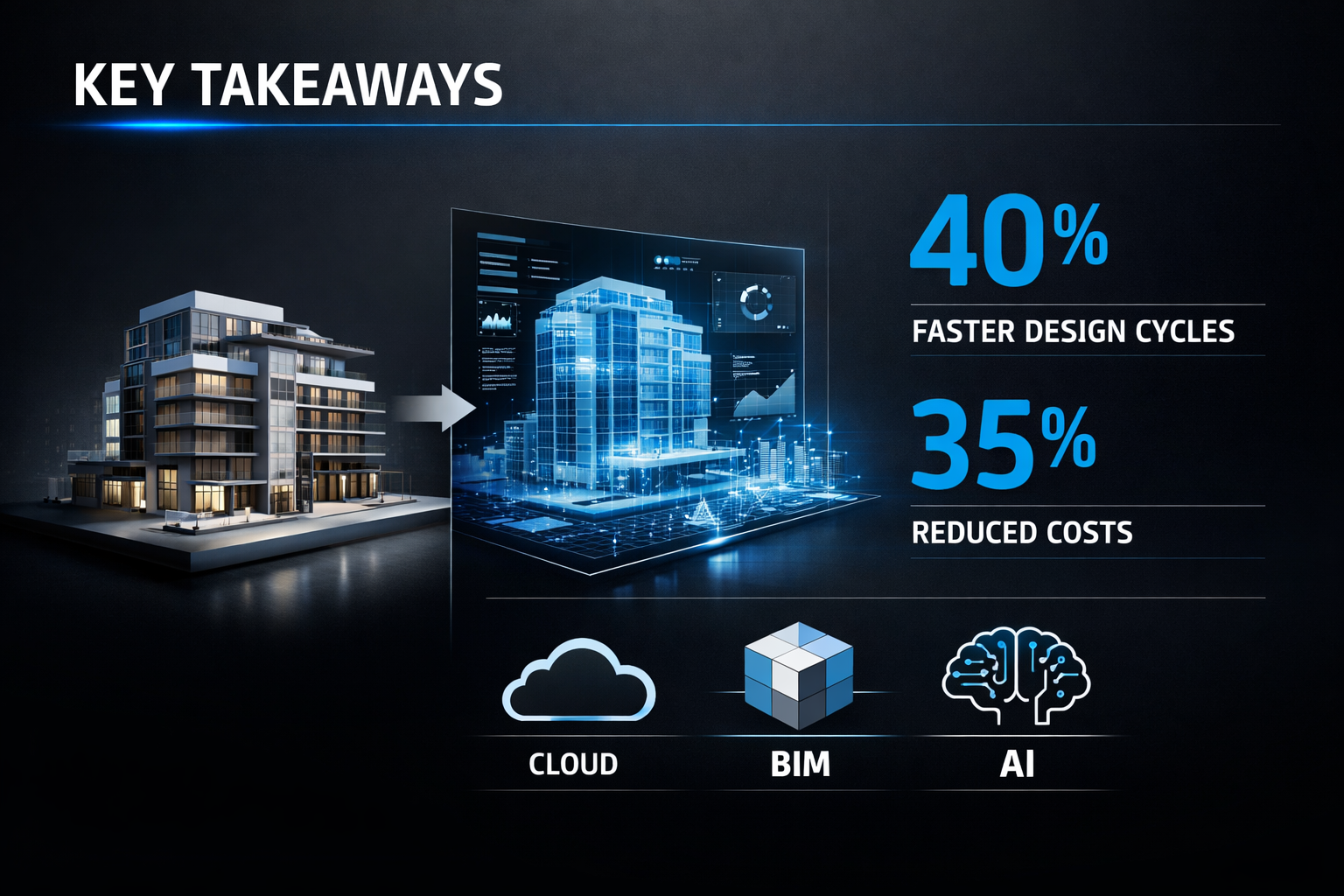
Key Takeaways
- Real-time data integration distinguishes digital twins from static 3D models by continuously updating with live sensor feeds, operational metrics, and environmental conditions rather than presenting fixed snapshots[1]
- Cloud-based collaboration platforms enable developers, city planners, architects, and stakeholders to simultaneously examine projects with their specific concerns visible, eliminating traditional planning fragmentation[1]
- Predictive capabilities powered by AI and machine learning allow digital twins to forecast equipment failures, optimize energy consumption, and simulate climate scenarios before construction begins[2]
- Extended reality (XR) integration through AR and VR technologies provides immersive exploration for buyers, construction workers, and facility managers, accelerating pre-sales and improving construction accuracy[1][2]
- Mission-critical sectors including healthcare, higher education, social housing, and large commercial portfolios are leading 2026 adoption due to operational complexity requirements[4]
Understanding Real-Time 3D Digital Twins: Interactive Models for Smarter Property Development
What Makes Digital Twins "Real-Time"?
The fundamental distinction between traditional 3D architectural models and real-time digital twins lies in their relationship with data. A conventional rendering presents a beautiful but static vision—a snapshot of what a building might look like at completion. In contrast, digital twins maintain continuous connections to data sources and update accordingly, creating living models that evolve with their physical counterparts[1].
This real-time capability stems from several technological components working in concert:
🔌 IoT Sensor Networks: Building-embedded sensors monitor heat, moisture, occupancy, air quality, energy consumption, and structural integrity. These devices feed constant streams of data into the digital twin, ensuring the virtual model reflects current physical conditions[3].
☁️ Cloud Infrastructure: Cloud-based platforms process massive data volumes from multiple sources simultaneously, enabling instant updates across all connected devices and stakeholders. This architecture supports the collaborative features that make digital twins transformative for property development[1].
🤖 AI and Machine Learning: Advanced algorithms analyze incoming data patterns, identify anomalies, predict future states, and optimize building performance automatically. The convergence of AI, machine learning, and IoT technologies has transformed digital twins into dynamic tools with predictive capabilities that extend far beyond static 3D models[2].
🔄 Bidirectional Data Flow: Unlike one-way monitoring systems, digital twins enable bidirectional communication. Changes made in the virtual model can trigger actions in the physical building, while physical changes immediately update the virtual representation.
For property developers working with London property surveyors, this real-time integration means assessment data, structural evaluations, and condition reports can feed directly into digital twin platforms, creating comprehensive property intelligence systems.
The Evolution from BIM to Digital Twins
Building Information Modeling (BIM) laid essential groundwork for digital twin technology, but the two serve different purposes. BIM primarily focuses on design and construction phases, creating detailed 3D models with embedded information about materials, specifications, and construction sequences. Digital twins extend this concept throughout the entire building lifecycle, incorporating operational data, maintenance records, and performance metrics long after construction completes[5].
The 2026 AEC (Architecture, Engineering, Construction) technology landscape shows this evolution clearly:
| Aspect | Traditional BIM | Real-Time Digital Twins |
|---|---|---|
| Data Type | Static design specifications | Live operational data streams |
| Lifecycle Phase | Design and construction | Entire building lifecycle |
| Update Frequency | Manual revisions | Continuous real-time updates |
| Primary Users | Architects and engineers | Multi-stakeholder collaboration |
| Predictive Capability | Limited to design scenarios | AI-powered performance forecasting |
| Integration | Isolated project files | Cloud-connected ecosystem |
This transformation enables property developers to make informed decisions based on actual building behavior rather than theoretical projections. When combined with comprehensive RICS property valuations, digital twins provide unprecedented accuracy in assessing property worth based on operational performance data.
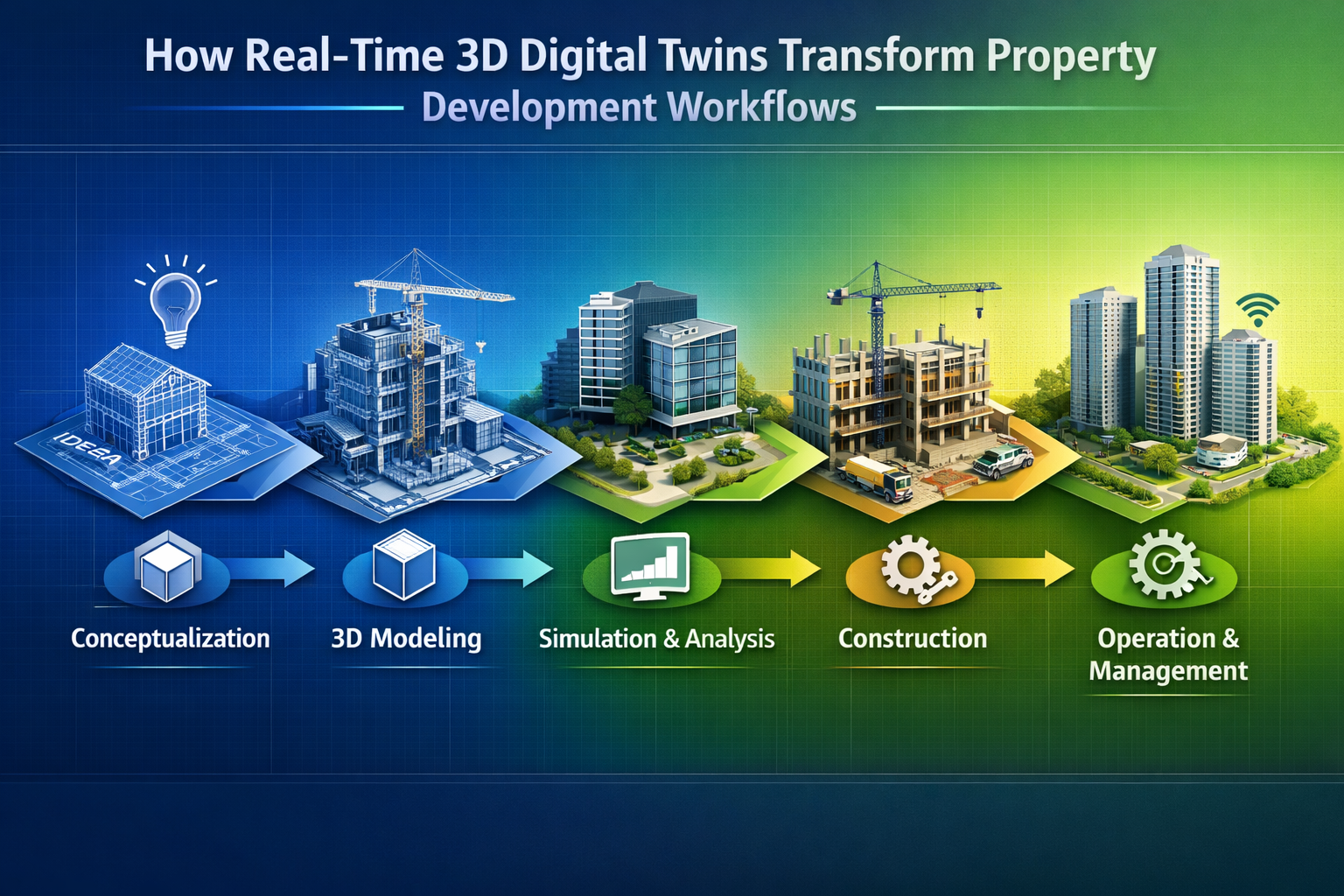
How Real-Time 3D Digital Twins Transform Property Development Workflows
Pre-Development Planning and Feasibility Analysis
Before breaking ground, developers face critical questions: Will this project meet market demand? How will it perform under various climate scenarios? What operational costs can tenants expect? Real-time 3D digital twins address these uncertainties by simulating land and building behavior under diverse conditions.
🌍 Environmental Impact Modeling: Digital twins integrate geographical data, climate projections, and environmental regulations to simulate how proposed developments interact with their surroundings. Developers can test different building orientations, materials, and systems to optimize energy efficiency and minimize environmental impact before committing to designs[1].
📊 Market Validation Through Virtual Pre-Sales: One of the most powerful applications involves allowing potential buyers to explore properties before construction begins. Prospective tenants can walk through virtual apartments with accurate lighting, textures, and spatial relationships, selecting finishing options and furniture arrangements. This capability reduces market uncertainty and provides validated demand data before significant construction commitments[1].
💰 Financial Modeling with Operational Data: Traditional feasibility studies rely on historical averages and industry benchmarks. Digital twins incorporate real-time data from similar properties—actual energy consumption patterns, maintenance costs, and occupancy rates—to generate more accurate financial projections. This precision helps developers secure financing and set realistic expectations with investors.
🏗️ Regulatory Compliance Simulation: Digital twins can model compliance with building codes, accessibility requirements, and environmental regulations, identifying potential issues during the planning phase rather than during construction when changes are exponentially more expensive.
Property developers working across different areas benefit from location-specific insights; for instance, teams working with Kingston property surveyors can incorporate local soil conditions, flood risk data, and neighborhood characteristics into their digital twin simulations.
Construction Phase Optimization
Once development proceeds, digital twins continue providing value through construction monitoring and coordination:
📱 AR-Enhanced Construction Accuracy: Construction workers equipped with AR headsets can view digital twins aligned with physical sites, displaying installation instructions, utility locations, and quality checkpoints directly in their field of vision. This technology reduces errors, minimizes rework, and accelerates construction timelines[1][2].
🔍 Progress Tracking and Quality Control: Regular site scans (using drones, laser scanners, or photogrammetry) compare actual construction progress against the digital twin model, automatically identifying discrepancies. Project managers receive instant alerts when work deviates from specifications, enabling immediate corrective action.
🤝 Stakeholder Communication: The digital twin serves as a single source of truth for all project participants. Architects, engineers, contractors, and owners access the same model, reducing miscommunication and coordination conflicts. When issues arise, teams can collaboratively explore solutions within the virtual environment before implementing physical changes.
⚡ Just-in-Time Material Delivery: By tracking construction progress in real-time, digital twins optimize material delivery schedules, reducing on-site storage requirements and minimizing waste from damaged or obsolete materials.
Post-Construction Operations and Facility Management
The operational phase represents where digital twins deliver the most sustained value over decades of building life:
🔧 Predictive Maintenance: Digital twins connected to IoT sensors can predict equipment failures before they occur. When HVAC system performance begins deviating from normal patterns, the system schedules proactive maintenance, reducing downtime and extending equipment lifespan[2]. This capability is particularly valuable for complex properties where unexpected failures disrupt operations and generate significant costs.
⚡ Energy Efficiency Optimization: Real-time insights into energy consumption, occupancy rates, and mechanical systems enable continuous optimization. The digital twin identifies inefficiencies—such as spaces being heated or cooled when unoccupied—and automatically adjusts settings or alerts facility managers to make changes[2]. These optimizations support both cost savings and environmental impact reduction.
📈 Space Utilization Analysis: For commercial properties, understanding how tenants actually use space informs renovation decisions and lease negotiations. Digital twins track occupancy patterns, identifying underutilized areas that could be reconfigured or repurposed to generate additional revenue.
🌡️ Climate Adaptation and Retrofitting: As climate change intensifies, real estate owners use digital twins to adapt buildings to new conditions and retrofit older structures for better efficiency[3]. The models simulate various adaptation strategies, predicting their effectiveness before implementation.
Property managers coordinating with specialists like Wimbledon property surveyors can integrate survey findings directly into digital twin platforms, creating comprehensive maintenance and improvement roadmaps.
Cloud-Based Collaboration: Breaking Down Development Silos
Multi-Stakeholder Access and Simultaneous Review
Traditional property development involves sequential handoffs between specialists—architects complete designs, engineers review structural feasibility, city planners assess regulatory compliance, environmental consultants evaluate impact, and financial analysts project returns. This fragmented approach creates delays, miscommunication, and costly revisions when conflicts emerge late in the process.
Cloud-based digital twin platforms fundamentally transform this workflow by creating unified models where multiple stakeholders can simultaneously examine projects with their specific concerns visible[1]. A city planner can review traffic impact while a developer explores unit layouts and an environmental agency assesses stormwater management—all within the same model, at the same time.
This collaborative approach offers several advantages:
✅ Reduced Review Cycles: Instead of waiting weeks for sequential approvals, stakeholders provide concurrent feedback, dramatically accelerating approval timelines.
✅ Conflict Resolution in Virtual Space: When competing interests arise—such as maximizing unit count versus preserving green space—teams can explore alternatives within the digital twin, visualizing trade-offs before committing to solutions.
✅ Transparent Decision-Making: All stakeholders view the same data and visualizations, reducing information asymmetry and building trust among parties with different objectives.
✅ Remote Participation: Cloud access enables global teams to collaborate without travel requirements, supporting distributed expertise and reducing project carbon footprints.
Role-Based Permissions and Data Security
While collaboration requires openness, commercial sensitivity and regulatory compliance demand controlled access. Modern digital twin platforms implement sophisticated permission systems that grant stakeholders access to relevant information while protecting proprietary data.
🔐 Granular Access Controls: Developers can share design visualizations with prospective buyers while restricting access to cost data, engineering specifications, or competitive intelligence.
📋 Audit Trails: Cloud platforms maintain comprehensive logs of who accessed what information and when, supporting compliance with data protection regulations and providing accountability for decisions.
🛡️ Secure Collaboration Spaces: Different project phases or stakeholder groups can work within isolated environments that share common base models but maintain separate annotations, analyses, and communications.
For property professionals handling sensitive client information, such as those providing property valuation services, these security features ensure confidential assessments remain protected while still benefiting from digital twin integration.
Integration with Existing Property Technology Ecosystems
Digital twins don't operate in isolation—they integrate with existing property technology systems to create comprehensive management ecosystems:
🏢 Building Management Systems (BMS): Direct connections to HVAC, lighting, security, and other building systems enable digital twins to both monitor and control physical assets.
📊 Enterprise Resource Planning (ERP): Financial data, procurement records, and maintenance schedules flow between ERP systems and digital twins, connecting physical building performance with business operations.
📱 Tenant Experience Platforms: Occupant feedback, service requests, and amenity usage data enrich digital twins with human behavioral insights that pure sensor data cannot capture.
🗺️ Geographic Information Systems (GIS): Integration with GIS platforms provides neighborhood context, infrastructure connections, and regional planning considerations that influence property development decisions.
This interconnected ecosystem creates a single source of truth that spans from individual building components to portfolio-level analytics, enabling data-driven decision-making at every scale.
Industry Applications and 2026 Adoption Trends
Mission-Critical Sectors Leading Adoption
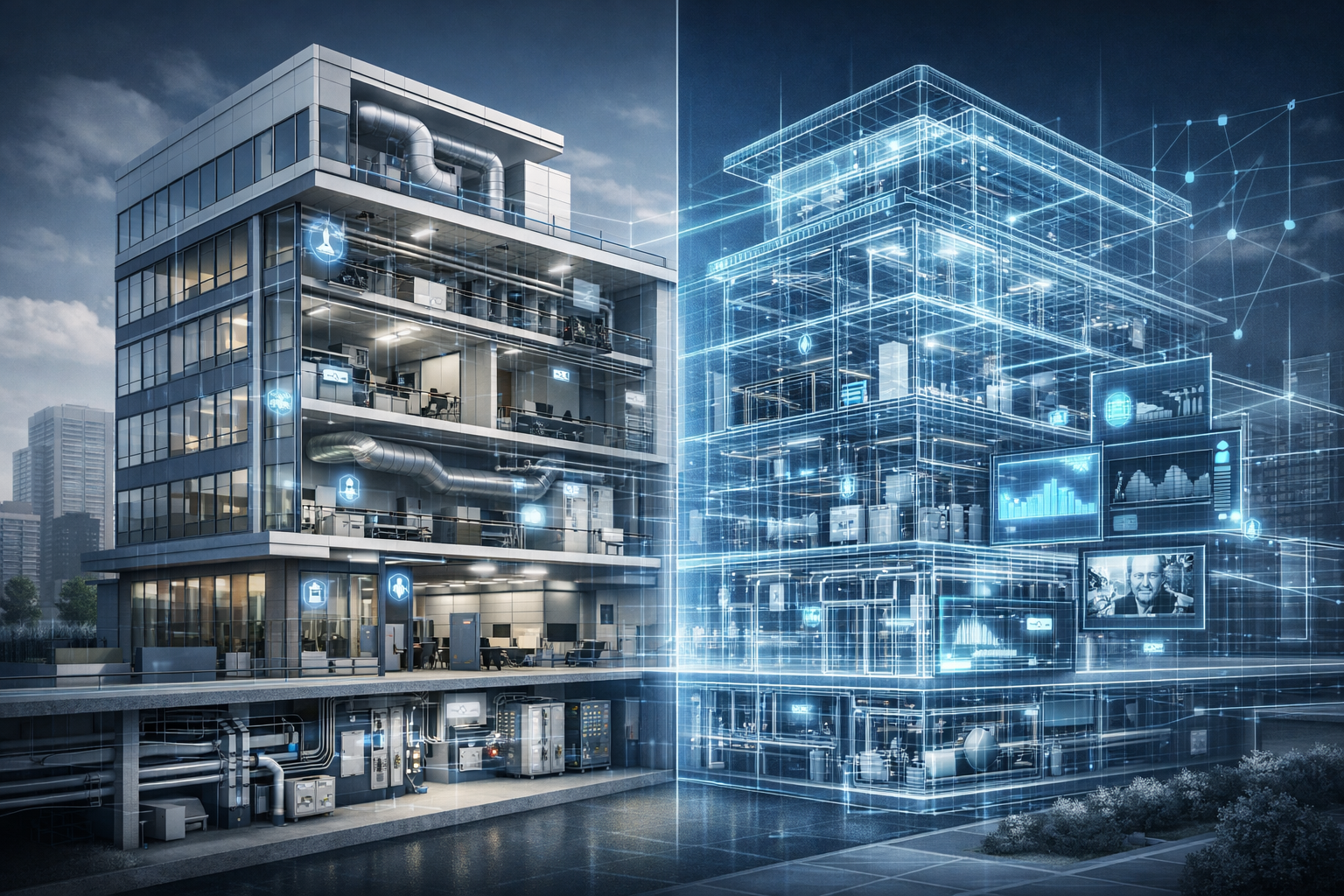
While digital twin technology offers benefits across all property types, 2026 operational adoption is concentrated in mission-critical sectors where buildings are operationally complex and performance directly impacts organizational objectives[4]:
🏥 Healthcare Facilities: Hospitals and medical centers use digital twins to optimize patient flow, maintain critical environmental conditions (temperature, humidity, air quality), predict equipment failures in life-support systems, and plan expansions without disrupting ongoing operations. The stakes are literally life-and-death, making predictive capabilities invaluable.
🎓 Higher Education Campuses: Universities manage diverse building portfolios with varying usage patterns, seasonal occupancy fluctuations, and aging infrastructure. Digital twins help optimize energy consumption across campuses, plan maintenance during academic breaks, and simulate renovation impacts on student experience.
🏘️ Social Housing Portfolios: Housing authorities responsible for thousands of units use digital twins to prioritize maintenance investments, identify properties requiring climate adaptation, and demonstrate accountability to residents and regulators through transparent performance data.
🏢 Large Commercial Real Estate: Office towers, shopping centers, and mixed-use developments leverage digital twins for tenant attraction (virtual tours), operational efficiency (energy optimization), and asset management (predictive maintenance across complex mechanical systems).
These sectors share common characteristics: operational complexity, long-term ownership horizons, regulatory oversight, and significant consequences from system failures. Digital twins address all these factors simultaneously.
Residential Development and Pre-Sales Acceleration
Beyond mission-critical facilities, residential developers are discovering digital twins' power to accelerate sales and reduce market risk:
🏠 Virtual Showrooms: Instead of building expensive physical model units, developers create photorealistic digital twins that buyers can explore remotely. Prospective owners customize finishes, furniture, and layouts, visualizing their future homes with unprecedented accuracy[1].
🎨 Design Customization: Digital twins enable mass customization within standardized floor plans. Buyers select from approved options (flooring, cabinetry, fixtures), and the system automatically generates updated visualizations and cost adjustments, streamlining the sales process.
📍 Neighborhood Integration: Digital twins can incorporate surrounding context—views from windows, natural lighting at different times of day, noise levels from nearby streets—helping buyers understand not just the unit but the living experience.
💳 Reduced Sales Cycles: By providing comprehensive virtual experiences, digital twins reduce the time buyers need for decision-making and minimize post-purchase regret, accelerating sales velocity and improving customer satisfaction.
Developers working with residential property advice specialists can integrate expert guidance directly into digital twin platforms, providing buyers with professional insights during their virtual explorations.
Retrofit and Adaptive Reuse Projects
Some of the most compelling digital twin applications involve existing buildings rather than new construction:
♻️ Historic Building Preservation: Digital twins document historic structures in precise detail, supporting preservation efforts while enabling careful modernization. Architects can simulate interventions virtually, ensuring changes respect heritage values while meeting contemporary performance standards.
🔄 Conversion Projects: Converting office buildings to residential use, warehouses to creative spaces, or retail to mixed-use requires understanding existing conditions and predicting how modifications will perform. Digital twins capture as-built conditions through laser scanning, then simulate proposed changes before physical work begins.
🌱 Sustainability Retrofits: Building owners targeting net-zero emissions use digital twins to model various retrofit strategies—improved insulation, window replacement, renewable energy integration, HVAC upgrades—comparing costs, performance improvements, and payback periods before selecting approaches.
📐 Space Reconfiguration: As workplace requirements evolve, commercial landlords use digital twins to simulate different space configurations, testing how changes affect circulation, natural light, mechanical system capacity, and tenant appeal.
For properties requiring detailed condition assessments before retrofit planning, services like those offered by Chiswick property surveyors provide essential baseline data that feeds into digital twin models.
Technical Components Enabling Real-Time Digital Twins
Sensor Technologies and IoT Integration
The "real-time" aspect of digital twins depends entirely on continuous data collection from physical assets. Modern buildings incorporate diverse sensor types:
🌡️ Environmental Sensors: Temperature, humidity, CO2 levels, air quality, and light intensity sensors monitor conditions throughout buildings, ensuring comfort and identifying system inefficiencies.
⚡ Energy Meters: Granular energy monitoring at the circuit, floor, or equipment level reveals consumption patterns and identifies optimization opportunities that aggregate utility bills obscure.
💧 Water and Leak Detection: Flow meters and moisture sensors detect leaks immediately, preventing water damage and reducing waste. Some systems can automatically shut off water when leaks are detected.
🚶 Occupancy Sensors: Passive infrared, ultrasonic, or camera-based systems track space utilization, informing HVAC and lighting controls while providing data for space planning decisions.
🔊 Acoustic Monitoring: Sound level sensors identify noise issues in residential buildings or monitor equipment for unusual sounds that indicate mechanical problems.
🏗️ Structural Health Monitoring: Strain gauges, vibration sensors, and tilt meters detect structural movements in tall buildings, bridges, or structures in seismically active areas, providing early warning of potential issues.
These sensors generate massive data volumes—a single large building might produce millions of data points daily. Cloud platforms process this information, filtering noise, identifying patterns, and updating digital twin models in real-time.
Data Processing and Analytics Platforms
Raw sensor data requires sophisticated processing to become actionable intelligence:
🧠 Edge Computing: Some processing occurs at the building level (the "edge") rather than sending all data to cloud servers. Edge devices filter irrelevant information, respond to time-critical situations (like fire alarms), and reduce bandwidth requirements.
☁️ Cloud Analytics: Centralized platforms aggregate data from multiple buildings, enabling portfolio-level insights and cross-property comparisons. Machine learning algorithms identify patterns invisible to human observers, such as subtle performance degradation that precedes equipment failure.
📊 Data Visualization: Digital twin platforms transform complex datasets into intuitive visualizations—heat maps showing energy consumption, color-coded maintenance alerts, or animated flows showing occupant movement through spaces.
🔮 Predictive Analytics: Historical data trains machine learning models to forecast future states. These predictions range from short-term (tomorrow's energy consumption based on weather forecasts) to long-term (equipment replacement schedules based on degradation rates).
⚙️ Optimization Engines: Advanced systems don't just predict—they prescribe optimal actions. For example, an optimization engine might automatically adjust HVAC schedules, lighting levels, and blind positions to minimize energy consumption while maintaining occupant comfort.
Extended Reality (XR) Interfaces
While digital twins exist as data and 3D models in computers, extended reality technologies provide immersive ways to interact with them:
🥽 Virtual Reality (VR): VR headsets transport users completely into digital twin environments. Prospective buyers explore properties as if physically present, architects review designs at full scale, and facility managers plan renovations by "walking through" proposed changes[1][2].
📱 Augmented Reality (AR): AR overlays digital twin information onto physical spaces through smartphone screens or specialized headsets. Construction workers see installation instructions aligned with actual building elements, maintenance technicians view equipment specifications and repair histories, and building operators identify assets by pointing devices at them[1][2].
🖥️ Mixed Reality (MR): Mixed reality combines VR and AR elements, allowing users to interact with virtual objects while remaining aware of physical surroundings. Designers can place virtual furniture in real rooms, testing arrangements before purchasing.
📺 Web-Based 3D Viewers: Not all digital twin interaction requires specialized hardware. Modern web browsers support sophisticated 3D visualization, enabling stakeholders to explore models from standard computers or tablets without installing software.
These interfaces democratize access to digital twin insights, making complex building data comprehensible to non-technical stakeholders and supporting broader organizational adoption.
Overcoming Implementation Challenges
Data Integration and Standardization
One of the most significant barriers to digital twin adoption involves integrating data from diverse sources with inconsistent formats, protocols, and quality levels:
🔌 Protocol Fragmentation: Building systems from different manufacturers often use proprietary communication protocols, making integration challenging. Industry standardization efforts (like BACnet for building automation) help, but legacy systems frequently require custom integration work.
📏 Data Quality Variability: Sensors vary in accuracy, calibration, and reliability. Digital twin platforms must account for this variability, filtering erroneous readings while flagging sensors requiring maintenance or replacement.
🗂️ Information Silos: Organizations often maintain separate databases for design documents, maintenance records, financial data, and operational metrics. Creating comprehensive digital twins requires breaking down these silos and establishing unified data governance.
🌐 Semantic Interoperability: Even when data is accessible, different systems may use different terminology for the same concepts. Semantic web technologies and ontologies help translate between systems, ensuring "HVAC-01" in the maintenance database corresponds to the correct equipment in the digital twin model.
Addressing these challenges requires both technical solutions (middleware, data lakes, API gateways) and organizational changes (data governance policies, cross-functional teams, executive sponsorship).
Cost Considerations and ROI Justification
Digital twin implementation requires significant upfront investment in sensors, software licenses, integration services, and staff training. Organizations need clear ROI justification:
💰 Capital Costs: Initial expenses include IoT sensors ($50-500 per sensor depending on type), software platforms ($10,000-500,000+ annually depending on building size and features), integration services ($50,000-500,000+ for complex buildings), and extended reality hardware ($300-3,000 per device).
📈 Operational Savings: Digital twins generate returns through energy savings (typically 10-30% reduction), reduced maintenance costs (predictive maintenance costs 30-50% less than reactive approaches), extended equipment life (proper maintenance extends HVAC life by 5-10 years), and reduced downtime (preventing failures that disrupt operations).
⏱️ Accelerated Sales: For developers, pre-sales acceleration and reduced market risk can justify digital twin investments even without operational benefits. Selling units months earlier significantly improves project IRR.
📊 Portfolio Effects: Organizations managing multiple properties achieve economies of scale—the marginal cost of adding buildings to existing digital twin platforms is substantially lower than initial implementation, while portfolio-level insights amplify benefits.
🎯 Phased Implementation: Rather than implementing comprehensive digital twins immediately, many organizations start with pilot projects focused on specific high-value use cases (like energy optimization or predictive maintenance for critical equipment), then expand as ROI is demonstrated.
For property investors evaluating potential acquisitions, understanding existing digital twin implementations and data infrastructure can significantly inform property purchase decisions and valuation adjustments.
Skills and Organizational Change Management
Technology alone doesn't create successful digital twin implementations—organizational readiness is equally critical:
👥 Skills Gaps: Effective digital twin management requires diverse expertise: IoT specialists who understand sensor networks, data scientists who can build predictive models, 3D modelers who create accurate visualizations, and facility managers who translate insights into operational actions. Many organizations lack these skills internally.
🎓 Training Requirements: Existing staff need training to work with digital twin platforms. Facility managers accustomed to reactive maintenance must adopt predictive approaches; property managers need to interpret performance dashboards; executives require understanding to make data-driven decisions.
🔄 Process Redesign: Digital twins enable new workflows that may conflict with established practices. Organizations must redesign processes to capitalize on real-time insights rather than forcing new technology into old workflows.
🤝 Cultural Resistance: Some stakeholders resist data-driven approaches, preferring intuition and experience. Successful implementations require change management that demonstrates value, addresses concerns, and builds buy-in across organizational levels.
📋 Governance Frameworks: Clear policies must define data ownership, access rights, decision authorities, and accountability for digital twin-informed actions. Without governance, implementations become chaotic and benefits remain unrealized.
Organizations that address these human factors alongside technical implementation achieve significantly better outcomes than those treating digital twins purely as technology projects.
Future Developments and Emerging Trends
AI-Powered Autonomous Building Management
Current digital twins provide insights and recommendations, but human operators make final decisions. The next evolution involves autonomous systems that manage buildings with minimal human intervention:
🤖 Self-Optimizing Systems: AI algorithms continuously adjust building systems based on occupancy patterns, weather forecasts, energy prices, and equipment conditions, optimizing multiple objectives simultaneously (comfort, cost, sustainability) without human input.
🔧 Automated Maintenance Scheduling: Rather than alerting facility managers to potential issues, future systems will automatically schedule maintenance, order parts, and coordinate with service providers based on predictive models.
💡 Adaptive Learning: Machine learning systems will continuously improve performance by learning from outcomes. If an optimization strategy underperforms, the system adjusts its approach automatically.
🎯 Personalization at Scale: Individual occupant preferences (temperature, lighting, air quality) will be learned and automatically accommodated as people move through buildings, creating personalized environments without manual adjustment.
These capabilities raise important questions about human oversight, liability when autonomous systems make errors, and the changing role of facility management professionals.
Integration with Smart City Ecosystems
Individual building digital twins are increasingly connecting to broader smart city platforms:
🚗 Transportation Integration: Building digital twins share occupancy forecasts with transportation systems, enabling dynamic transit scheduling and parking management that responds to actual demand[1].
⚡ Grid Integration: As buildings incorporate renewable energy and battery storage, digital twins coordinate with electrical grids to provide demand response services, storing energy when abundant and releasing it during peak demand.
💧 Water Management: Digital twins monitor water consumption patterns and coordinate with municipal systems during drought conditions, implementing conservation measures based on city-wide needs.
🌳 Environmental Monitoring: Building sensor networks contribute to city-wide environmental monitoring, creating dense data coverage that supports urban planning and public health initiatives.
🚨 Emergency Response: During emergencies, building digital twins provide first responders with real-time information about occupancy, hazardous materials, accessibility routes, and system status.
This integration transforms buildings from isolated assets into nodes in urban ecosystems, enabling coordination that benefits both individual properties and broader communities.
Blockchain for Data Integrity and Transactions
Blockchain technology is emerging as a solution for digital twin data integrity and property transactions:
🔐 Immutable Records: Blockchain creates tamper-proof records of building performance, maintenance history, and modifications, supporting transparency and accountability throughout building lifecycles.
📜 Smart Contracts: Automated agreements execute based on digital twin data—for example, performance-based maintenance contracts that trigger payments when verified service occurs, or energy efficiency guarantees that adjust based on actual consumption.
🏠 Property Transactions: Digital twins with blockchain-verified data histories support faster, more transparent property transactions. Buyers access comprehensive, trustworthy information about building conditions and performance.
👥 Decentralized Governance: For properties with multiple stakeholders (condominiums, mixed-use developments), blockchain enables transparent, automated governance based on digital twin data and predetermined rules.
While still emerging, these applications address fundamental challenges around trust, verification, and coordination in complex property ecosystems.
Practical Implementation Roadmap
Assessing Organizational Readiness
Before implementing digital twins, organizations should evaluate their readiness across several dimensions:
📊 Current Data Maturity: What building data currently exists? Is it accessible, accurate, and well-organized? Organizations with mature data practices can implement digital twins faster than those starting from scratch.
🎯 Clear Use Cases: Which specific problems will digital twins address? Energy optimization? Predictive maintenance? Pre-sales acceleration? Focused implementations targeting high-value use cases succeed more often than unfocused "boil the ocean" approaches.
💼 Executive Sponsorship: Do senior leaders understand and support digital twin initiatives? Without executive backing, implementations struggle to secure resources and overcome organizational resistance.
🏗️ Technical Infrastructure: Does existing IT infrastructure support digital twin requirements? Adequate network bandwidth, cloud connectivity, and cybersecurity capabilities are prerequisites.
👥 Skills Assessment: What expertise exists internally, and what must be acquired through hiring, training, or partnerships? Honest skills assessment prevents implementation delays and quality issues.
Organizations working with property inspection guidance professionals can leverage their assessment methodologies when evaluating building conditions for digital twin baseline development.
Selecting Technology Partners and Platforms
The digital twin marketplace includes numerous vendors with varying capabilities, specializations, and business models:
🔍 Platform Evaluation Criteria:
- Scalability: Can the platform grow from pilot projects to portfolio-wide implementation?
- Integration Capabilities: Does it connect with existing building systems, enterprise software, and data sources?
- User Experience: Are interfaces intuitive for non-technical users?
- Analytics Sophistication: Does it provide basic monitoring or advanced predictive capabilities?
- Vendor Stability: Is the vendor financially stable with a track record of supporting customers long-term?
🤝 Partnership Models: Some organizations build digital twins using internal resources and open-source tools, while others engage full-service providers who handle everything from sensor installation to ongoing analytics. Hybrid approaches are common, with organizations managing some components internally while outsourcing specialized functions.
🔒 Data Ownership and Portability: Ensure contracts clearly specify data ownership and provide mechanisms to export data if changing vendors. Avoiding vendor lock-in preserves flexibility as technology evolves.
🌐 Industry Specialization: Some vendors specialize in specific property types (healthcare, commercial, residential) and offer pre-configured solutions for common use cases in those sectors.
Pilot Projects and Scaling Strategies
Successful digital twin adoption typically follows a phased approach:
🎯 Phase 1 – Focused Pilot (3-6 months): Implement digital twin for a single building or specific system (like HVAC), targeting a clearly defined use case with measurable success criteria. This pilot validates technology, builds organizational capability, and demonstrates ROI.
📈 Phase 2 – Expansion (6-12 months): Based on pilot learnings, expand to additional buildings or use cases. Refine processes, address integration challenges, and develop internal expertise.
🌐 Phase 3 – Portfolio Rollout (12-24 months): Scale digital twins across the property portfolio, standardizing approaches while accommodating building-specific requirements. Develop portfolio-level analytics and optimization strategies.
🔄 Phase 4 – Continuous Improvement: Digital twin implementation is never "finished"—organizations continuously add capabilities, integrate new data sources, and refine analytics as technology evolves and organizational needs change.
Throughout this journey, maintaining clear communication about progress, challenges, and benefits helps sustain organizational commitment and support.
Conclusion: Embracing the Digital Twin Revolution in Property Development
Real-Time 3D Digital Twins: Interactive Models for Smarter Property Development represent far more than technological novelty—they fundamentally transform how properties are conceived, built, operated, and valued. By maintaining continuous connections between physical assets and virtual models, digital twins enable predictive rather than reactive management, collaborative rather than siloed decision-making, and data-driven rather than intuition-based strategies.
The 2026 landscape shows accelerating adoption across mission-critical sectors where operational complexity and performance consequences justify implementation investments. Healthcare facilities, educational campuses, social housing portfolios, and large commercial properties are leading the way, demonstrating measurable benefits in energy efficiency, maintenance optimization, and stakeholder collaboration[4].
Yet digital twins' transformative potential extends well beyond these early adopters. Residential developers are discovering how virtual pre-sales accelerate projects and reduce market risk. Retrofit specialists are using digital simulations to optimize sustainability investments. City planners are integrating building-level digital twins into smart city ecosystems that coordinate transportation, energy, and environmental management[1].
Actionable Next Steps
For property developers, owners, and managers ready to explore digital twin opportunities:
1. Define Your Objectives: Identify specific challenges digital twins could address—energy costs, maintenance unpredictability, sales cycle length, regulatory compliance, or stakeholder coordination. Clear objectives guide technology selection and measure success.
2. Assess Current Capabilities: Evaluate existing building data, technical infrastructure, and organizational skills. Understanding your starting point informs realistic implementation timelines and resource requirements.
3. Start Small, Think Big: Launch focused pilot projects targeting high-value use cases while designing with future expansion in mind. Pilots validate approaches and build organizational confidence before major commitments.
4. Engage Expert Partners: Whether building surveyors, technology vendors, or implementation consultants, leverage specialized expertise to accelerate success and avoid common pitfalls.
5. Invest in People: Technology alone doesn't create value—skilled people interpreting insights and taking informed actions do. Prioritize training, change management, and organizational development alongside technical implementation.
6. Embrace Continuous Learning: Digital twin technology evolves rapidly. Maintain awareness of emerging capabilities, participate in industry communities, and continuously refine your approaches based on experience and innovation.
The property development industry stands at an inflection point. Organizations that embrace real-time 3D digital twins position themselves to deliver superior buildings, operate more efficiently, satisfy stakeholders more effectively, and adapt more successfully to evolving market demands and environmental challenges. Those that delay risk competitive disadvantage as digital-native approaches become industry expectations rather than differentiators.
The future of property development is interactive, data-driven, and continuously optimizing. The question isn't whether to adopt digital twins, but how quickly and strategically to integrate them into your development and management practices. The buildings of 2026 and beyond will be smarter, more responsive, and more valuable—and digital twins are the foundation making that transformation possible.
References
[1] Unlocking The Future Of Urban Planning With 3d Digital Twins – https://www.thedigitalbunch.com/blog/unlocking-the-future-of-urban-planning-with-3d-digital-twins
[2] Immersive Digital Twins In Real Estate – https://www.cuubstudio.com/blog/immersive-digital-twins-in-real-estate/
[3] Watch – https://www.youtube.com/watch?v=uJAcqWFWDUQ
[4] What Do Digital Twins Hold For 2026 From Visualisation To Smart Building Operations – https://www.twinview.com/insights/what-do-digital-twins-hold-for-2026-from-visualisation-to-smart-building-operations
[5] The 2026 Aec Technology Bim Ai Digital Twins – https://www.teslaoutsourcingservices.com/blog/the-2026-aec-technology-bim-ai-digital-twins/
[6] Digital Twin Technology Corporate Real Estate – https://www.deloitte.com/us/en/services/consulting/articles/digital-twin-technology-corporate-real-estate.html