

Dilapidations Survey: The Complete Guide to Protecting Your Commercial Property Interests in 2026

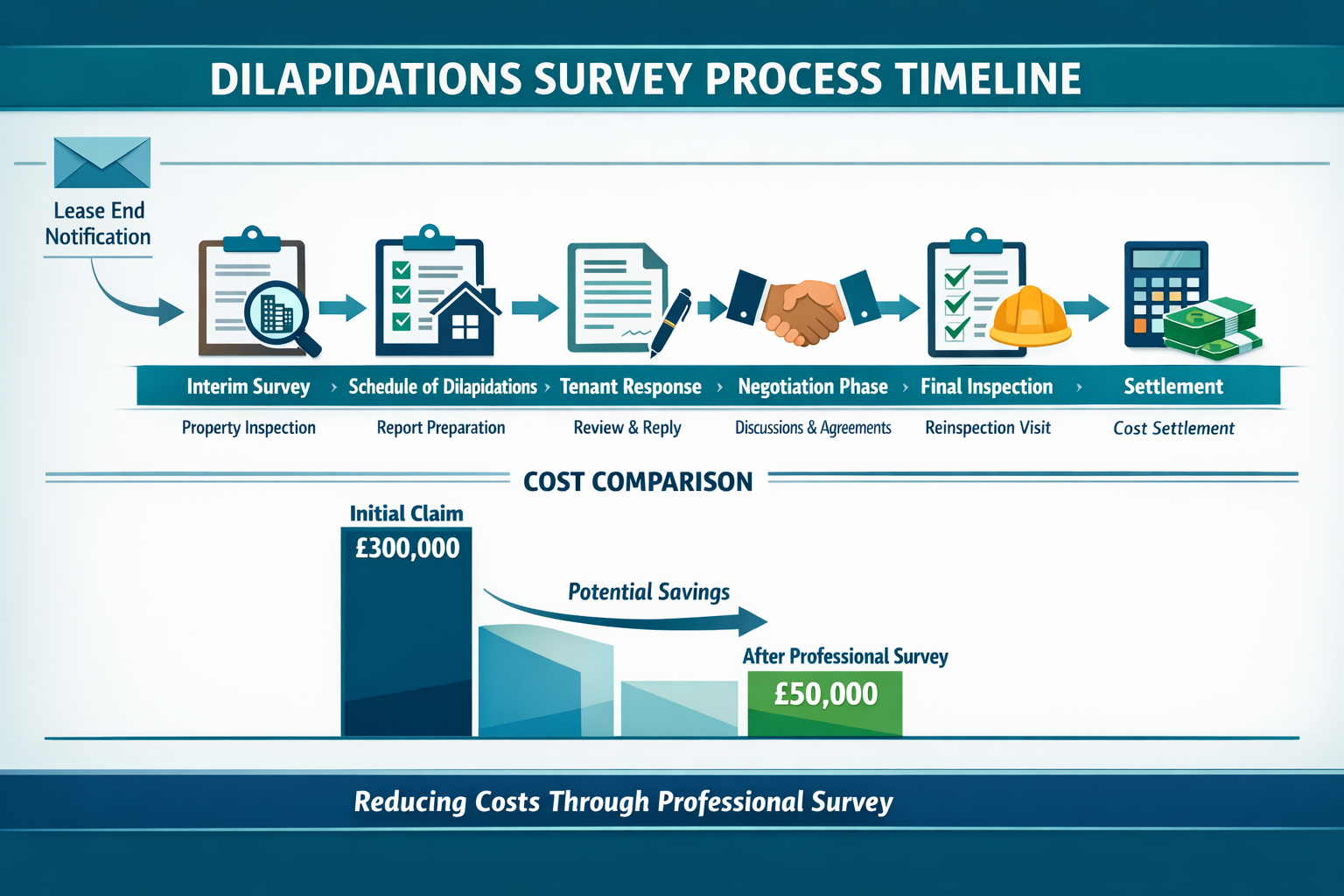
When a commercial lease approaches its end, the stakes couldn’t be higher. Landlords face potential losses from unreported damage, while tenants risk overpaying for repairs they never caused. In 2026, a single dilapidations survey can mean the difference between a £300,000 liability and a £50,000 settlement—a documented saving that demonstrates the transformative power of professional property assessment[2]. As commercial property markets navigate unprecedented uncertainty and technological disruption, understanding the critical role of dilapidations surveys has never been more essential for protecting substantial financial interests.
Key Takeaways
- A dilapidations survey provides an independent assessment of a property’s condition at lease end, documenting repair obligations and preventing costly disputes between landlords and tenants
- Professional surveys can save hundreds of thousands of pounds through accurate cost assessment and negotiation support, with documented cases showing reductions from £300,000 to £50,000[2]
- The dilapidations landscape is rapidly evolving in 2026, driven by AI technology adoption, sustainability requirements, and market uncertainty that demands expert professional judgment[1]
- Over 50% of industry professionals are investing in technology to enhance their dilapidations practice, combining digital tools with traditional surveying expertise[1]
- Timing is critical: conducting surveys at strategic lease milestones—interim periods and lease end—maximizes protection and negotiation leverage for all parties
What Is a Dilapidations Survey? 📋
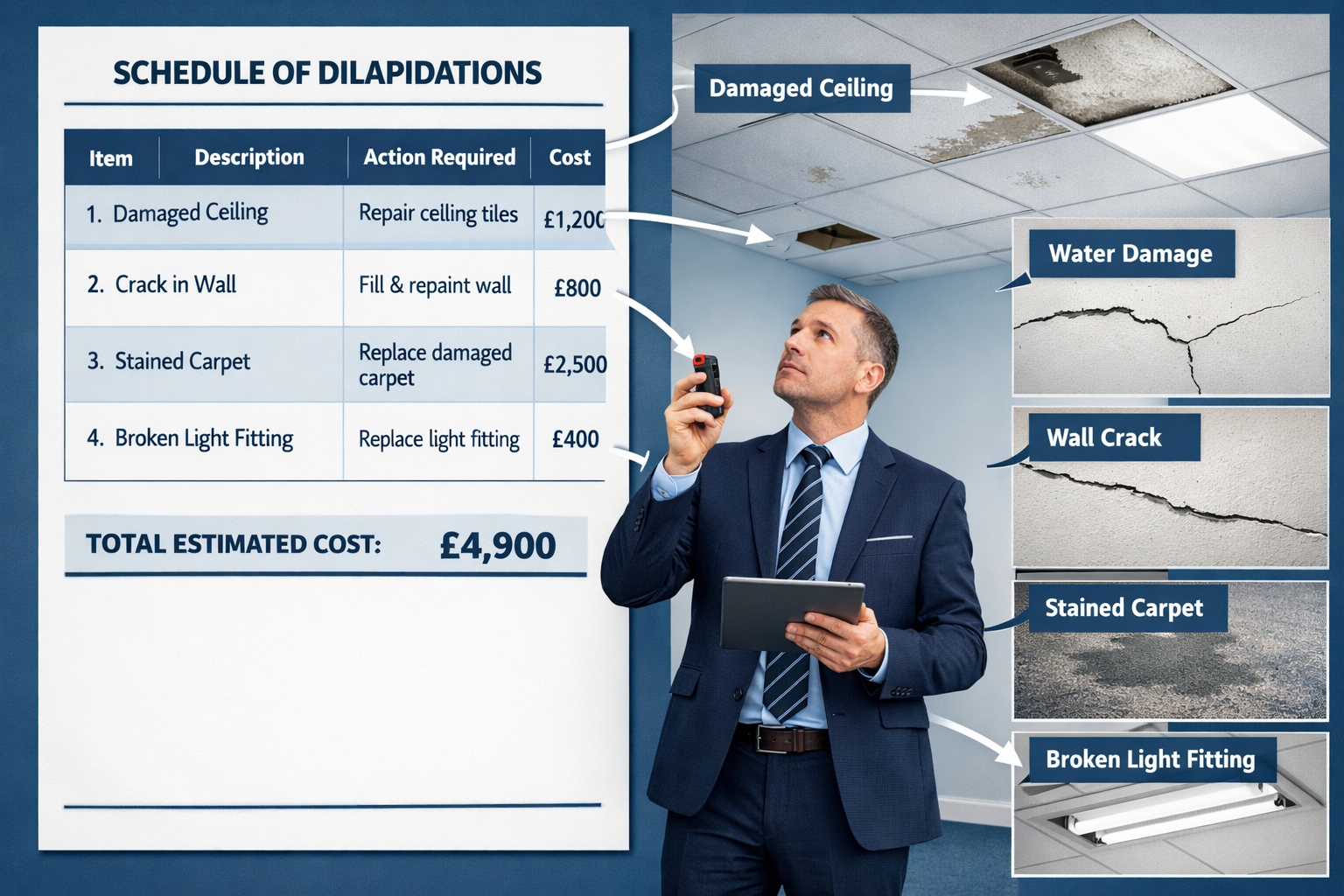
A dilapidations survey is a comprehensive professional inspection of commercial property that documents its physical condition and identifies repair obligations under a lease agreement. Unlike residential property surveys, dilapidations surveys specifically focus on assessing breaches of lease covenants and quantifying the cost of remedial works required to return the property to its contractually agreed state.
These specialized assessments serve multiple critical functions:
- Evidence documentation: Creating an objective record of property condition with photographic evidence and detailed descriptions
- Cost quantification: Providing accurate estimates for necessary repairs, reinstatement works, and decorative improvements
- Liability allocation: Clearly identifying which party bears responsibility for specific defects or deterioration
- Dispute prevention: Establishing transparent, evidence-based foundations for negotiations between landlords and tenants
The comprehensive dilapidations report produced from these surveys becomes a crucial document in lease-end negotiations, often preventing expensive legal disputes and facilitating fair settlements.
The Legal Framework Behind Dilapidations
Commercial lease agreements typically contain repairing covenants that obligate tenants to maintain the property in good condition throughout the tenancy and return it in a specified state at lease end. When tenants fail to meet these obligations, landlords can pursue dilapidations claims to recover costs.
The legal framework governing dilapidations includes:
| Legal Principle | Application | Impact on Surveys |
|---|---|---|
| Landlord and Tenant Act 1927 | Caps claims at the diminution in property value | Surveyors must consider market value impact |
| Dilapidations Protocol | Requires pre-action procedures and reasonable negotiation | Surveys must follow standardized methodologies |
| Supersession | Prevents claims for repairs if landlord plans alterations | Surveyors assess landlord’s future intentions |
| Section 18 Valuation | Limits recovery to actual financial loss | Cost assessments must reflect realistic market conditions |
Professional dilapidations surveys incorporate these legal considerations, ensuring that assessments remain defensible and aligned with current case law and regulatory requirements[5].
Types of Dilapidations Surveys and When They’re Needed
Understanding which type of dilapidations survey suits specific circumstances enables property stakeholders to make informed decisions about timing and scope. Each survey type serves distinct strategic purposes within the lease lifecycle.
Interim Dilapidations Survey
Conducted during the active lease term, interim surveys provide early warning systems for both landlords and tenants. These proactive assessments identify developing issues before they escalate into major liabilities.
Benefits for landlords:
- Early identification of lease breaches requiring tenant attention
- Documentation establishing a pattern of neglect if disputes arise later
- Opportunity to enforce repairing obligations while tenants remain in occupation
- Prevention of exponential deterioration that increases ultimate costs
Benefits for tenants:
- Clear understanding of current obligations and potential liabilities
- Opportunity to address issues incrementally rather than facing massive lease-end bills
- Budget planning for upcoming repair expenditures
- Negotiation leverage if considering lease renewal or early termination
Interim surveys typically cost less than terminal surveys because they focus on identifying issues rather than comprehensive quantification, making them cost-effective risk management tools[3].
Terminal Dilapidations Survey
Performed at or near lease expiry, terminal surveys represent the comprehensive assessment that determines final settlement amounts. These detailed inspections form the basis for Schedules of Dilapidations—formal documents itemizing required works and associated costs.
Key components include:
✅ Comprehensive property inspection covering structure, services, finishes, and external areas
✅ Photographic evidence documenting every identified defect
✅ Detailed Schedule of Dilapidations listing each breach with specific remedial requirements
✅ Quantified Demand providing cost estimates for all necessary works
✅ Section 18 valuation considerations assessing diminution in property value
Terminal surveys require significantly more time and expertise than interim assessments, as they must withstand potential legal scrutiny and form the foundation for substantial financial claims or defenses[2].
Schedule of Condition Survey
Prepared at lease commencement, Schedules of Condition document the property’s initial state, establishing a baseline against which future condition can be measured. These surveys protect tenants from liability for pre-existing defects.
The quality and consistency of Schedules of Condition have emerged as significant industry concerns in 2026, with professionals recognizing that inadequate initial documentation creates disputes and uncertainty throughout the lease term[1]. Working with experienced chartered surveyors ensures comprehensive baseline documentation that protects all parties’ interests.
The Dilapidations Survey Process: Step-by-Step 🔍
Understanding the systematic approach professional surveyors employ demystifies the process and helps property stakeholders prepare effectively for assessments.
1. Initial Consultation and Document Review
Before any site inspection occurs, qualified surveyors review critical documentation:
- Lease agreement: Identifying specific repairing covenants and obligations
- Previous surveys: Understanding property history and past condition
- Correspondence: Reviewing any notices or communications about repairs
- Planning permissions: Assessing authorized versus unauthorized alterations
This preparatory phase ensures inspectors understand contractual obligations and can identify breaches accurately during the physical assessment.
2. Comprehensive Property Inspection
The physical inspection represents the survey’s core activity. Professional surveyors systematically examine:
Structural elements:
- Foundation integrity and settlement indicators
- Wall condition, including cracks, dampness, and structural movement
- Roof condition, coverings, flashings, and weatherproofing
- Floor stability and levelness
Building services:
- Heating, ventilation, and air conditioning systems
- Electrical installations and compliance with current regulations
- Plumbing, drainage, and sanitary fittings
- Fire safety systems and emergency lighting
Internal finishes:
- Decorative condition of walls, ceilings, and woodwork
- Floor coverings and their state of repair
- Fixtures, fittings, and tenant installations
- Cleanliness and general maintenance standards
External areas:
- Car parks, access roads, and paved surfaces
- Boundary walls, fences, and gates
- Landscaping and grounds maintenance
- External lighting and signage
Modern surveyors increasingly employ digital tools and AI-enhanced technologies for data capture, with over 50% of professionals investing in technological solutions to improve accuracy and efficiency[1]. However, technology serves to augment rather than replace professional judgment—a critical distinction in 2026’s evolving landscape.
3. Photographic Documentation
Comprehensive photographic evidence forms an essential component of credible dilapidations surveys. Professional documentation includes:
- Wide-angle contextual shots establishing location
- Close-up detail images of specific defects
- Comparative photographs showing deterioration patterns
- Annotated images highlighting particular concerns
This visual evidence proves invaluable during negotiations and potential dispute resolution, providing objective proof of conditions that written descriptions alone cannot convey.
4. Cost Quantification and Schedule Preparation
Following inspection, surveyors prepare detailed cost assessments for identified works. This complex process involves:
Specification development: Describing exact remedial works required for each defect
Measurement: Quantifying areas, volumes, or units requiring attention
Pricing: Applying current market rates for labor, materials, and professional fees
Contingencies: Including appropriate allowances for unforeseen complications
The resulting Schedule of Dilapidations presents a comprehensive, itemized breakdown that forms the basis for financial claims or negotiations. Professional surveys prevent overpayment for repairs not genuinely a party’s responsibility and help avoid disputes over liability allocation[2].
5. Section 18 Valuation Assessment
A critical but often misunderstood element, Section 18 valuations assess whether repair costs exceed the actual diminution in property value caused by disrepair. This legal safeguard prevents landlords from recovering more than their genuine financial loss.
Professional surveyors consider:
- Current property market conditions and rental values
- Landlord’s actual intentions for the property post-lease
- Whether planned alterations would supersede claimed repairs
- Realistic assessment of market value impact
In 2026’s uncertain commercial property market, Section 18 considerations have gained heightened importance, requiring surveyors to combine technical expertise with insight into economic drivers and market trends[1].
Who Needs a Dilapidations Survey? Key Stakeholders
Multiple parties benefit from professional dilapidations surveys, each with distinct interests and strategic considerations.
Commercial Landlords 🏢
Property owners commission dilapidations surveys to:
- Protect asset value by ensuring properties return in acceptable condition
- Quantify legitimate claims against departing tenants
- Provide evidence supporting recovery of repair costs
- Demonstrate reasonable and proportionate claims if disputes arise
Landlords working with professional surveyors across locations from London to Croydon benefit from local market knowledge that enhances valuation accuracy and settlement negotiations.
Commercial Tenants
Occupiers engage surveyors to:
- Understand actual obligations versus potentially inflated landlord claims
- Negotiate fair settlements based on objective evidence
- Identify opportunities to challenge unreasonable demands
- Plan exit strategies that minimize financial exposure
The documented case of a tenant’s liability reducing from £300,000 to £50,000 through professional survey support demonstrates the substantial value expert representation provides[2]. This £250,000 saving far exceeds survey costs, illustrating the return on investment professional assessments deliver.
Property Managers and Managing Agents
Professional managers utilize dilapidations surveys to:
- Fulfill fiduciary duties to property owner clients
- Maintain consistent standards across property portfolios
- Facilitate smooth lease transitions with minimal disputes
- Provide objective third-party assessments that support fair negotiations
Legal and Financial Advisors
Professional advisors rely on survey reports to:
- Support litigation strategies with credible expert evidence
- Advise clients on settlement negotiations with realistic cost assessments
- Structure lease agreements with appropriate repairing covenants
- Assess financial provisions required for lease-end obligations
The Changing Landscape of Dilapidations in 2026 🚀
The dilapidations sector is experiencing rapid transformation driven by multiple converging forces that are reshaping professional practice and client expectations.
Technology and AI Integration
Digital innovation is revolutionizing how surveyors deliver services, from initial data capture through final client reporting. The RICS Dilapidations Conference 2025 attracted nearly 400 industry experts, with technology adoption emerging as a dominant theme[1].
Current technological applications include:
- Digital measurement tools: Laser scanners and photogrammetry replacing traditional methods
- AI-assisted defect identification: Machine learning algorithms highlighting potential issues
- Cloud-based reporting platforms: Real-time collaboration between surveyors and clients
- Predictive analytics: Forecasting deterioration patterns and future liabilities
- Automated cost databases: Ensuring pricing reflects current market rates
However, industry consensus remains clear: surveyors are not at risk of being replaced by technology, but professionals who fail to adapt may become irrelevant[1]. The winning formula combines technological efficiency with irreplaceable professional judgment, experience, and client relationship skills.
Sustainability and ESG Considerations
Environmental, Social, and Governance (ESG) pressures are fundamentally altering dilapidations practice. The upcoming RICS Dilapidations Conference 2026 will expand focus to include sustainability and circular fit-out considerations[4], reflecting the sector’s recognition that traditional “rip out and replace” approaches no longer align with contemporary values.
Emerging sustainability considerations:
🌱 Circular economy principles: Prioritizing repair, reuse, and recycling over disposal
🌱 Embodied carbon assessments: Evaluating environmental impact of remedial works
🌱 Energy efficiency upgrades: Balancing lease obligations with climate goals
🌱 Sustainable materials: Specifying environmentally responsible repair solutions
These considerations add complexity to traditional dilapidations assessments but create opportunities for innovative solutions that benefit all stakeholders while supporting broader environmental objectives.
Market Uncertainty and Economic Pressures
Commercial property market turbulence in 2026 has created unprecedented challenges for dilapidations professionals. Tightening budgets, changing workplace patterns, and economic uncertainty require surveyors to provide not merely technical assessments but strategic advice informed by market realities[1].
Key market factors influencing dilapidations:
- Hybrid working impacts: Reduced office demand affecting property values and supersession arguments
- Retail sector challenges: High street struggles influencing realistic recovery prospects
- Industrial and logistics growth: Strong demand supporting robust dilapidations claims
- Interest rate environments: Affecting property valuations and investment decisions
Professional surveyors must now combine traditional technical expertise with sophisticated understanding of economic drivers, market trends, and investment dynamics to provide genuinely valuable advice.
Quality and Consistency Concerns
Despite technological advances, the industry continues grappling with quality and consistency issues, particularly regarding Schedules of Condition. Inconsistent standards create uncertainty, fuel disputes, and undermine confidence in professional assessments[1].
Leading practitioners advocate for:
- Standardized methodologies and reporting templates
- Enhanced professional training and continuing education
- Peer review processes ensuring quality control
- Clear communication of assumptions and limitations
Organizations providing professional surveyor services increasingly differentiate themselves through demonstrable quality assurance processes and transparent methodologies that build client confidence.
Cost Considerations: What to Expect from a Dilapidations Survey 💰
Understanding the financial investment required for professional dilapidations surveys enables informed decision-making and realistic budget planning.
Survey Fee Structures
Dilapidations survey costs vary based on multiple factors:
Property size and complexity:
- Small retail units (under 1,000 sq ft): £1,500 – £3,000
- Medium offices (1,000 – 5,000 sq ft): £3,000 – £6,000
- Large commercial properties (5,000 – 20,000 sq ft): £6,000 – £15,000
- Complex multi-unit developments: £15,000+
Survey scope and purpose:
- Basic Schedule of Condition: Lower end of range
- Comprehensive terminal survey with detailed quantification: Higher end of range
- Expert witness services for litigation: Premium rates with additional preparation time
Geographic location:
- Central London and prime locations command premium rates
- Regional properties typically cost 20-30% less than equivalent London assessments
Surveyors serving areas from Westminster to Ealing adjust pricing to reflect local market conditions and travel requirements.
Return on Investment
While survey fees represent significant expenditure, the potential savings and risk mitigation typically deliver substantial returns. Consider these scenarios:
Tenant perspective:
- Survey cost: £5,000
- Initial landlord claim: £300,000
- Negotiated settlement after professional survey: £50,000
- Net saving: £245,000 (49:1 return on investment)[2]
Landlord perspective:
- Survey cost: £8,000
- Professional Schedule of Dilapidations: £180,000
- Settlement without professional evidence: £60,000
- Additional recovery: £112,000 (14:1 return on investment)
These examples illustrate why professional surveys represent prudent investments rather than discretionary expenses for parties facing substantial dilapidations exposure.
Hidden Costs of Inadequate Surveys
Attempting to economize through inadequate surveys or non-specialist assessments often proves far more expensive than engaging qualified professionals initially:
❌ Rejected claims: Poorly evidenced schedules failing to withstand challenge
❌ Protracted negotiations: Inadequate documentation prolonging settlement discussions
❌ Legal costs: Disputes escalating to litigation due to insufficient professional evidence
❌ Opportunity costs: Management time diverted to disputes rather than productive activities
The importance of dilapidations reports extends beyond immediate cost quantification to encompass risk management, dispute avoidance, and relationship preservation—benefits that inadequate assessments cannot deliver.
Choosing the Right Dilapidations Surveyor: Essential Criteria ✅
Selecting appropriate professional representation significantly influences outcomes. Key selection criteria include:
Professional Qualifications
RICS membership (Royal Institution of Chartered Surveyors) represents the gold standard for dilapidations professionals. RICS-qualified surveyors must:
- Complete rigorous academic and practical training
- Demonstrate technical competence through Assessment of Professional Competence
- Maintain continuing professional development
- Adhere to strict ethical standards and professional conduct rules
- Carry appropriate professional indemnity insurance
Verify surveyor credentials through the RICS directory and confirm active membership status before engagement.
Specialist Experience
Dilapidations work requires specialized knowledge distinct from other surveying disciplines. Assess candidates based on:
- Years practicing specifically in dilapidations (minimum 5 years preferred)
- Volume of similar instructions completed annually
- Property type experience matching your specific circumstances
- Geographic knowledge of relevant local markets
- Expert witness experience if litigation potential exists
General practice surveyors may lack the nuanced understanding that dilapidations specialists bring to complex negotiations and technical assessments.
Technology Capabilities
In 2026’s digitally-enhanced environment, surveyor technology adoption influences service quality and efficiency. Evaluate:
- Digital inspection and measurement tools employed
- Reporting platforms and client communication systems
- Data security and confidentiality protections
- Turnaround times enabled by technological processes
However, remember that technology investment alone proves insufficient—professional judgment combined with sound implementation defines quality outcomes[1].
Communication and Accessibility
Effective surveyors combine technical expertise with clear communication and responsive client service:
- Plain language explanations of technical issues and legal implications
- Transparent fee structures with clear scope definitions
- Regular progress updates throughout the survey process
- Accessibility for questions and strategy discussions
- Negotiation support beyond mere report delivery
The best professionals function as strategic advisors rather than mere report producers, providing ongoing guidance through the entire dilapidations process.
Local Market Knowledge
Understanding regional property markets enhances valuation accuracy and negotiation effectiveness. Surveyors with established practices in specific areas—whether Kensington, Camden, or Richmond—bring valuable insights into local conditions, contractor pricing, and market dynamics that influence settlement outcomes.
Common Dilapidations Survey Challenges and Solutions 🔧
Understanding typical complications enables proactive management and realistic expectation setting.
Challenge 1: Disputed Lease Interpretations
Issue: Ambiguous lease wording creating disagreement about actual obligations
Solution: Early legal advice combined with surveyor expertise interpreting covenants in light of case law precedents. Professional surveyors experienced in delap survey processes navigate these complexities routinely.
Challenge 2: Supersession Arguments
Issue: Landlords planning alterations that would supersede claimed repairs, potentially invalidating claims
Solution: Thorough investigation of landlord intentions, market evidence of realistic plans, and Section 18 valuations properly accounting for supersession effects. Transparent assessment prevents inflated claims that courts would ultimately reject.
Challenge 3: Access Restrictions
Issue: Occupied properties limiting inspection scope or preventing comprehensive assessment
Solution: Negotiated access arrangements, phased inspections, and clear documentation of limitations affecting survey scope. Professional reports explicitly state restrictions and their potential impact on findings.
Challenge 4: Betterment Allegations
Issue: Landlords seeking improvements beyond lease requirements or tenants claiming repairs constitute betterment
Solution: Precise specification of works returning property to lease-compliant condition without enhancement. Photographic evidence and Schedule of Condition comparisons demonstrate legitimate restoration versus improvement.
Challenge 5: Cost Estimate Disputes
Issue: Significant variation between landlord and tenant cost assessments
Solution: Detailed breakdowns with transparent pricing methodologies, competitive quotations from reputable contractors, and independent quantity surveyor verification when substantial amounts justify additional cost. Similar principles apply whether assessing building survey costs or dilapidations liabilities.
Maximizing Value from Your Dilapidations Survey: Practical Tips 📌
Strategic approach and preparation enhance survey effectiveness and outcomes.
For Tenants Receiving Schedules of Dilapidations:
- Act promptly: Dilapidations Protocol requires responses within 56 days—delays weaken negotiating positions
- Engage professionals immediately: Early expert involvement prevents tactical disadvantages
- Gather historical evidence: Photographs, maintenance records, and correspondence supporting your position
- Consider strategic options: Negotiate settlement, undertake works directly, or dispute liability
- Assess settlement economics: Compare litigation costs and risks against settlement amounts
For Landlords Preparing Claims:
- Conduct interim surveys: Early identification of issues enables timely enforcement
- Maintain property records: Documentation of previous condition, permitted alterations, and correspondence
- Consider market realities: Section 18 limitations and realistic recovery prospects
- Prepare comprehensive evidence: Detailed schedules with robust cost justification
- Demonstrate reasonableness: Dilapidations Protocol compliance and proportionate claims
For Both Parties:
✓ Prioritize negotiation: Most dilapidations settle without litigation—collaborative approaches save time and costs
✓ Maintain perspective: Commercial relationships often extend beyond individual leases
✓ Seek early professional advice: Tactical advantages accrue to parties who engage expertise promptly
✓ Document everything: Contemporary records prove invaluable in subsequent disputes
✓ Consider alternative dispute resolution: Mediation and expert determination offer cost-effective alternatives to litigation
Understanding when to seek specialist surveys—whether RICS homebuyer surveys for residential properties or specialized dilapidations assessments for commercial leases—ensures appropriate professional support for specific circumstances.
The Future of Dilapidations Surveys: Trends to Watch 🔮
Several emerging trends will shape dilapidations practice in coming years:
Advanced Digital Integration
Expect continued evolution of AI and digital tools transforming service delivery. The RICS Dilapidations Conference 2026 will specifically address these technologies[4], reflecting their growing importance. Future developments may include:
- Virtual reality property inspections enabling remote assessments
- Blockchain-based condition records providing tamper-proof documentation
- Predictive maintenance algorithms forecasting future liabilities
- Automated negotiation platforms facilitating settlement discussions
Sustainability Mainstreaming
ESG considerations will transition from emerging concerns to standard practice requirements. Future dilapidations assessments will routinely incorporate:
- Carbon impact evaluations of proposed remedial works
- Circular economy alternatives to traditional disposal approaches
- Green building certifications affecting property values
- Climate resilience considerations in long-term property planning
Regulatory Evolution
Anticipate potential regulatory changes affecting dilapidations practice:
- Standardized Schedule of Condition requirements
- Enhanced disclosure obligations for both landlords and tenants
- Mandatory alternative dispute resolution before litigation
- Professional qualification requirements for expert witnesses
Market Adaptation
Commercial property market evolution will continue influencing dilapidations practice:
- Flexible workspace growth affecting traditional lease structures
- Shorter lease terms changing dilapidations timing and economics
- Increased focus on operational costs driving maintenance standards
- Technology sector expansion creating new property use categories
Professionals who combine traditional expertise with adaptability to these emerging trends will thrive in the evolving landscape, while those resistant to change risk obsolescence[1].
Conclusion: Protecting Your Interests Through Professional Dilapidations Surveys
In 2026’s complex commercial property environment, professional dilapidations surveys represent essential risk management tools that protect substantial financial interests for both landlords and tenants. Whether facing potential liabilities of £50,000 or £300,000, the difference between informed professional representation and inadequate assessment can determine outcomes that impact business viability and property investment returns.
The dilapidations landscape continues evolving rapidly, driven by technological innovation, sustainability imperatives, and market uncertainty. However, core principles remain constant: accurate condition assessment, transparent cost quantification, and professional judgment form the foundation of effective dilapidations practice. Technology enhances these capabilities but cannot replace the expertise, experience, and strategic insight that qualified surveyors provide.
Your Next Steps:
If you’re a tenant approaching lease end:
- Review your lease repairing covenants immediately
- Engage a qualified RICS surveyor for independent assessment
- Document current property condition comprehensively
- Develop a strategic response plan before receiving landlord claims
- Consider interim works to minimize ultimate liabilities
If you’re a landlord with departing tenants:
- Commission professional terminal surveys before lease expiry
- Ensure Schedules of Dilapidations reflect realistic, defensible costs
- Consider Section 18 limitations and market conditions
- Prepare comprehensive evidence supporting your position
- Approach negotiations reasonably and proportionately
For both parties:
Recognize that professional dilapidations surveys deliver value far exceeding their cost through dispute prevention, negotiation support, and fair settlement facilitation. The documented case of £250,000 savings through expert representation[2] illustrates returns that dwarf survey fees—making professional engagement a prudent investment rather than discretionary expense.
The commercial property sector’s future will be shaped by professionals who combine traditional surveying expertise with technological capability, sustainability awareness, and market insight. By engaging qualified specialists who understand this evolving landscape, property stakeholders position themselves for optimal outcomes in dilapidations matters that can significantly impact financial performance and business relationships.
Don’t navigate the complex dilapidations process alone. Invest in professional expertise that protects your interests, minimizes risks, and delivers fair, evidence-based outcomes that all parties can accept with confidence.
References
[1] Dilapidations In 2025 – https://goreport.com/dilapidations-in-2025/
[2] Surveys – https://www.dilapsolutions.com/services/surveys/
[3] Dilapidation Assessment Reports – https://horde.group/blog/dilapidation-assessment-reports/
[4] Dilapidations Conference – https://www.rics.org/training-events/conferences/dilapidations-conference
[5] Dilapidations Explained A Strategic Guide For Landlords Tenants And Property Managers – https://hfwjsurveyors.com/advice-insights/dilapidations-explained-a-strategic-guide-for-landlords-tenants-and-property-managers/