

Dilapidation Survey: Your Complete Guide to Property Condition Documentation in 2026
When a major construction project begins next door to your property, or when you’re about to lease a commercial space, a single overlooked crack could cost you thousands of pounds in disputed damages. A dilapidation survey serves as your financial safety net—a comprehensive photographic and written record that documents a property’s exact condition at a specific point in time, protecting both property owners and tenants from unfair liability claims.
In 2026, with construction activity surging across urban areas and commercial lease disputes becoming increasingly complex, understanding what a dilapidation survey entails has never been more critical. Whether you’re a homeowner concerned about neighboring construction, a commercial tenant preparing to vacate premises, or a landlord seeking to protect your investment, this detailed guide will walk you through everything you need to know about dilapidation surveys.
Key Takeaways
- A dilapidation survey documents the existing condition of a property through detailed photographs, measurements, and written descriptions to establish a baseline before construction work or at the start/end of a lease period
- Pre-construction dilapidation surveys protect homeowners from being held liable for damage caused by nearby construction projects, providing crucial evidence if disputes arise
- Commercial lease dilapidations require tenants to return properties to their original condition, making terminal surveys essential for determining repair obligations and potential costs
- Professional surveyors use specialized equipment including laser measuring devices, moisture meters, and high-resolution cameras to create comprehensive condition reports that stand up in legal proceedings
- The cost of a dilapidation survey is minimal compared to the potential financial exposure from disputed damage claims, which can reach tens of thousands of pounds
What Is a Dilapidation Survey?
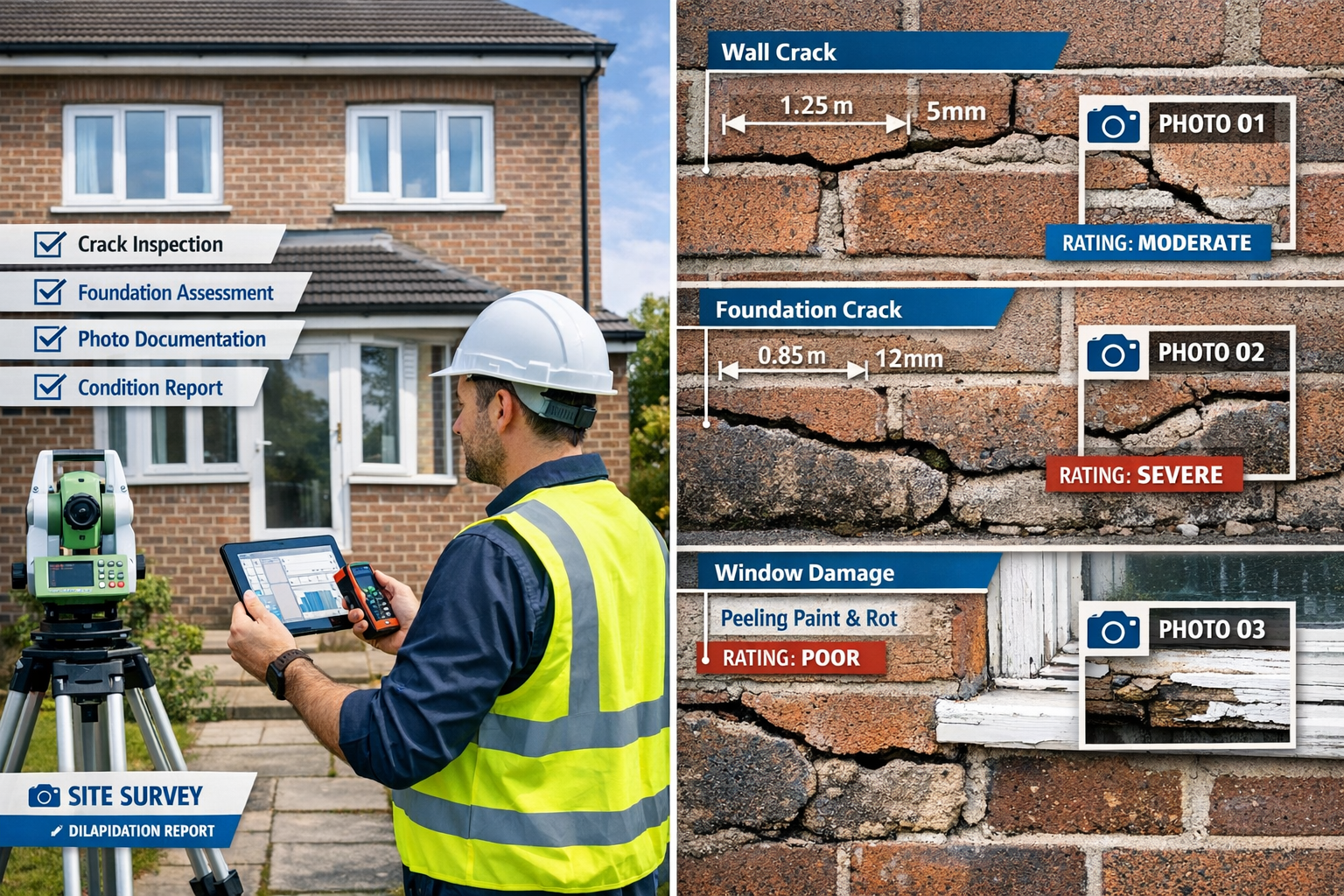
A dilapidation survey is a professional inspection and documentation process that records the precise condition of a building or property at a specific moment in time. Think of it as a detailed snapshot that captures every crack, stain, defect, and structural characteristic of a property through photographs, written descriptions, and technical measurements [1].
The primary purpose of conducting a dilapidation survey is to create an irrefutable baseline record that can be referenced later to determine whether new damage has occurred. This becomes particularly valuable when:
- Construction projects are planned near your property
- Commercial leases are beginning or ending
- Renovation work is about to commence
- Boundary disputes or party wall matters arise
- Insurance claims need supporting documentation
Types of Dilapidation Surveys
There are several distinct types of dilapidation surveys, each serving different purposes:
| Survey Type | Primary Use | Typical Timeline |
|---|---|---|
| Pre-Construction Survey | Documents property condition before nearby construction begins | 1-2 weeks before work starts |
| Interim Dilapidation Survey | Records ongoing lease condition during tenancy | Mid-lease period |
| Terminal/Final Survey | Assesses property at lease end to determine repair obligations | 3-6 months before lease expiry |
| Schedule of Dilapidations | Formal legal document detailing required repairs | At lease termination |
According to industry standards, a comprehensive dilapidation survey should include detailed photographic evidence, written descriptions of all defects, floor plans with marked locations of issues, and measurements of cracks or structural concerns [2].
Why You Need a Dilapidation Survey: Key Benefits
The importance of obtaining a professional dilapidation survey cannot be overstated, particularly in 2026’s increasingly litigious property environment. Here are the compelling reasons why this investment protects your interests:
🛡️ Legal Protection and Evidence
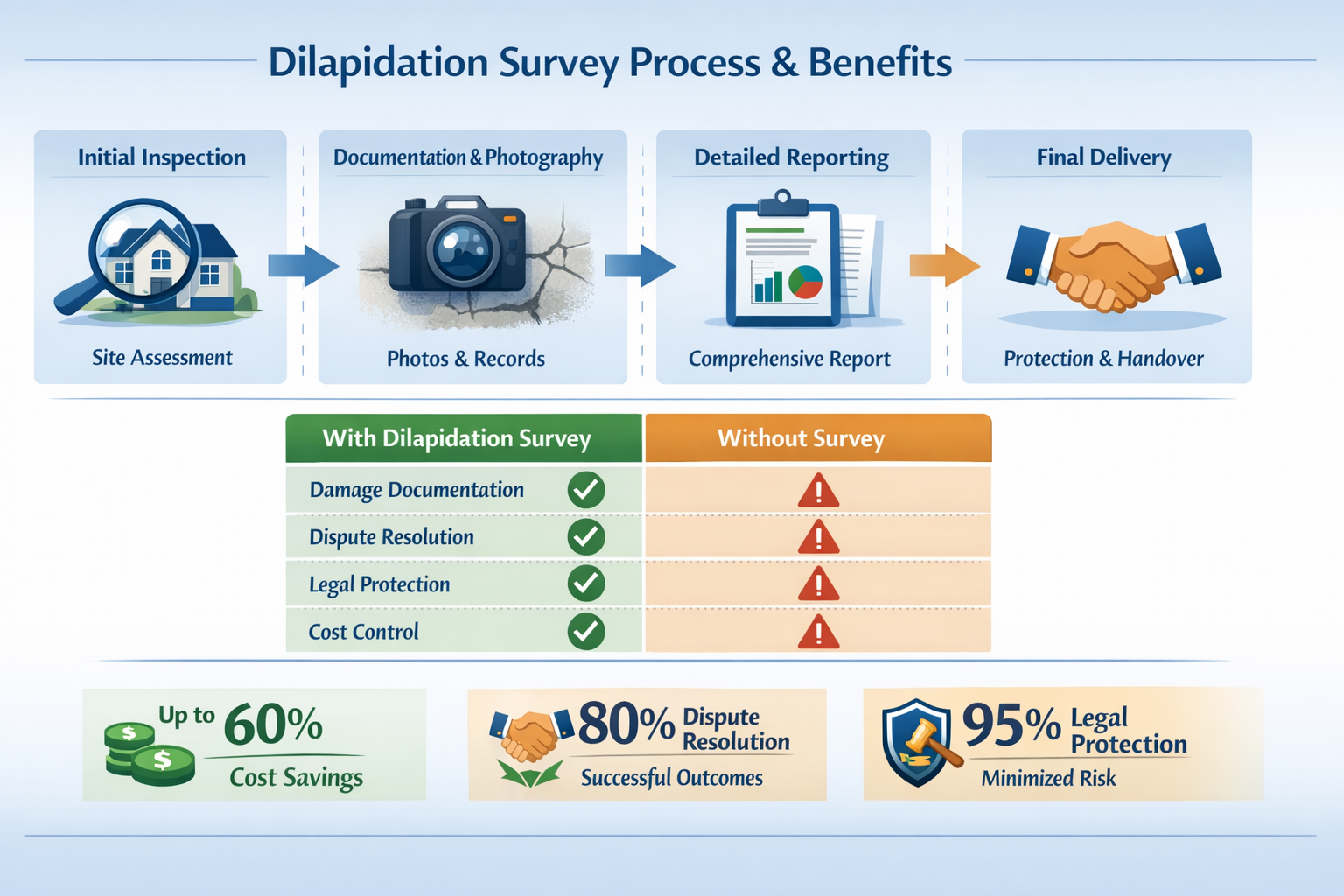
A properly conducted dilapidation survey provides legally defensible evidence in disputes. When a neighbor’s construction project causes cracks in your walls, or when a landlord claims you damaged a property that was already deteriorating, photographic and written evidence from before the event becomes invaluable [3].
Courts and insurance companies recognize professionally prepared dilapidation reports as credible evidence. The detailed documentation created by qualified building surveyors can make the difference between winning and losing a dispute worth thousands of pounds.
💰 Financial Protection
The financial implications of not having a dilapidation survey can be severe. Consider these scenarios:
- A homeowner without a pre-construction survey may struggle to prove that foundation cracks resulted from nearby excavation work
- A commercial tenant facing a £50,000 dilapidations claim might have avoided most charges with proper documentation at lease commencement
- A landlord without terminal survey evidence may find it difficult to recover costs for genuine tenant-caused damage
The cost-benefit ratio is overwhelmingly positive. While a dilapidation survey might cost between £300-£1,500 depending on property size and complexity, the potential financial exposure from disputed claims can easily exceed £20,000-£100,000 [3].
📋 Clear Accountability
Dilapidation surveys establish clear accountability by creating an undisputed record of property condition. This clarity benefits all parties:
- Property owners can confidently pursue legitimate damage claims
- Tenants can avoid paying for pre-existing damage
- Contractors can demonstrate they didn’t cause alleged damage
- Landlords can accurately assess repair costs at lease end
🏗️ Construction Project Requirements
Many local authorities and construction companies now require neighboring properties to undergo pre-construction dilapidation surveys before major projects commence. This requirement protects both the construction company and surrounding property owners by establishing baseline conditions [1].
For properties adjacent to significant construction work—particularly involving excavation, piling, or demolition—a dilapidation survey is often mandatory rather than optional.
📊 Insurance and Claims Support
Insurance companies increasingly request dilapidation survey evidence when processing claims related to:
- Subsidence or settlement
- Construction-related damage
- Water damage progression
- Structural deterioration
Having a recent dilapidation survey can expedite claims processing and improve settlement outcomes. Similar to how a damp survey in London provides specific evidence for moisture-related claims, a dilapidation survey offers concrete documentation for structural issues.
The Dilapidation Survey Process: What to Expect
Understanding what happens during a professional dilapidation survey helps property owners and tenants prepare adequately and ensure comprehensive documentation. Here’s the detailed step-by-step process:
Step 1: Initial Consultation and Scope Definition
The process begins with a consultation between the property owner or tenant and the surveying professional. During this stage:
- Survey objectives are clearly defined (pre-construction, lease-related, etc.)
- Property details including size, age, and construction type are discussed
- Specific concerns or areas requiring particular attention are identified
- Timeline requirements are established
- Fee quotations are provided based on property complexity
Step 2: Site Inspection and Documentation
A qualified surveyor will conduct a thorough on-site inspection, typically lasting 2-6 hours depending on property size. The inspection includes:
External Assessment:
- Foundation and structural walls
- Roof condition and drainage systems
- Windows, doors, and external joinery
- Pathways, driveways, and boundary features
- External decorative condition
Internal Assessment:
- Wall, ceiling, and floor conditions
- Evidence of cracks, stains, or deterioration
- Fixtures and fittings condition
- Moisture levels using specialized meters
- Decorative state and finish quality
The surveyor uses professional equipment including:
- High-resolution digital cameras for detailed photographic evidence
- Laser distance measurers for accurate crack and defect measurements
- Moisture meters to detect hidden dampness
- Crack width gauges for precise documentation
- Floor plans and annotation tools [2]
Step 3: Photographic Evidence Collection
Comprehensive photographic documentation forms the cornerstone of any dilapidation survey. Professional surveyors typically capture:
- Wide-angle shots showing overall room or facade conditions
- Close-up images of specific defects with measurement references
- Multiple angles of significant issues
- Date and location stamped images
- Comparative shots showing context and scale
In 2026, many surveyors also utilize 360-degree photography and video documentation to create immersive records that can be reviewed remotely [1].
Step 4: Detailed Report Preparation
Following the site inspection, the surveyor prepares a comprehensive written report that includes:
Essential Report Components:
- Executive Summary – Overview of property condition
- Methodology Statement – Description of inspection approach
- Property Description – Basic details and construction type
- Detailed Findings – Room-by-room or area-by-area condition assessment
- Photographic Appendix – Organized images with annotations
- Floor Plans – Marked with defect locations
- Recommendations – Suggested actions or monitoring requirements
- Limitations – Scope boundaries and access restrictions
The report uses clear, descriptive language accessible to non-technical readers while maintaining professional standards required for legal proceedings [5].
Step 5: Report Delivery and Review
The completed dilapidation survey report is typically delivered within 5-10 working days of the inspection. The surveyor should:
- Provide both digital and hard copy versions
- Offer a review meeting to explain findings
- Answer questions about specific observations
- Advise on next steps or recommended actions
- Store records securely for future reference
Commercial Lease Dilapidations: Special Considerations
For commercial tenants and landlords, dilapidation surveys take on particular significance due to lease obligations and potential financial exposure. Understanding these specialized requirements is essential for anyone involved in commercial property leasing.
Lease Obligations and Repairing Covenants
Most commercial leases contain repairing covenants that require tenants to:
- Maintain the property in good condition throughout the lease term
- Return the property to its original state at lease end (fair wear and tear excepted)
- Undertake specific repairs or reinstatement works
- Remove alterations and restore original configurations [4]
The interpretation of these obligations can be complex, making professional dilapidation surveys crucial for both parties.
Schedule of Dilapidations
A Schedule of Dilapidations is a formal document prepared by the landlord’s surveyor that itemizes:
- Specific breaches of lease repair obligations
- Detailed descriptions of required remedial works
- Estimated costs for each repair item
- Total financial claim against the tenant
This differs from a standard dilapidation survey in that it’s a legal claim document rather than a neutral condition assessment. Professional guidance from a chartered surveyor experienced in dilapidations is essential when responding to such schedules.
Terminal Dilapidation Survey Strategy
Smart commercial tenants commission their own terminal dilapidation survey approximately 18 months before lease expiry. This strategic timing allows:
✅ Early identification of required repairs
✅ Cost-effective remediation before formal claims arise
✅ Negotiation leverage with documented evidence
✅ Budget planning for end-of-lease costs
✅ Dispute avoidance through proactive compliance
According to industry data, tenants who conduct early terminal surveys typically reduce their final dilapidations liability by 30-50% compared to those who wait for landlord claims [4].
Diminution in Value vs. Cost of Works
An important legal principle in commercial dilapidations is the concept of diminution in value. Under Section 18 of the Landlord and Tenant Act 1927, a landlord’s claim cannot exceed the reduction in property value caused by the disrepair.
This means that if repairs would cost £100,000 but only increase property value by £40,000, the maximum recoverable claim is £40,000. Professional dilapidation surveys help establish both actual repair costs and realistic value impacts.
Pre-Construction Dilapidation Surveys: Protecting Your Property
When significant construction work is planned near your property—whether it’s a new development, basement excavation, or major renovation next door—a pre-construction dilapidation survey becomes your primary defense against unfair damage claims.
When to Commission a Pre-Construction Survey
You should consider obtaining a pre-construction dilapidation survey when:
🏗️ Major construction is planned within 50 meters of your property
🏗️ Excavation or piling work will occur nearby
🏗️ Demolition activities are scheduled in adjacent buildings
🏗️ Heavy machinery will operate close to your property boundaries
🏗️ Party wall work is being undertaken (see our guide on party wall agreements)
The survey should be completed before any construction work begins, ideally 2-4 weeks in advance to allow for proper documentation and report preparation [7].
What the Survey Should Document
A comprehensive pre-construction dilapidation survey must capture:
Structural Elements:
- Foundation condition and any existing settlement
- Wall integrity including all existing cracks (with measurements)
- Ceiling and floor level variations
- Roof structure and covering condition
- Drainage systems and underground services
Sensitive Areas:
- Areas most vulnerable to vibration damage
- Existing defects that could worsen with construction activity
- Historic features requiring special protection
- Recent repairs or renovations
Baseline Measurements:
- Crack width measurements using precision gauges
- Floor level surveys to detect future settlement
- Plumb measurements for wall verticality
- Moisture readings in vulnerable areas
Using Survey Evidence After Construction Damage
If damage occurs during nearby construction, your pre-construction dilapidation survey becomes critical evidence. The process typically involves:
- Immediate documentation of new damage through photographs and notes
- Commissioning a post-construction survey to document changes
- Comparative analysis between pre and post-construction conditions
- Expert opinion from the surveyor on causation
- Formal claim submission to the construction company or their insurers
Having professional documentation significantly strengthens your position. Similar to how understanding what to do after a bad building survey helps buyers navigate property issues, knowing how to leverage dilapidation survey evidence helps homeowners protect their interests.
Choosing the Right Surveyor for Your Dilapidation Survey
The quality and credibility of your dilapidation survey depends entirely on the expertise and professionalism of the surveyor you choose. Here’s how to select the right professional:
Essential Qualifications and Credentials
Look for surveyors with:
Professional Membership:
- RICS (Royal Institution of Chartered Surveyors) membership is the gold standard
- AssocRICS or MRICS designations indicate qualified professionals
- Specialist dilapidations experience and training
Relevant Experience:
- Proven track record in dilapidation surveys
- Experience with your property type (residential, commercial, industrial)
- Familiarity with local construction standards and regulations
- Court experience if litigation support may be needed [5]
Questions to Ask Potential Surveyors
Before commissioning a dilapidation survey, ask:
- How many dilapidation surveys have you completed in the past year?
- Do you have experience with [property type] similar to mine?
- What equipment and methodology will you use?
- How detailed will the photographic documentation be?
- What is your typical turnaround time for report delivery?
- Can you provide sample reports for review?
- Have your reports been used in legal proceedings?
- What are your professional indemnity insurance limits?
Understanding Survey Costs
Dilapidation survey costs vary based on several factors:
| Property Type | Typical Cost Range | Factors Affecting Price |
|---|---|---|
| Small Residential | £300 – £600 | Property size, accessibility, detail level |
| Large Residential | £600 – £1,200 | Number of rooms, property age, defects present |
| Small Commercial | £800 – £2,000 | Floor area, complexity, lease requirements |
| Large Commercial | £2,000 – £5,000+ | Multiple floors, specialized areas, extensive documentation |
While cost is a consideration, the cheapest option rarely provides the best value. A comprehensive, professionally prepared survey from an experienced building surveyor offers far better protection than a basic inspection that might miss critical details.
Red Flags to Avoid
Be cautious of surveyors who:
❌ Lack professional qualifications or RICS membership
❌ Offer unusually low fees without clear justification
❌ Cannot provide references or sample reports
❌ Rush the inspection process
❌ Don’t use professional photography equipment
❌ Offer vague timelines or deliverables
❌ Have inadequate professional indemnity insurance
Dilapidation Survey vs. Other Property Surveys
Understanding how dilapidation surveys differ from other types of property assessments helps ensure you commission the right service for your needs.
Dilapidation Survey vs. Building Survey
While both involve property inspection, they serve fundamentally different purposes:
Building Survey (Level 3 Survey):
- Comprehensive assessment of property condition for prospective buyers
- Identifies defects, needed repairs, and maintenance issues
- Provides advice on property suitability and future costs
- Forward-looking assessment for purchase decisions
- Learn more about the difference between survey levels
Dilapidation Survey:
- Documents current condition at a specific point in time
- Creates baseline record for future comparison
- Focuses on evidence gathering rather than advice
- Backward and forward-looking for dispute resolution
- Often required for legal or contractual purposes
Dilapidation Survey vs. Schedule of Condition
These terms are sometimes used interchangeably, but there are subtle differences:
A Schedule of Condition is typically:
- Attached to a commercial lease as a legal document
- Defines the property condition at lease commencement
- Limits tenant repair obligations to maintaining this baseline
- More concise and legally focused
A Dilapidation Survey is generally:
- More comprehensive and detailed
- Can be conducted at any time (not just lease start)
- Includes more extensive photographic evidence
- May cover broader scope including external surroundings
Dilapidation Survey vs. Specific Defect Survey
A specific defect survey focuses on investigating a particular issue (like subsidence or dampness), while a dilapidation survey provides comprehensive documentation of overall property condition without detailed investigation into causes or solutions.
Common Dilapidation Survey Challenges and Solutions
Even with professional surveys, certain challenges can arise. Understanding these potential issues helps you navigate the process more effectively.
Challenge 1: Access Limitations
Problem: Some areas may be inaccessible during the survey (locked rooms, blocked areas, high roofs).
Solution:
- Schedule the survey when full access can be arranged
- Document access limitations in the report
- Consider follow-up inspections if access improves
- Use specialized equipment (drones, endoscopes) where appropriate
Challenge 2: Disputed Pre-Existing Conditions
Problem: Disagreement about whether damage existed before or after a triggering event.
Solution:
- Ensure extremely detailed photographic documentation
- Include measurements and precise descriptions
- Use date-stamped digital evidence
- Consider video documentation for comprehensive coverage
- Engage independent third-party surveyors when disputes seem likely
Challenge 3: Interpretation of “Fair Wear and Tear”
Problem: In commercial leases, distinguishing between tenant responsibility and acceptable deterioration.
Solution:
- Reference industry standards and case law precedents
- Engage surveyors experienced in commercial dilapidations
- Document property age and expected lifecycle of elements
- Obtain legal advice on lease interpretation when necessary
Challenge 4: Cost Recovery Disputes
Problem: Disagreement over reasonable repair costs or necessity of works.
Solution:
- Obtain multiple contractor quotations for disputed items
- Reference industry cost guides (BCIS, Spon’s)
- Consider alternative dispute resolution (mediation, expert determination)
- Understand diminution in value principles for commercial properties
Challenge 5: Timing and Urgency
Problem: Construction may start before survey completion, or lease end approaches rapidly.
Solution:
- Commission surveys well in advance of anticipated need
- Request expedited service when necessary (often available for additional fee)
- Conduct preliminary photographic documentation immediately if time-critical
- Maintain regular communication with surveyor about deadlines
Recent Developments in Dilapidation Surveying (2026)
The dilapidation surveying sector continues to evolve with technological advances and regulatory changes. Here are key developments relevant in 2026:
Digital Documentation Technologies
Modern dilapidation surveys increasingly incorporate:
- 3D laser scanning for precise spatial documentation
- Drone photography for difficult-to-access roofs and elevations
- Thermal imaging to detect hidden defects
- Digital annotation tools for real-time reporting
- Cloud-based storage for secure, accessible record-keeping
These technologies enhance accuracy and provide more compelling evidence when disputes arise.
RICS Professional Standards Updates
The Royal Institution of Chartered Surveyors continues to refine professional standards for dilapidations work. Recent guidance emphasizes:
- Enhanced transparency in cost estimation
- Clearer communication of limitations and assumptions
- Improved photographic documentation standards
- Better integration with environmental and sustainability considerations [6]
Commercial Lease Code Developments
The commercial property sector has seen increased focus on fair dilapidations practices, with industry bodies promoting:
- Earlier engagement between landlords and tenants
- More realistic repair specifications
- Proportionate approach to end-of-lease claims
- Alternative dispute resolution mechanisms
Environmental and Sustainability Considerations
In 2026, dilapidation surveys increasingly address:
- Energy efficiency implications of repair works
- Sustainable materials and methods for reinstatement
- Environmental impact assessments for major works
- Compliance with updated building regulations on carbon reduction
Frequently Asked Questions About Dilapidation Surveys
How long does a dilapidation survey take?
The on-site inspection typically takes 2-6 hours depending on property size and complexity. Report preparation usually requires 5-10 working days, though expedited services may be available.
How long is a dilapidation survey valid?
There’s no fixed validity period, but the survey represents conditions at a specific date. For pre-construction purposes, surveys should be conducted within 2-4 weeks of work commencing. For lease purposes, timing depends on contractual requirements.
Can I conduct my own dilapidation survey?
While you can document property condition yourself, professional surveys carry significantly more weight in disputes due to the surveyor’s qualifications, independence, and expertise. Self-conducted documentation may be challenged in legal proceedings.
What happens if damage is discovered after construction?
Compare the post-construction condition against your pre-construction dilapidation survey. Commission a follow-up survey to document new damage, then engage with the construction company or their insurers with comparative evidence.
Do I need a dilapidation survey for residential leases?
While less common than in commercial leases, residential dilapidation surveys (or inventories) can protect both landlords and tenants, particularly for high-value properties or furnished lets.
Can dilapidation surveys be used in court?
Yes, professionally prepared dilapidation surveys are admissible as evidence. Surveyors may be called as expert witnesses to explain their findings and methodology.
Conclusion: Protecting Your Property Interests with Professional Documentation
A dilapidation survey represents one of the most cost-effective forms of property protection available in 2026. Whether you’re facing nearby construction, entering a commercial lease, or preparing to vacate business premises, comprehensive professional documentation of property condition provides invaluable peace of mind and financial protection.
The relatively modest investment in a quality dilapidation survey—typically £300-£2,000 depending on property type—pales in comparison to the potential costs of disputed damage claims, which can easily reach tens of thousands of pounds. More importantly, the survey provides clarity, establishes accountability, and often prevents disputes from arising in the first place.
Your Next Steps
If you’re considering a dilapidation survey, take these actions:
- Assess your situation – Determine whether you need a pre-construction, lease-related, or other type of dilapidation survey
- Research qualified surveyors – Look for RICS-qualified professionals with relevant experience in your property type and location
- Request quotations – Contact multiple surveyors to compare services, timelines, and costs
- Schedule promptly – Don’t wait until construction starts or lease deadlines approach
- Review the report carefully – Understand the findings and ask questions about anything unclear
- Store documentation securely – Keep digital and physical copies in multiple locations for future reference
The construction landscape continues to intensify across the UK, commercial lease markets remain active, and property disputes show no signs of declining. In this environment, professional dilapidation surveys aren’t just recommended—they’re essential for anyone serious about protecting their property interests and avoiding costly legal battles.
By investing in comprehensive documentation today, you’re safeguarding your financial position and ensuring that when questions about property condition arise, you have irrefutable evidence to support your position. Don’t wait for damage to occur or disputes to emerge—commission your dilapidation survey now and gain the protection and peace of mind you deserve.
For expert guidance tailored to your specific situation, consult with qualified building surveyors who can assess your needs and provide professional dilapidation survey services that stand up to scrutiny when it matters most.
References
[1] Guide To Dilapidation Reporting Importance And Process – https://jimsbuildinginspections.com.au/blog/guide-to-dilapidation-reporting-importance-and-process/
[2] Dilapidation Surveys And Dilapidation Reports – https://esosurveyors.com.au/services/dilapidation-surveys-and-dilapidation-reports/
[3] 5 Reasons Why Dilapidation Surveys Are Important – https://www.giromax.co.uk/blog/5-reasons-why-dilapidation-surveys-are-important/
[4] Commercial Tenants What Is A Dilapidations Survey When Is One Required – https://fourthwallbc.com/blog/commercial-tenants-what-is-a-dilapidations-survey-when-is-one-required/
[5] Dilapidations For Surveyors – https://goreport.com/dilapidations-for-surveyors/
[6] Dilapidations Conference – https://www.rics.org/training-events/conferences/dilapidations-conference
[7] Dilapidation Survey New Eltham – https://www.wilsonarchitecturalengineering.co.uk/dilapidation-survey-new-eltham