
Fewer than one in five chartered surveyors who accept expert witness instructions fully understand how significantly the rules governing that role differ from their everyday advisory work. That gap matters enormously: a surveyor who conflates the two risks disciplinary action, adverse cost orders, and, most critically, misleading the court. The framework governing when surveyors act as expert witnesses draws heavily on the discipline that professional engineers have long applied to technical litigation: rigorous methodology, transparent documentation, and an overriding duty to the tribunal rather than to the client who pays the fee. This article examines those principles, maps them onto the 2026 RICS standard, and draws practical lessons for every surveyor or engineer who may be asked to give expert evidence in a UK property dispute.
Key Takeaways
- Surveyors and professional engineers share the same overriding duty as expert witnesses: to assist the court impartially, not to advocate for the instructing party.
- The RICS 5th edition global standard, effective 30 November 2026, introduces mandatory provisions on independence, AI use, and supervised work that all expert witnesses must follow.
- A Register of RICS Accredited Expert Witnesses, launched in March 2026, formalises the accreditation pathway and raises the bar for competence.
- Conflicts of interest, dual roles, and inadequate report formats remain the most common grounds for RICS disciplinary action against surveyor expert witnesses.
- Lessons from professional engineering practice, particularly the emphasis on technical methodology and robust documentation, directly improve the quality of surveyor expert evidence in valuation, boundary, and structural disputes.
The Shared Foundation: Duty to the Court Above All Else
The single most important principle in expert witness practice is one that professional engineers learned through decades of high-stakes infrastructure litigation: the expert's primary duty runs to the court or tribunal, not to the party that instructed them. This principle is codified in Civil Procedure Rule 35 and reinforced throughout every edition of the RICS professional standard on surveyors acting as expert witnesses [1].
The RICS 4th edition (2020) made this duty explicit, and the new 5th edition, published in August 2026 and effective from 30 November 2026, elevates it further by making independence a mandatory rather than merely recommended obligation [3]. Where earlier editions offered guidance, the 2026 standard creates enforceable duties. Surveyors who breach them face not only adverse judicial comment but formal RICS regulatory consequences.
Why does this matter for property disputes specifically?
UK property litigation is peculiarly personal. Boundary disputes, dilapidations claims, and contested valuations often involve clients who feel strongly that they are right and who may pressure their appointed expert to reflect that view. Professional engineers who give structural evidence in construction defect cases face identical pressure. The engineering profession's response, embedding independence as a professional value from initial instruction through to cross-examination, offers a model that surveying practice has increasingly adopted.
The 2024 RICS Practice Alert reinforced this message sharply, reminding members that the current standard must be followed and that any attempt to act simultaneously as adviser and expert witness in the same matter is a breach of mandatory duty [5]. The alert was issued precisely because regulators identified a pattern of surveyors blurring these roles in contentious property matters.
What "Independence" Actually Requires in Practice
Independence is not neutrality about the facts. An expert witness is entitled, and expected, to hold and defend a professional opinion. What independence prohibits is:
- Tailoring conclusions to match the client's desired outcome
- Suppressing material facts that undermine the instructed party's case
- Accepting instructions that create a financial interest in the outcome (such as a contingency fee arrangement)
- Acting as both valuation adviser and expert witness for the same client in the same dispute
The 5th edition 2026 standard addresses all four of these scenarios with explicit mandatory language [3]. Surveyors reviewing their engagement terms ahead of 30 November 2026 should audit every active instruction against these criteria.
When Surveyors Act as Expert Witnesses: Lessons from Professional Engineers in UK Property Disputes on Technical Methodology
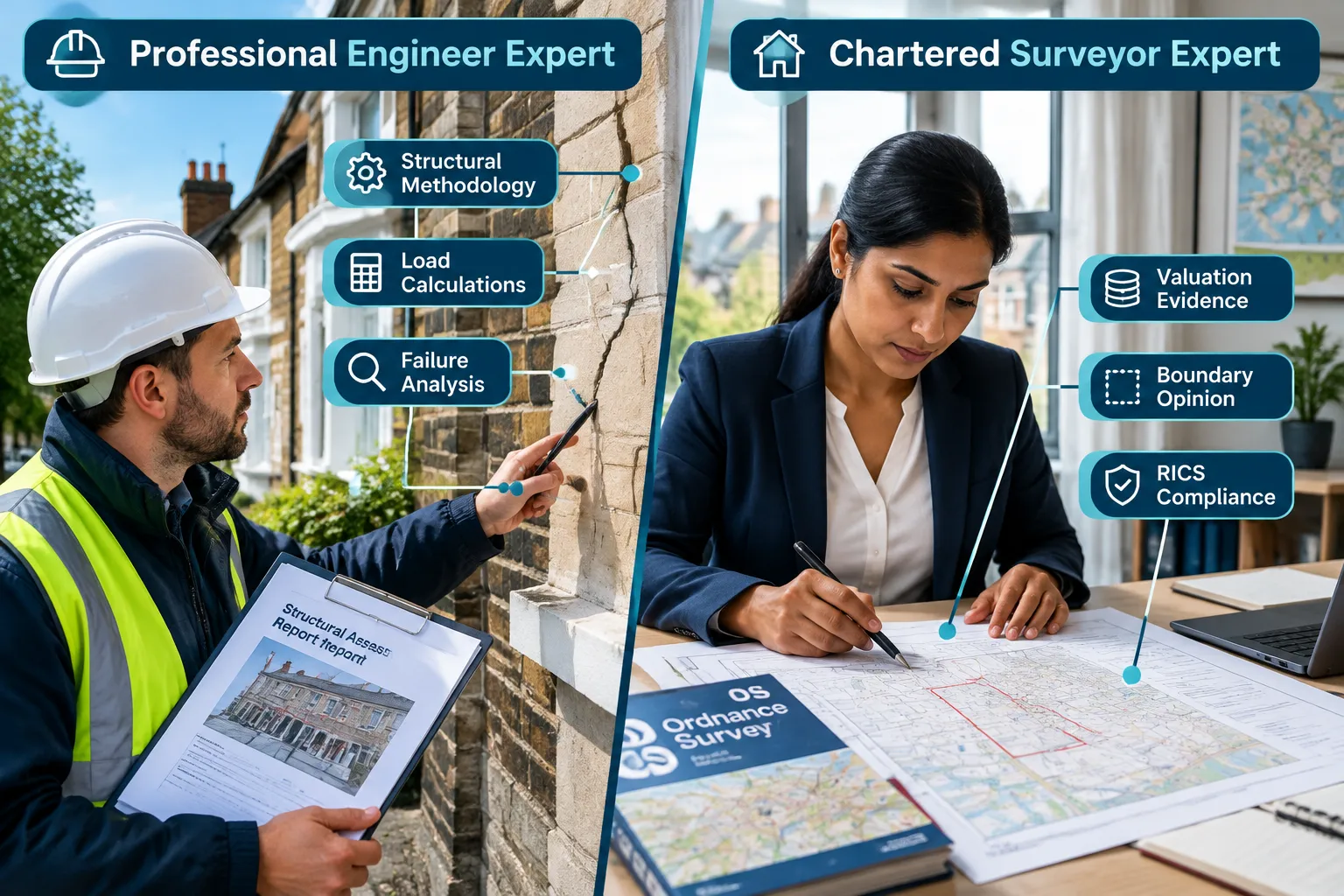
One of the clearest lessons that surveying practice can draw from professional engineering is the emphasis on documented technical methodology. In structural engineering expert evidence, the methodology section of a report is not a formality, it is the foundation on which the opinion rests. Courts scrutinise it closely, and opposing experts attack it first. Surveyors giving valuation or boundary evidence have historically been less rigorous about methodology documentation, a gap that the 2026 RICS standard directly addresses [2].
The 5th edition requires expert reports to set out the methodology used to reach each opinion, including any tools, databases, or analytical frameworks applied. This is directly analogous to the approach long required of engineering experts in construction adjudication and Technology and Construction Court proceedings.
Valuation Experts: Methodology Under the Microscope
Valuation disputes, whether in matrimonial proceedings, inheritance tax appeals, or compulsory purchase compensation, require the surveyor to explain not just what a property is worth but how that figure was derived. The comparable method, the investment method, the residual method: each carries its own methodological assumptions, and each must be disclosed and defended.
For RICS members, Red Book valuation standards provide a recognised framework that courts treat as authoritative. An expert who departs from Red Book methodology without explanation invites challenge. An expert who follows it and documents their reasoning clearly is far harder to undermine in cross-examination.
Regional price variations add another layer of complexity. Expert witnesses in northern valuation disputes may apply different comparable evidence and yield assumptions than those working in London markets [9]. The 2026 standard requires experts to acknowledge and explain such regional factors rather than treating national averages as a substitute for local analysis.
Boundary and Land Disputes: The Engineer's Precision Standard
Boundary disputes are among the most technically demanding areas of surveying expert evidence. They require the expert to interpret historical title documents, Ordnance Survey data, physical features, and sometimes photographic or aerial evidence, and to synthesise these into a clear opinion on the legal boundary line.
Professional engineers who give topographic or geodetic evidence in land disputes apply a precision standard that many surveying experts would benefit from adopting. Every measurement is recorded, every instrument calibrated, and every assumption stated. The result is an opinion that is traceable from raw data to conclusion, a chain of reasoning that can withstand forensic scrutiny.
For UK property boundary disputes, this level of rigour is not optional. Courts have repeatedly criticised boundary experts whose reports contained conclusions unsupported by adequately documented evidence. The 2026 RICS standard responds to this by requiring methodology disclosure as a mandatory element of every expert report [3].
Structural and Condition Evidence: Where Engineering and Surveying Overlap
Many UK property disputes involve both a valuation question and a structural or condition question. A buyer who discovers undisclosed subsidence after completion may bring a claim that requires both a structural engineer's evidence on the nature and cause of the defect and a surveyor's evidence on the resulting diminution in value.
In these cases, the two experts must be careful not to stray into each other's territory. A chartered surveyor giving valuation evidence should not offer structural engineering opinions, and vice versa. The 2026 standard reinforces the competence boundary: experts must only give opinions within their area of expertise [3].
Understanding what a surveyor does, and, critically, what they do not do, is therefore essential reading for any property professional considering an expert witness instruction.
When Surveyors Act as Expert Witnesses: Lessons from Professional Engineers in UK Property Disputes on Report Standards and the 2026 RICS Framework
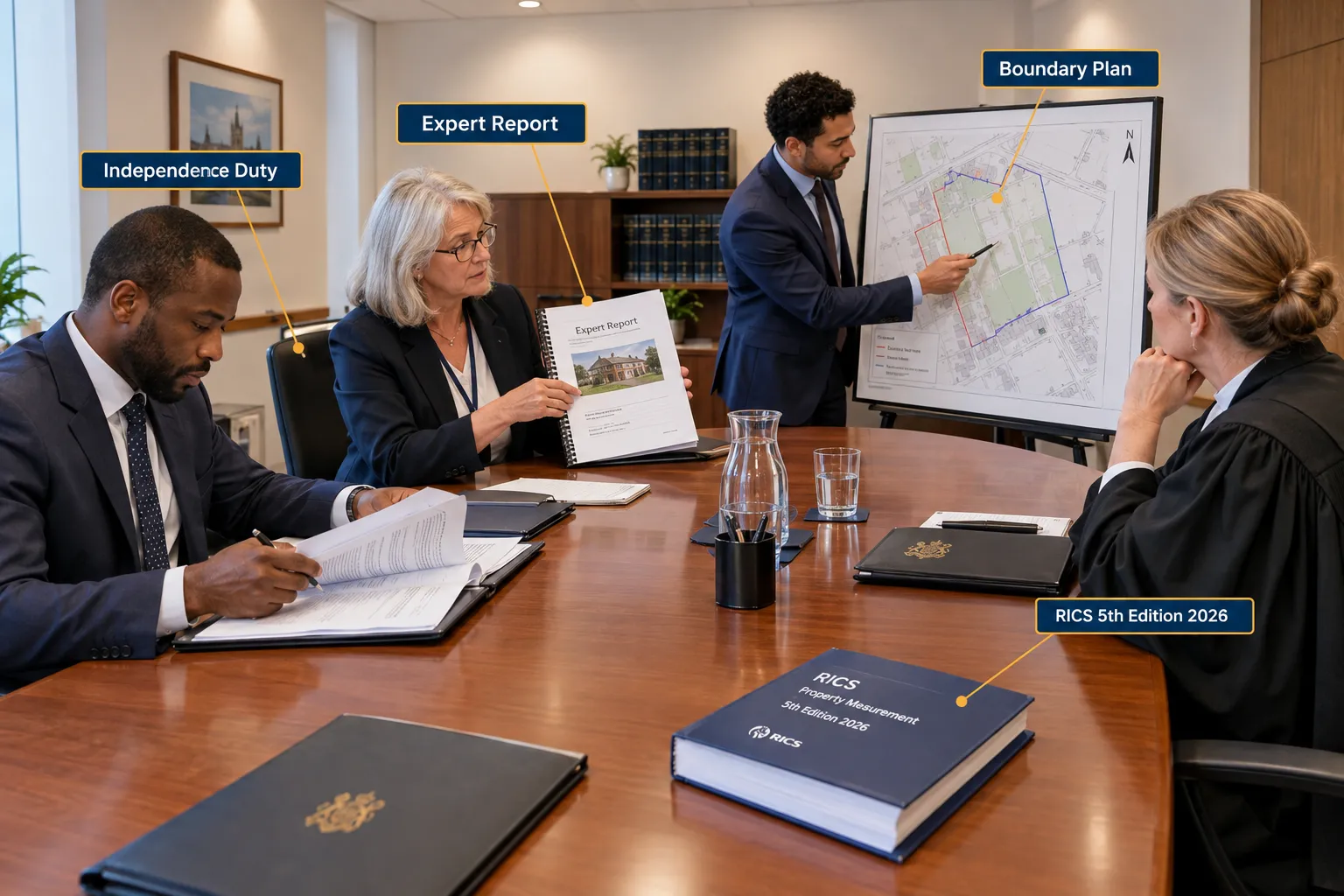
The 5th edition RICS global standard, effective 30 November 2026, represents the most significant revision to expert witness guidance for surveyors in over a decade [2]. It was shaped by a global consultation conducted throughout 2025 and is explicitly designed to align surveying expert practice with the wider standards applied across professional disciplines, including engineering, medicine, and accountancy.
Key Changes Introduced by the 2026 Standard
The table below summarises the most significant changes between the 4th edition (2020) and the new 5th edition (2026):
| Area | 4th Edition (2020) | 5th Edition (2026) |
|---|---|---|
| Independence | Recommended | Mandatory |
| AI and technology use | Not addressed | Explicit mandatory provisions |
| Supervised/delegated work | Guidance only | Mandatory disclosure requirements |
| Dual role prohibition | Guidance only | Mandatory prohibition |
| Accreditation | Voluntary pathway | Register of Accredited Expert Witnesses (March 2026) |
| Methodology disclosure | Recommended | Mandatory |
Sources: [3][6]
The AI provisions deserve particular attention. The 2026 standard explicitly addresses the use of artificial intelligence tools in preparing expert reports, requiring disclosure of any AI assistance and confirmation that the expert has independently verified all AI-generated content [3]. This is a direct response to concerns, shared across the engineering and legal professions, that AI tools may generate plausible but inaccurate technical content that an expert then adopts uncritically.
The Register of RICS Accredited Expert Witnesses
Launched in March 2026, the Register of RICS Accredited Expert Witnesses formalises what was previously an informal accreditation pathway. Surveyors who wish to be listed must demonstrate:
- Relevant professional qualification and experience
- Completion of approved expert witness training
- Familiarity with the current RICS standard and CPR Part 35
- A track record of expert witness instructions
The register provides solicitors, barristers, and courts with a searchable directory of surveyors whose expert witness competence has been independently verified. For property surveyors considering expert witness work, registration signals credibility and is likely to become an increasingly important differentiator as the register matures.
Report Format: What the 2026 Standard Requires
The mandatory report format under the 5th edition includes the following elements [3]:
- Statement of instructions, what the expert was asked to do and by whom
- Statement of facts, the factual basis on which the opinion rests
- Methodology, how the expert reached their opinion, including tools and data sources
- Opinion, the expert's conclusions, clearly separated from fact
- Statement of truth, a declaration that the expert understands their overriding duty to the court
- Declaration of AI use, if any AI tools were used in preparing the report
- Disclosure of supervised work, if any part of the report was prepared by a supervised junior
This format mirrors the structured approach that professional engineers have long applied in Technology and Construction Court proceedings and is now mandatory for all RICS expert witnesses [3].
Fees and Engagement Terms
Current market rates for surveyor expert witnesses in UK property disputes vary significantly by specialism and seniority. As of September 2026, hourly rates for RICS-accredited expert witnesses in London typically range from £200 to £600 per hour, with senior chartered surveyors in specialist areas such as compulsory purchase or development valuation commanding the higher end of that range [9].
Critically, the 2026 standard prohibits contingency fee arrangements, any fee structure that makes the expert's remuneration contingent on the outcome of the dispute. This prohibition, long established in engineering expert practice, is now explicitly mandatory for surveyor experts [3].
For those exploring legal disputes involving property, understanding the cost implications of expert evidence is an important part of litigation planning. Instructing solicitors should discuss fee structures with their appointed expert at the outset and ensure the engagement letter reflects the mandatory requirements of the 2026 standard.
Practical Guidance for Surveyors Considering Expert Witness Instructions
The lessons drawn from professional engineering practice, combined with the requirements of the 2026 RICS standard, translate into a set of practical disciplines for any surveyor considering expert witness work.
Before Accepting Instructions
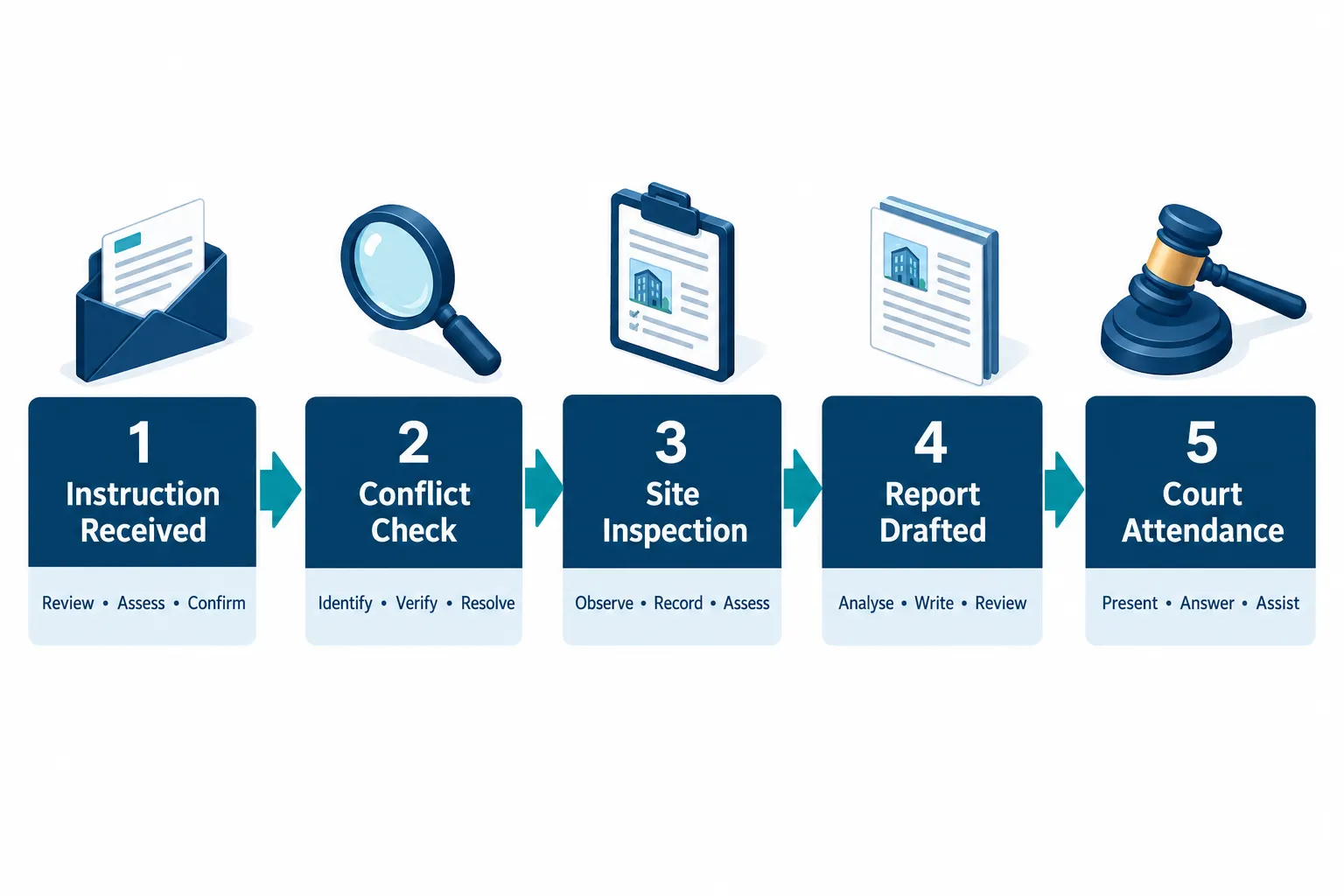
- Conduct a conflict check. Review all current and recent instructions involving the parties, the property, and the subject matter of the dispute. The 2026 standard makes conflict disclosure mandatory [3].
- Assess competence honestly. Accept instructions only in areas where genuine expertise can be demonstrated. A residential valuation surveyor should not accept instructions to give boundary survey evidence without relevant experience.
- Review the engagement terms. Ensure the fee arrangement is fixed or time-based, not contingency-linked. Confirm the scope of instructions in writing.
- Check RICS registration status. Ensure current RICS membership and familiarity with the 5th edition standard before accepting any instruction after 30 November 2026.
For RICS surveyors, the professional framework provides both the authority to give expert evidence and the disciplinary consequences for doing so improperly.
During the Instruction
- Document all site visits, data sources, and analytical steps contemporaneously.
- Maintain a clear separation between the advisory role (if any) and the expert role.
- If instructed jointly by both parties, ensure all communications are copied to both sets of solicitors.
- Disclose any material change in circumstances, including new information that affects the opinion, promptly.
Preparing the Report
- Follow the mandatory format set out in the 2026 standard [3].
- Disclose any AI tools used and verify all AI-generated content independently.
- Identify any work delegated to supervised staff and confirm that the expert has reviewed and takes responsibility for it.
- Include a signed statement of truth in the prescribed form.
Conclusion
The evolution of expert witness standards for UK surveyors has followed a trajectory that professional engineers would recognise: from informal guidance toward mandatory, enforceable obligations that place the court's interests above those of the paying client. The RICS 5th edition global standard, effective 30 November 2026, marks a decisive step in that direction.
For surveyors, the practical lessons are clear. Accept instructions only within genuine areas of competence. Conduct rigorous conflict checks before engaging. Document methodology with the precision that engineering experts have long applied to structural and technical evidence. Follow the mandatory report format. Disclose AI use. Never accept a contingency fee. And above all, remember that the expert's duty runs to the tribunal, not to the client.
Actionable next steps for surveyors in 2026:
- Review the RICS 5th edition standard in full before 30 November 2026 and update all engagement templates to reflect mandatory requirements.
- Apply for listing on the Register of RICS Accredited Expert Witnesses if expert witness work forms a regular part of practice.
- Attend CPD training on CPR Part 35 and the new AI disclosure provisions.
- Audit all current expert witness instructions for compliance with the dual-role prohibition and conflict requirements.
- Consult the boundary dispute resolution resources available for complex land boundary instructions.
Surveyors who invest in these disciplines will not only avoid regulatory risk, they will deliver expert evidence that genuinely assists courts in resolving UK property disputes fairly and efficiently.
References
[1] Surveyors Acting As Expert Witnesses – rics.org
[2] Rics 2026 Expert Witness Guidance Key Changes For Surveyors – rimkus.com
[3] Surveyors Acting As Expert Witnesses 5th Edition 280826 – rics.org
[4] Surveyors acting as expert witnesses Feb2023amend – rics.org
[5] Practice Alert Expert Witnesses February 2024 – rics.org
[6] August 2020 Surveyors Acting As Expert Witnesses 4th Edition – rics.org
[9] Expert Witness Roles In Northern Vs Southern Valuation Disputes Navigating 2026 Regional Price Gaps – princesurveyors.co.uk