
Roughly 60% of all party wall disputes in England and Wales arise from residential extensions and basement excavations, yet one of the most overlooked factors shaping the physical risk to a shared wall is the direction it faces. Party Wall Risks on North-Facing and West-Facing Homes: Orientation Matters Under the Party Wall Act is not a formal legal category, but it is a practical reality that experienced surveyors navigate every day. The Party Wall etc. Act 1996 makes no mention of compass bearings [7], but the physical condition of a party wall, and therefore the scope of any surveyor's award, is profoundly shaped by whether that wall spends its life in shadow and rain or in sun and shelter.
Key Takeaways
- The Party Wall etc. Act 1996 is orientation-neutral in law, but north-facing and west-facing walls carry higher damp, weathering, and frost risk that directly affects survey recommendations and award clauses.
- North and west orientations reduce solar drying and increase exposure to prevailing south-westerly rainfall, accelerating mortar decay and increasing the likelihood of pre-existing defects being disputed during works.
- Three categories of work trigger notices under the Act, boundary walls (Section 1), party structure works (Section 2/3), and excavations (Section 6), and all are subject to the same statutory notice periods regardless of orientation.
- A thorough schedule of condition is especially critical for north-west-facing party walls, because pre-existing damp and weathering damage must be documented before works begin to protect both parties.
- Homeowners planning works on or near a north-facing or west-facing party wall should engage a qualified surveyor early, serve notices on time, and ensure award clauses specifically address orientation-related vulnerabilities.
Why Orientation Is a Physical, Not a Legal, Risk Factor
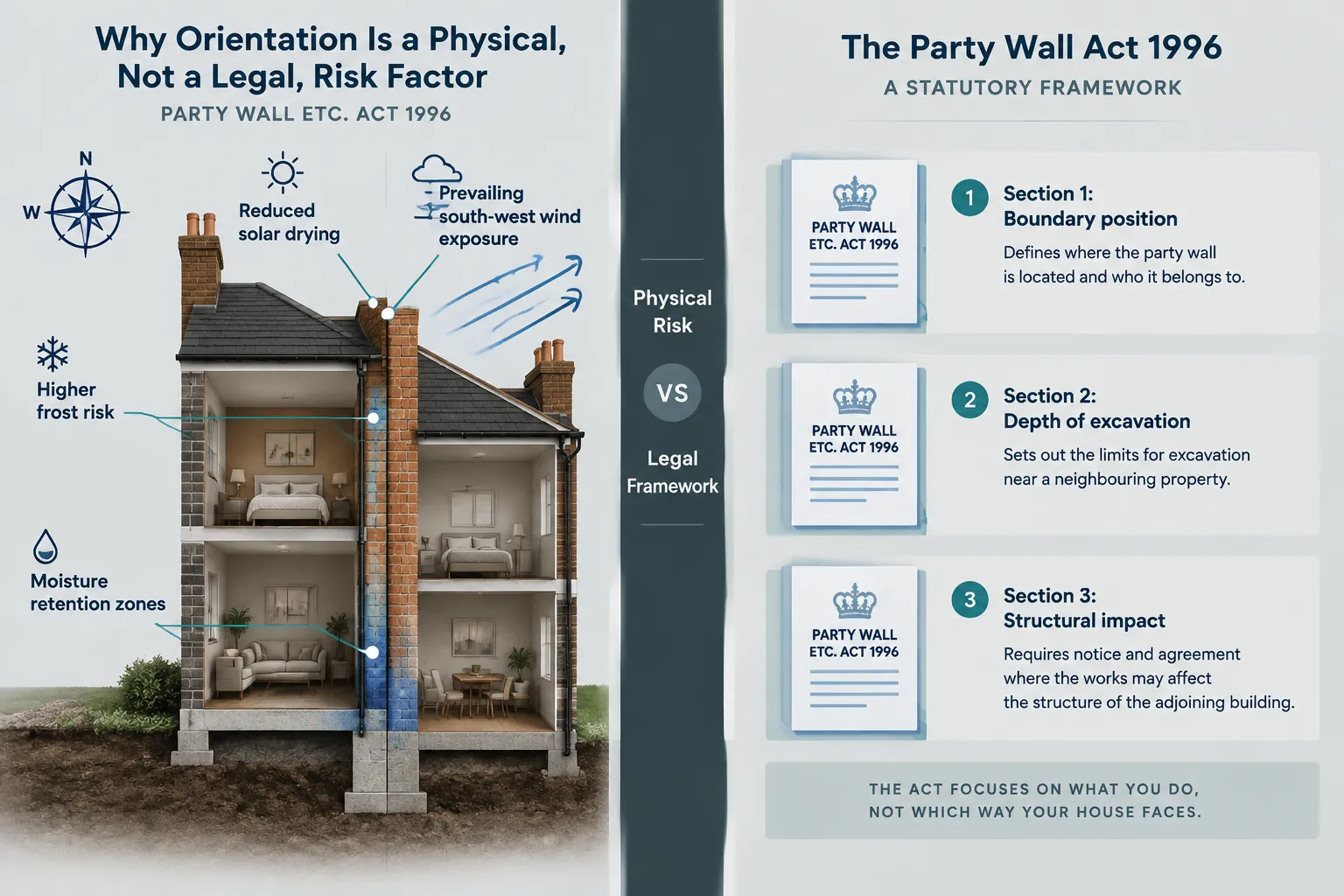
The Party Wall etc. Act 1996 came into force to provide a statutory framework for works to party walls, boundary walls, and excavations near neighbouring buildings across England and Wales [7]. Its operative sections focus entirely on boundary position, depth of excavation, and structural impact. Government guidance on preventing and resolving party wall disputes reiterates the core procedures, service of notice, neighbour responses, and dispute resolution through surveyors, treating all adjoining owners identically regardless of whether their property faces north, west, or any other direction [2].
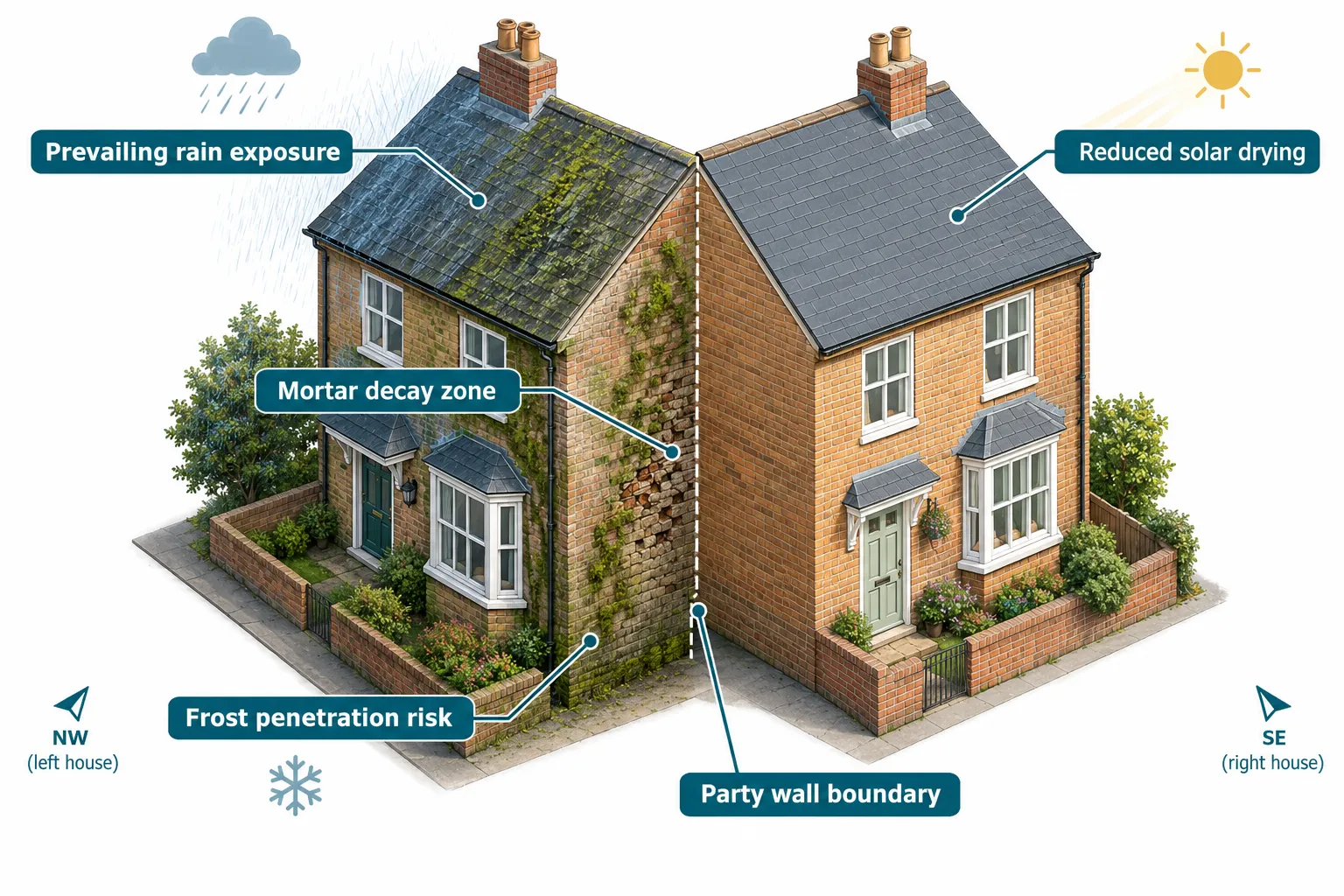
So why does orientation matter at all? Because the Act's procedures exist to protect physical structures, and those structures do not age uniformly. A party wall that faces north or north-west in the UK receives far less direct sunlight than one facing south or east. Less sunlight means less drying. Less drying means persistent moisture in the masonry. Combine that with the UK's prevailing south-westerly winds driving rain against west-facing elevations, and the result is a wall that is statistically more likely to show:
- Damp penetration through porous brickwork or failed pointing
- Frost spalling, where water trapped in mortar freezes and expands, breaking the surface
- Biological growth, moss, algae, and lichen, which holds moisture against the wall face
- Mortar decay, which can compromise the structural bond between masonry units over time
None of these conditions change which sections of the Act apply. What they change is the baseline condition of the wall before any works begin, and that baseline is the foundation of every schedule of condition and every party wall award.
Key insight: Orientation does not determine whether the Act applies. It determines how much pre-existing damage a surveyor is likely to find, and therefore how carefully the award must be drafted to protect both the building owner and the adjoining owner.
How the Party Wall Act Works: The Orientation-Neutral Framework
Understanding the legal framework is essential before exploring how orientation modifies practical risk. The Act establishes three categories of notifiable work, each with its own notice period [4][7][10]:
| Section | Type of Work | Minimum Notice Period |
|---|---|---|
| Section 1 | New wall at or astride the boundary (line of junction) | 1 month |
| Sections 2 & 3 | Works to an existing party wall or party structure | 2 months |
| Section 6 | Excavations within 3 m or 6 m of a neighbouring building | 1 month |
For Section 6 excavations, the 6-metre zone applies where the excavation will go deeper than the line drawn at 45 degrees from the base of the neighbour's foundations [4][8]. These thresholds are entirely orientation-neutral, a basement dig in a south-facing garden triggers exactly the same notice requirements as one in a north-facing garden.
Once a notice is served, the adjoining owner has 14 days to respond. Consent allows works to proceed; dissent, or silence, triggers a dispute that must be resolved through the appointment of surveyors [2]. The surveyors then produce a party wall award, a legally binding document that sets out how the works will be carried out, what protections are in place for the adjoining property, and what remediation is required if damage occurs.
For a clear breakdown of the differences between a notice, an agreement, and an award, the Party Wall Notice vs Agreement vs Award: The Difference guide provides a useful reference. Understanding these distinctions matters because homeowners sometimes confuse informal consent with a formal award, and informal consent does not waive statutory rights under the Act [2].
To understand what serving a Party Wall Notice actually involves in practice, including timelines and what happens if a notice is defective, reviewing the procedural requirements early in the planning process is strongly advisable.
Party Wall Risks on North-Facing and West-Facing Homes: What Surveyors Actually Find
This is where Party Wall Risks on North-Facing and West-Facing Homes: Orientation Matters Under the Party Wall Act moves from theory into practice. When a surveyor inspects a party wall on a north-facing or west-facing property ahead of proposed works, certain findings appear with disproportionate frequency.
Damp and Moisture Ingress
North and north-west-facing walls receive minimal direct sunlight in the UK's latitude. Solar radiation is the primary natural drying mechanism for masonry. Without it, moisture from rainfall, condensation, and ground-level splash-back remains in the wall fabric for extended periods. Over years, this produces rising and penetrating damp that can affect both the building owner's property and the adjoining owner's interior finishes.
When works are proposed, say, a rear extension that involves cutting into the party wall to insert steels, the surveyor must record this pre-existing damp in the schedule of condition. If damp is not documented before works begin, any moisture-related damage discovered afterwards may be incorrectly attributed to the construction works, creating a dispute that is both costly and difficult to resolve.
Weathering, Frost, and Mortar Decay
West-facing walls in England and Wales bear the brunt of the prevailing south-westerly weather systems. Rain is driven horizontally against these elevations during storms, saturating mortar joints that may already be aged or lime-based. Frost then acts on this saturated mortar during cold spells, causing spalling and joint erosion.
For party wall purposes, this matters in two ways. First, a wall in poor condition may not safely support the additional loads imposed by, for example, a loft conversion with steels bearing onto the party wall [3][5]. Second, if the wall is already structurally compromised by weathering, the award must include specific provisions about temporary support, sequencing of works, and post-works reinstatement to a condition no worse than before.
Biological Growth and Surface Contamination
Moss and algae colonise north-facing masonry surfaces more readily than south-facing ones because the persistent shade and moisture create ideal growing conditions. While this may appear cosmetic, biological growth holds water against the wall face and can accelerate mortar decay. A surveyor inspecting a north-west-facing party wall will often note this growth as evidence of chronic moisture exposure, which informs the award's condition baseline.
Implications for the Schedule of Condition
The schedule of condition is arguably the most important document produced under the party wall process for orientation-affected properties. It is a photographic and written record of the adjoining owner's property, including the party wall itself, taken before works begin. For north-facing and west-facing walls, a thorough schedule should specifically record:
- Existing damp staining on internal and external faces
- Mortar joint condition across the full height of the shared wall
- Any existing cracks in the masonry, with crack monitors if appropriate
- Biological growth extent and location
- Evidence of previous repairs that may indicate historic movement or water ingress
Without this documentation, both parties are exposed. The building owner risks being held liable for damage that predated their works; the adjoining owner risks being unable to prove their claim.
Drafting Award Clauses for North-West-Facing Walls
A standard party wall award covers working hours, dust and noise controls, access arrangements, and a requirement to make good any damage. For north-facing and west-facing properties, experienced surveyors go further. The award should address orientation-specific vulnerabilities directly.
Temporary Weatherproofing
Where works expose the party wall, for example, during a loft conversion or chimney breast removal, the award should require the building owner to provide temporary weatherproofing immediately. For a west-facing wall, this is not a precaution; it is a necessity. Even a short period of unprotected exposure during autumn or winter can allow significant water ingress into a wall that is already moisture-laden.
Drainage and Waterproofing Specifications
If the proposed works include a basement excavation or underpinning near a north-facing wall, the award should specify waterproofing standards for the new structure. Water table levels and ground moisture tend to be higher on north-facing plots because evaporation rates are lower. The 3-metre and 6-metre excavation zones under Section 6 of the Act [7][10] apply equally, but the award's technical requirements should reflect the wetter ground conditions typical of perpetually shaded plots.
Reinstatement Standards
The award's reinstatement clause should specify that any repointing or masonry repair uses materials compatible with the existing wall, particularly important for older lime-mortar walls common in Victorian and Edwardian terraces. Using modern cement mortar to repair a lime-mortar wall can trap moisture and accelerate decay, which is a particular risk on north and west elevations where moisture is already problematic.
Practical Steps for Homeowners on North-Facing and West-Facing Properties
Whether planning works or receiving a notice from a neighbour, homeowners on north-facing or west-facing properties should follow a clear process.
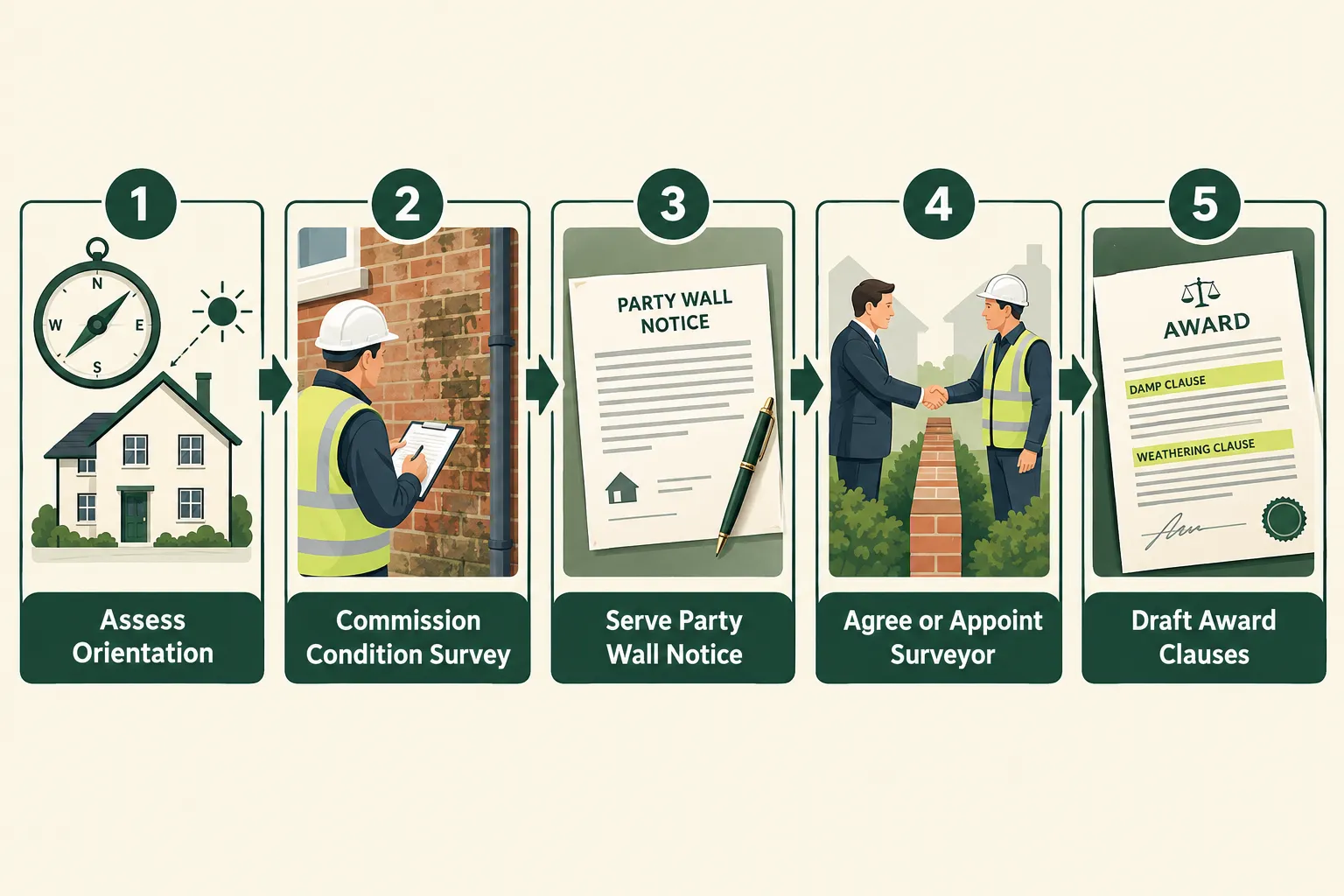
Step 1: Assess your property's orientation before planning works. Identify whether your party wall faces north, north-west, or west. This assessment should inform the scope of the pre-works survey and the level of detail required in the schedule of condition.
Step 2: Engage a qualified party wall surveyor early. The RICS consultation on updated guidance for party wall legislation and procedure emphasises competence, fee structures, and public engagement as priorities [1]. Selecting a surveyor with demonstrable experience of orientation-related defects is important for north and west-facing properties. For help finding the right professional, the Party Wall Agreement Surveyor Get The Help You Need In London resource is a practical starting point.
Step 3: Serve notices on time. Two months before party structure works; one month before boundary wall or excavation works [2][4]. Late or defective notices can invalidate the process and expose the building owner to injunctions. For guidance on the Party Wall Agreement Assistance process, professional support is available.
Step 4: Commission a thorough schedule of condition. For north-west-facing walls, this schedule should go beyond the minimum. Thermal imaging can reveal hidden moisture that standard photography misses, and crack monitors can establish whether any existing movement is live or historic.
Step 5: Review the draft award carefully. Ensure it includes orientation-specific clauses on weatherproofing, drainage, and reinstatement standards. A generic award that ignores the physical condition of a chronically damp north-facing wall is inadequate protection for either party.
Step 6: Budget realistically. Works on north-facing and west-facing walls often require additional remediation of pre-existing defects, which affects cost. Understanding the Party Wall Agreements Understanding The Costs Involved before committing to a programme of works helps avoid budget surprises. For London-specific pricing context, the Cost Of Party Wall Surveyor Understanding London Prices guide provides current benchmarks.
Common Misconceptions About Orientation and the Party Wall Act
Misconception 1: "Orientation affects whether I need to serve a notice."
It does not. The triggers for notification under the Act are based on the type and location of works, not the direction the property faces [7][2].
Misconception 2: "A damp party wall means I cannot carry out works."
Not necessarily. Pre-existing damp does not prohibit works; it requires that the award addresses it properly. Surveyors routinely manage works on structurally sound but moisture-affected walls.
Misconception 3: "My neighbour's consent means I do not need a formal award."
Consent allows works to proceed without a formal award, but it does not waive the neighbour's rights to claim for damage [2]. For north-facing and west-facing walls where pre-existing defects are common, a formal award with a schedule of condition provides far stronger protection for both parties.
Misconception 4: "Orientation issues are covered by planning, not the Party Wall Act."
Amenity issues such as overshadowing and loss of light are indeed addressed through planning rather than the Party Wall Act framework. However, the physical consequences of orientation, damp, weathering, structural vulnerability, fall squarely within the surveyor's remit when assessing the condition of a party wall and drafting an award.
Conclusion
Party Wall Risks on North-Facing and West-Facing Homes: Orientation Matters Under the Party Wall Act is a subject that sits at the intersection of building science and legal procedure. The statute itself is blind to compass bearings, the Act's notice periods, dispute resolution mechanisms, and award procedures apply identically to every property in England and Wales [7][2]. But the physical reality of a north or west-facing party wall, its chronic moisture exposure, weathering vulnerability, and biological growth, shapes every practical decision a surveyor makes.
Actionable next steps for homeowners in 2026:
- Before planning any notifiable works, walk around the property and assess which faces of the party wall receive direct sunlight. North-facing and west-facing walls warrant closer scrutiny.
- Instruct a qualified surveyor to carry out a pre-notice condition assessment, not just a standard schedule of condition, if the wall shows signs of damp or mortar decay.
- Serve notices within the statutory timeframes and ensure they are properly addressed to all adjoining owners [2][4].
- Insist on award clauses that specifically address temporary weatherproofing, compatible reinstatement materials, and drainage requirements appropriate to the wall's orientation and moisture history.
- Keep copies of all notices, consents, awards, and schedules of condition, these documents are the primary evidence base if a dispute arises during or after works.
Orientation is not a legal category under the Party Wall etc. Act 1996, but it is a physical one. Treating it seriously is the mark of a thorough surveyor and a well-protected homeowner.
References
[1] Party Wall Legislation And Procedure – rics.org
[2] Preventing And Resolving Disputes In Relation To Party Walls – gov.uk
[3] Rics Consumer Guide Party Walls – ricsfirms.com
[4] Uk Party Wall Agreement Guide 2026 – calchub.uk
[5] Party Walls – rics.org
[7] legislation.gov.uk – legislation.gov.uk
[8] Party Wall Agreement Uk 2026 – pg-construction.co.uk
[10] The Party Wall Act A Complete Guide – beamsrenovation.com